To save content items to your account,
please confirm that you agree to abide by our usage policies.
If this is the first time you use this feature, you will be asked to authorise Cambridge Core to connect with your account.
Find out more about saving content to .
To save content items to your Kindle, first ensure no-reply@cambridge.org
is added to your Approved Personal Document E-mail List under your Personal Document Settings
on the Manage Your Content and Devices page of your Amazon account. Then enter the ‘name’ part
of your Kindle email address below.
Find out more about saving to your Kindle.
Note you can select to save to either the @free.kindle.com or @kindle.com variations.
‘@free.kindle.com’ emails are free but can only be saved to your device when it is connected to wi-fi.
‘@kindle.com’ emails can be delivered even when you are not connected to wi-fi, but note that service fees apply.
This scoping review directs attention to artificial intelligence–mediated informal language learning (AI-ILL), defined as autonomous, self-directed, out-of-class second and foreign language (L2) learning practices involving AI tools. Through analysis of 65 empirical studies published up to mid-April 2025, it maps the landscape of this emerging field and identifies the key antecedents and outcomes. Findings revealed a nascent field characterized by exponential growth following ChatGPT’s release, geographical concentration in East Asia, methodological dominance of cross-sectional designs, and limited theoretical foundations. Analysis also demonstrated that learners’ AI-mediated informal learning practices are influenced by cognitive, affective, and sociocontextual factors, while producing significant benefits across linguistic, affective, and cognitive dimensions, particularly enhanced speaking proficiency and reduced communication anxiety. This review situates AI-ILL as an evolving subfield within intelligent CALL and suggests important directions for future research to understand the potential of constantly emerging AI technologies in supporting autonomous L2 development beyond the classroom.
The Celtic hypothesis is a cover term used to refer to a number of structural features of Old English (and later stages of English) which might have their origin in language contact and shift between the BrythonicBrittonic-speaking Celtic population and the Germanic invaders in the early Old English period. Among such features are the internal possessor construction, the isomorphy of intensifiers and reflexives, two forms of the verb be, the progressive and periphrastic do. This chapter reviews the literature on this area and considers the case to be made for contact and transfer during language shift but accords equal weight to internal factors in an attempt to reach a balanced appraisal of the Celtic hypothesis.
English is a member of the Germanic subgroup of Indo-European, sharing with other Germanic languages a distinctive set of hallmarks, though recent developments have made it in some respects an outlier in this group. In addition, English shares some features with successively smaller subsets of these languages. The observed pattern of similarities and differences arises from a history of shared inheritance, divergence and subsequent interaction which can be reconstructed in detail by systematically comparing the languages, guided by a rigorous methodology. A focus of scholarship for two centuries, this enterprise has taken on renewed vitality in recent decades, informed by new understandings of the role of language contact in shaping linguistic histories. After a brief introduction to the process of comparative reconstruction and the traditional representation of the pedigree of English derived from it, this chapter will introduce the more intricate picture emerging from recent studies.
In the early 2000s, mainstream US wellness culture started to develop something of an obsession with the distant past. These “paleofantasies” (Zuk 2013), such as barefoot running and the Paleo diet, are not based in scientific evidence about prehistoric human behavior or accurate understandings of evolutionary theory. Why, then, do so many people (especially men) find them compelling? In this paper, I argue that the “stone age” chronotope is implicitly masculine and in fact tends to exclude women altogether. Women are largely absent from imaginings of prehistory, whether those imaginings are car insurance commercials, diet and exercise programs, or even anthropological texts. Looking at various popular discourses about the stone age chronotope, I consider how women are effectively rendered invisible, leaving behind what is perceived as a distilled masculine essence. I suggest that the proliferation of paleofantasy in the past two decades has been part of a broader cultural backlash against feminist progress.
Zaiwa (ISO 639-3 code: atb; Glottocode: zaiw1241) belongs to the Burmese branch of the Tibeto-Burman languages, sharing many common features with the Burmese and Achang languages of the same branch. It is primarily spoken by a subgroup of Jingpo people, who identify as ‘Zaiwa’. Beyond Zaiwa, the Jingpo people encompass four distinct subgroups, each conversing in unique linguistic variations, namely Jingpo (景颇), Langsu (浪速), Leqi (勒期), and Bola (波拉). Jingpo is distinctively affiliated with the Jingpo branch of the Tibeto-Burman languages, whereas the other three languages, including Zaiwa, are categorized within the Burmese branch (He, 2016). The majority of Zaiwa speakers are found in Luxi (潞西), Yingjiang (盈江), Longchuan (陇川), Ruili (瑞丽), Lianghe (梁河), and Wanding (畹町) counties within the Dehong Dai and Jingpo Autonomous Prefecture (德宏傣族景颇族自治州) of Yunnan province (云南省) as well as the Shan and Kachin states in Myanmar. Zaiwa is widely used in Zaiwa-dominant areas or communities with a significant Zaiwa presence. It is used not only in daily life contexts, such as among family members, villages, markets, and shops, but also in a range of social sectors, including in government and judicial offices, as well as on radio and broadcasting stations. Among the Jingpo languages, Zaiwa has the largest number of users. Individuals who speak Zaiwa often speak languages of other Jingpo subgroups in addition to Mandarin Chinese. Due to the extensive promotion and dissemination of Mandarin, particularly in educational and media contexts, Mandarin has emerged as the predominant second language for the youth within the community. Moreover, in neighboring regions or mixed communities where the Zaiwa subgroup is prominent, individuals from other ethnic groups such as the Achang, Han, Dai, and Lisu also frequently speak Zaiwa. According to the statistics from China’s Sixth National Population Census in 2010, the total population of the Jingpo ethnic group is approximately 140,000. There were over 80,000 Zaiwa speakers within China, constituting more than 60% of the total Jingpo ethnic population in the country (He, 2016). Scholars such as Xu and Xu (1984), Dai (1989), Kong (2001), Pan (2014), He (2016), Lu and Kong (2019), and Lu et al. (2025) have conducted studies on the phonetics of Zaiwa.
This study examines the underlying mechanisms driving the bilingual advantage in learning English as a foreign language (EFL) among kindergarten-aged children. Participants included 85 Dutch-speaking monolinguals and 34 bilingual children. We assessed children’s English vocabulary and grammar as the outcome variables. Furthermore, phonological awareness, executive functions and motivation to learn English were measured as potential mediators of the bilingualism–EFL relationship. We also controlled for child age, non-verbal IQ, Dutch (majority language) proficiency, intensity of school English instruction, parental education and exposure to English activities. Results showed that bilingual children outperformed monolinguals in English receptive vocabulary, but only for noncognate words; no differences emerged for cognate words or English grammar. However, none of the proposed mediators explained this advantage. Findings are discussed in terms of why the effect was limited to vocabulary and potential alternative mechanisms not explored in the present study.
The study investigated the strength of L2 form-meaning connections among advanced L2 speakers. Two unmasked intralingual L2 semantic priming experiments were conducted, with lexical decision and semantic categorization tasks. Thirty-eight native English speakers and 40 advanced Chinese learners of English were tested in each task. The stimuli involved L2 word targets that were preceded by either a related L2 prime or an unrelated one. Previous research has used the lexical decision task in this investigation, and the semantic task was also used in the present study to boost the involvement of conceptual connections in L2 processing. Consistent with previous findings, native English speakers showed a reliable priming effect in both tasks, but English L2 speakers showed no priming effect in either task. No task effect was found in either group. The findings provided further evidence for a weaker L2 form-meaning connection among advanced L2 speakers.
This retrospective study investigates two questions: (a) whether speech sound difficulties, reported by parents looking back on their children’s early speech sound skills and concurrently at ages 7–8, can predict language comprehension and early reading challenges in children identified as poor readers and (b) whether there is a relationship between the type of speech errors and language comprehension and early reading skills in these children. Two hundred twenty-eight children identified as poor readers were assessed on reading and language comprehension. The findings revealed that children whose parents reported early speech sound difficulties, and those with speech sound difficulties at ages 7–8, had significantly poorer language comprehension compared to children without a history of speech sound difficulties. This difference in language comprehension skills persisted after controlling for phoneme awareness. Additionally, both delayed and disordered speech errors significantly predicted difficulties in language comprehension compared to children without speech sound difficulties.
Services related to paid domestic work in private households are an important global labor market for migrant women. The Philippines is one of the largest exporters of work-force for the international domestic work sector. In this context, the linguistic legacy of American colonization becomes a key factor: English is an official language of the Philippines alongside Filipino. In addition, several varieties of Philippine English are widespread. Against this backdrop, Filipino and Filipina workers are positioned as competent, Anglophone workers in low-wage sectors such as the global domestic work market. Based on these attributions, they are also commodified as workers who can easily learn other languages and who are versatile and compatible with all linguistic and cultural spaces – worldwide. This paper sheds light on the multilingual repertoires of Filipina domestic workers in the Spanish capital, Madrid. The study is grounded in the paradigms of critical ethnographic sociolinguistics, migration linguistics and multilingualism research. The underlying data are based on narratives of Filipinas who migrated to Spain between 1971 and 2017. The findings reveal complex tensions around English. On the one hand, English is often perceived as prestigious and therefore valuable linguistic capital that can lead to social mobility. On the other hand, English is not seen as a panacea for securing employment beyond domestic work. Extrapolating from these findings, the overall picture that emerges is that English is deeply embedded in structurally determined social inequalities, which can be observed both in the country of origin and in the destination society.
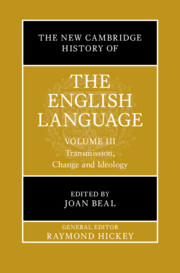
How language change manifests itself in the history of English is the primary focus of this volume. It considers the transmission of English though dictionaries and grammars down to the digital means found today. The chapters investigate various issues in language change, for instance what role internal and external factors played throughout history. There are several chapters dedicated to change in different areas and on different levels of language, includinginvestigations of the verbal system, of adverbs, of negation and case variation in English as well as more recent instances of syntactic change. This volume also looks atissues such as style and spelling practices which fed into emergent standard writing, and the complex issue of linguistic prescriptivism, with chapters on linguistic ideology, phonological standards and the codification of English in dictionaries. Itconcludes with a consideration of networks and communities of practice and also of the historical enregisterment of linguistic features.
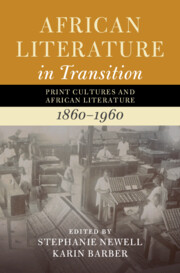
This book offers a compelling vision of the dynamism of local printing presses across colonial Africa and the new textual forms they generated. It invites a reconceptualisation of African literature as a field by revealing the profusion of local, innovative textual production that surrounded and preceded canonical European-language literary traditions. Bringing together examples of print production in African, Europea and Arabic languages, it explores their interactions as well as their divergent audiences. It is grounded in the material world of local presses, printers, publishers, writers and readers, but also traces wider networks of exchange as some texts travelled to distant places. African print culture is an emerging field of great vitality, and contributors to this volume are among those who have inspired its development. This volume moves the subject forward onto new ground, and invites literary scholars, historians and anthropologists to contribute to the on-going collaborative effort to explore it.
Designed specifically for class use, this text guides students through developing their own full, working constructed language. It introduces basic concepts and the decisions students need to make about their conlang's speakers and world, before walking them through the process of conlanging in incremental stages, from selecting a language's sounds to choices about its grammar. It includes hundreds of examples from natural and constructed languages, and over seventy end-of-chapter exercises that allow students to apply concepts to an in-progress conlang and guide them in developing their own conlang. Ideal for undergraduates, the text is also suitable for more advanced students through the inclusion of clearly highlighted sections containing advanced material and optional conlang challenges. Instructor resources include an interactive slideshow for selecting stress patterns, an exercise answer guide and a sample syllabus, and student resources include a 'select-a-feature' conlang adventure, a spreadsheet of conlang features, and supplementary documentation for the exercises.
Phonology is concerned with the system of distinctive sounds (phonemes) in a language, and how these phonemes may be combined (phonotactics). Phonological changes may thus be defined as innovations that bring about a change in phoneme inventories and phonotactics. This chapter examines in detail one such type of phonological change, that is shifts, in order to illustrate the challenges posed by historical sound-change to phonological theory. It addresses questions regarding the ontology of change, as well as the relationship between phonetics and phonology, realisations and systems. It looks specifically at the shift known as the ‘Great Vowel Shift’ or more recently as the ‘Long Vowel Shift’, to see how well different phonological theories are able to account for and to explain this shift.
Adverbs are the ‘mixed bag’ among the word classes, today comprising such diverse items as time, space or manner adverbs (PDE now, here, quickly), intensifiers (PDE very, terribly) or stance (PDE surely, frankly) and linking adverbs (PDE however, therefore). After a rough sketch of the formal developments in adverbs, in particular the emergence and establishment of the adverbial suffix –ly by re-analysis, this chapter will show that the functional heterogeneity within today’s English adverbs is a rather recent development. Overall, we see semantic and functional diversification in the category ‘adverb’, gradually becoming more varied in signalling epistemic, evidential and textual speaker attitudes. This diversification is here seen to have been supported by the new distinct mark of adverbial status, the adverbial suffix –ly.
Covers the following theoretical perspectives as they pertain to conversation memory: speech acts, sociolinguistic/conversation analysis, discursive psychology, communication theory, cognitive theory, and collective memory theory.
Prescriptive discourse basically evaluates linguistic variants and sometimes gives reasons for preferring one variant over another. It is most readily found in metalinguistic texts, like dictionaries and grammars. Several basic assumptions in prescriptive discourse that have endured to the present were already present in early centuries and set the stage for the flourishing of prescriptive discourse in the eighteenth century. Prescriptive discourse continued to flourish and became more widespread and naturalised in subsequent centuries. It remains a robust tradition and has adapted to new modes of communication and new cultural forces. Key features of prescriptive discourse examined in this chapter include the degree of specificity with which the discourse was formulated, the venues that published prescriptive discourse, the kinds of linguistic variants that were included in prescriptive discourse, and the justifications for the prescriptive judgements.