To save content items to your account,
please confirm that you agree to abide by our usage policies.
If this is the first time you use this feature, you will be asked to authorise Cambridge Core to connect with your account.
Find out more about saving content to .
To save content items to your Kindle, first ensure no-reply@cambridge.org
is added to your Approved Personal Document E-mail List under your Personal Document Settings
on the Manage Your Content and Devices page of your Amazon account. Then enter the ‘name’ part
of your Kindle email address below.
Find out more about saving to your Kindle.
Note you can select to save to either the @free.kindle.com or @kindle.com variations.
‘@free.kindle.com’ emails are free but can only be saved to your device when it is connected to wi-fi.
‘@kindle.com’ emails can be delivered even when you are not connected to wi-fi, but note that service fees apply.
In recent decades, scholars have examined the genesis of Jewish language varieties, particularly Yiddish, as well as Modern Hebrew, drawing intriguing parallels with creole formation processes. This chapter delves into the ecological aspects of language contact, comparing the sociohistorical and linguistic contexts of Jewish language emergence with Caribbean plantation creoles. Particular emphasis is placed on Judeo-Spanish (Ladino), tracing its linguistic trajectory following the traumatic expulsion of Sephardic Jews from Spain in 1492. By applying the “Founder Principle,” the research investigates the linguistic repertoires of founding populations, examining their social stratification, literacy capabilities, familial structures, and intricate social networks.
The author embraces Uniformitarianism to re-examine whether creoles and pidgins emerged in an exceptional way and why there are so few pidgins lexified by European languages in coastal Africa where the earliest trade contacts between European mercantile companies and Indigenous rulers took place. Equally significant is the fact that no historian of the trade mentions usage of a Portuguese pidgin-cum-broken language, though it appears that Portuguese functioned as the default lingua franca from the coast of West Africa to coastal East Asia. Note also that no English pidgin emerged in India, the territory from which the British East India Company spread its activities to Southeast and East Asia. There are more English pidgins than those based on other European languages; and most English pidgins are in the South Pacific. An extensive review of how the trade between Europeans and non-Europeans operated, through brokers-cum-interpreters, reveals that pidgins emerged like creoles by basilectalization away from the lexifier and not sooner than the early nineteenth century. Comparisons with the emergence of more specifically the Romance languages also suggests that the latter evolved similarly to creoles and pidgins, by gradual divergence away from the lexifier, under substrate influence.
The editors trace Uniformitarianism, aka the Uniformitarian Principle, to the nineteenth-century geologist Charles Lyell. Applying it critically to language evolution, they explain their interpretation of it as a two-way heuristic concept that uses information about language change in the distant past to shed light on recent changes and at the same time employs findings about recent language evolution, especially from an ecological perspective, to ask useful questions about earlier cases of language speciation. Assuming that the emergence of creoles and pidgins instantiates language speciation, they argue that the tables can be turned around how to use the ecological approach to show evolutionary similarities between the emergence of these new language varieties and that of their lexifiers. Evidence is adduced not only from the histories of the relevant language contacts but also from various restructuring processes observed in diverse domains of linguistics, such as the Nicaraguan Sign Language (NSL). The editors argue that the Uniformitarian approach disputes the interpretation of the home signs brought to the boarding school for the Deaf as pidgins. Specifically, the emergence of NSL illustrates the kinds of social dynamics under which communal languages (creoles and non-creoles alike) must have emerged in the history of mankind.
This chapter explores the Spanish Creole Debate (Granda 1968; Schwegler 1999; Lipski 2005; Sessarego 2021) through Afro-Veracruz Spanish (AVS), a vernacular spoken in rural Veracruz, Mexico. Findings align with studies on other Afro-Hispanic dialects (Díaz-Campos & Clements 2008; Sessarego 2013a, 2014, 2015, 2019), showing that colonial Veracruz lacked the conditions for creole formation, challenging earlier claims (McWhorter 2000: 11). By integrating sociohistorical and linguistic perspectives, it adds a valuable piece to the Spanish Creole Debate.
This chapter offers a close analysis of the Uniformitarian Principle and its use as a conceptual tool for understanding and narrating language contact and language change, paying special attention to the social life of Anguillian, the English-lexifier Creole language of Anguilla, the most northerly of the Caribbean’s Leeward Islands. The language and aspects of the situation of contact that led to its emergence are described from a novel uniformitarian perspective that integrates insights from general linguistics, Communication Accommodation Theory, and the analysis of early colonial-era archives.
What psycholinguistic mechanisms shape the emergence of Creole languages, and are these processes unique or universal across human language evolution? In this exploration, determiner-noun fusion (DNF) in Haitian Creole takes center stage, challenging assumptions about the sole role of substrate influence. By analyzing DNF patterns in Haitian Creole and comparing them to those in Mauritian Creole, the chapter reveals how statistical learning – hallmarks of word segmentation – plays a pivotal role. These findings align Creole emergence with broader linguistic processes, refuting claims of a “break in transmission.” This chapter bridges Creole linguistics and psycholinguistics, providing support for the Uniformitarian Principle and reshaping the debate on Creole emergence.
The uniformitarian approach to language evolution advocated by Mufwene, DeGraff, and Aboh claims that the emergence of creoles is driven by the same restructuring processes as those of other languages. Together with the genetic inheritance from the parent languages, language contact and population structure are important factors which may explain why some emergent varieties exhibit more divergent structures than others. The analysis of Brazilian Portuguese presented here has been conceived of within this uniformitarian view on language evolution. Despite the striking divergence between the Brazilian and the European Portuguese varieties, Brazilian Portuguese cannot be considered a creole language because it was not forged in a society characterized by the same demographic distribution pattern of the ecologies in which creole languages have emerged. It is, nevertheless, a language that has emerged in an ecology of intense multilingualism in which European, Bantu, Gbe, and Native Brazilian languages interacted daily. Explanations for its peculiarities will then have to take this fact into consideration. From a uniformitarian approach, the study of a non-creole language resulting from intense multilingual contact such as Brazilian Portuguese can help shed light on its main claim: that creoles and noncreoles have emerged by the same restructuring mechanisms.
Framed within historical pragmatics, this chapter revisits and explains the nature of Portuguese encounters along the western coast of Africa as reported by sailors, missionaries, and merchants. The chapter examines sources written in Portuguese, Dutch, Danish, French, or, later, English. Although Portuguese was used as the trade lingua franca in forts such as Elmina, there is no evidence that it ever pidginized. This disputes the long-held assumption in creolistics that the initial contacts between Europeans and non-Europeans systematically produced pidgins. An important reason is that the use of Portuguese was restricted to the brokers, also known in colonial history as intermediaries, middlemen, and go-betweens. By the seventeenth century, the coastal fortifications were also quite cosmopolitan contact settings where various Europeans speaking different languages and Africans interacted with each other in diverse languages, often without interpreters. Professional interpreters were needed particularly for expensive-commodity transactions. The chapter shows that contact between different populations and “brokers on the move” led to the emergence of new Portuguese varieties in the Cape Verdean archipelago and in Rios de Guiné, just like Portuguese itself had developed from the contact of populations migrating within the former Roman Empire.
In this chapter, the author puts forth the notion of “universal creolization” to undermine the false dichotomy between mixed and non-mixed languages. The premise of this position is that as no language evolves in a vacuum, but instead unavoidably comes into contact with other languages, all languages undergo varying degrees of language mixing. Reclaiming the word creolization to refer to language mixing (be it at the lexical, morphophonological, semantic, and syntactic levels) is a first step towards blurring up the false dichotomy between Creoles and non-Creoles or between mixed and non-mixed languages, effectively undercutting Creole Exceptionalism. This chapter promotes instead a uniformitarian approach to the study of Creoles and uses as evidence the diversity and variation within and across Creoles, as well as the processes they undergo in their development, similarly to all other languages. To illustrate universal creolization, we take as evidence the mixed nature of English, starting with Old English and finishing with Modern English. We unpack the Language Subordination framework to show how the false dichotomy between Creoles and non-Creoles may have first emerged.
This chapter presents the first genetic and areal study of copula systems in West African Pidgin (WAP). The typological analysis of the three WAP varieties Pichi (Equatorial Guinea), Cameroon Pidgin, and Ghanaian Pidgin reveals a founder signal of their ancestor Krio (Sierra Leone) and its Yoruba substrate, plus an areal signal from the African adstrates and European superstrates in their respective ecologies. The strength of the founder signal increases in the order Ghanaian Pidgin < Cameroon Pidgin < Pichi. The areal signal follows the inverse order, reflective of differences in “social entrenchment,” a shorthand for the demographic strength of founder communities, differing social functions, and the extent of vernacularization of each variety. A qualitative and phylogenetic analysis reveals a rich functional and formal differentiation of nominal, locative, and property predication in West African Pidgin and its African adstrates. Despite different social histories, there is no evidence for pidginization or other types of “abnormal transmission” in the evolution of WAP. Instead, natural principles of genetic transmission, areal diffusion, and adaptation have colluded in shaping the copula systems of the WAP varieties in ways specific to each ecology.
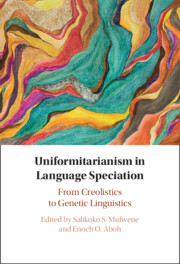
Uniformitarianism is the widely held assumption that, in the case of languages, structural and other changes in the past must have been triggered and constrained by the same ecological factors as changes in the present. This volume, led by two of the most eminent scholars in language contact, brings together an international team of authors to shed new light on Uniformitarianism in historical linguistics. Applying the Uniformitarian Principle to creoles and pidgins, as well as other languages, the chapters show that, contrary to the received doctrine, the former group of languages did not emerge in an exceptional way. Covering a typologically and geographically broad range of languages, and focusing on different contact ecologies in Africa, Latin America, and the Caribbean, the book also dispels common misconceptions about what Uniformitarianism is. It shows how similar processes in different ecosystems result in different linguistic patterns, which don't require exceptional linguistic explanations in terms of creolization, pidginization, simplification, or incomplete acquisition.
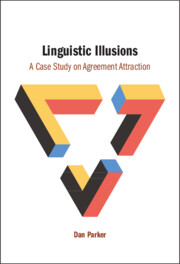
Linguistic illusions are cases where we systematically misunderstand, misinterpret, or fail to notice anomalies in the linguistic input, despite our competencies. Revealing fresh insights into how the mind represents and processes language, this book provides a comprehensive overview of research on this phenomenon, with a focus on agreement attraction, the most widely studied linguistic illusion. Integrating experimental, computational, and formal methods, it shows how the systematic study of linguistic illusions offers new insights into the cognitive architecture of language and language processing mechanisms. It synthesizes past findings and proposals, offers new experimental and computational data, and identifies directions for future research, helping readers navigate the rapidly growing body of research and conflicting findings. With clear explanations and cross-disciplinary appeal, it is an invaluable guide for both seasoned researchers, and newcomers seeking to deepen their understanding of language processing, making it a vital resource for advancing the field.