To save content items to your account,
please confirm that you agree to abide by our usage policies.
If this is the first time you use this feature, you will be asked to authorise Cambridge Core to connect with your account.
Find out more about saving content to .
To save content items to your Kindle, first ensure no-reply@cambridge.org
is added to your Approved Personal Document E-mail List under your Personal Document Settings
on the Manage Your Content and Devices page of your Amazon account. Then enter the ‘name’ part
of your Kindle email address below.
Find out more about saving to your Kindle.
Note you can select to save to either the @free.kindle.com or @kindle.com variations.
‘@free.kindle.com’ emails are free but can only be saved to your device when it is connected to wi-fi.
‘@kindle.com’ emails can be delivered even when you are not connected to wi-fi, but note that service fees apply.
In this chapter we explore a manually annotated subset of data from the corpora studied in this book, which have been analysed to show the presence of narratives as understood by researchers studying this concept. In this narrative study we return to an exploration of differences arising from L1 and cultural background and, inter alia, conclude that cultural background may have an important role to play in the frequency and nature of narrative. In drawing such conclusions, we refer, where appropriate, to existing research on SLA and narrative. Overall, the study suggests that, while there are similarities between L1 and L2 narrative use, there are also differences, some attributable to the learner, others to the task/context in which the data was gathered.
In this chapter the macro-structures in the TLC, its L1/L1 counterpart and the spoken BNC 2014 are compared. The results broadly divide into three groups: discourse unit functions, which are shared across all three corpora; task-specific discourse unit functions; and a number of discourse unit functions unique to individual corpora. The overall findings are that the construct used in the test in the Trinity corpus is a good match, in terms of discourse unit functions, for everyday conversational English, but also that some apparent differences, especially in Dimension 1, are illusory. The analysis of the BNC and the L1/L1 Trinity corpus leads to a revision of the Dimension 1 data for the L2/L1 Trinity corpus, which has the effect of making all three corpora more similar functionally. The chapter also explores the possibility of meso-structures within the discourse units and uses the concept of face to explain some of its findings. Throughout, the presence of narrative is so salient in all three corpora that the chapter concludes with a decision to explore narrative in more detail.
So far in the book the concept of narrative has been left largely unexplored except in so far as it has arisen as a functional labelling of data emerging from the short-text MDA of the corpora examined. However, while these labels were applied using the expertise of linguists, the fit between narrative so described and narrative as studied by linguists is unclear. This chapter sets the background for the examination of narrative, as defined by the model of Labov and Waletzky, both by introducing the model and working through an example of the intersection of these researchers’ approach to narrative and the micro- and macro-structural analyses in our data.
Various factors affecting language learning are introduced, including demographic variables, and learners’ L1, cultural background and the context of language use, noting that the analysis of learner corpora can enable the exploration of language-learning processes during SLA and across different contexts. Practical challenges involved in building extensive learner corpora, especially spoken learner corpora, are discussed (e.g. variable constraints, scale of data, availability of data). The Trinity Lancaster Corpus (TLC), a spoken corpus based upon a language proficiency test, and two other corpora, are then introduced. The chapter then discusses MDA and its adaptation for short texts (short-text MDA). The chapter describes the challenges of analysing short texts within corpora and explains how short-text MDA may make it possible to explore discourse at both the micro-structural (turn) and macro-structural (discourse units) levels. The chapter concludes by noting that this exploration will lead to a deeper analysis of narrative structures as a result of the findings from the corpora studied in the book using short-text MDA.
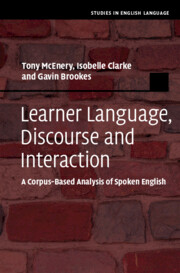
How do language learners interact with those who already speak the language they are learning? It is more than just a question of learning vocabulary and grammars – learners also need to learn how to put together conversations in their new language and to vary the way they interact across different contexts. This book shows, using millions of words of data, how this happens. It is the first large scale, corpus-based exploration of the discourse macro-structures in conversational interaction between L1 and L2 speakers, and explores three corpora to show, in spoken interaction with L1 speakers across a range of tasks, the dynamics of discourse construction. Considering factors including cultural background, task and proficiency, it characterises the repertoire of discourse functions used in these interactions and shows how they vary according to a range of variables. This title is also available as open access on Cambridge Core.
This chapter establishes what it means to do discourse analysis. This is done by defining discourse analysis and providing examples of discourse. The chapter offers a practical overview of how the discourse in discourse analysis fits within the research process. The examples of discourse that are introduced in this chapter are grammar, actions and practices, identities, places and spaces, stories, ideologies, and social structures. After reading the chapter, readers will know what discourse analysis is; understand that there are many types of discourse; know that discourse is an object of study; and understand how an object of study fits within a research project.
The chapter establishes the role of context in an analysis. This is done by defining context, presenting a context continuum that can be used to understand an object of study, and introducing the types of conditions that shape understandings of discourse. Six different approaches to studying context are discussed in this chapter: systemic functional linguistics, the SPEAKING model, frames, indexicality, contextualization cues, and next-turn proof procedure. After reading this chapter, readers will understand what context is and why it is important; be able to study context using different models and constructs; and know how discourse and context work together to create meaning.
This chapter reviews the perspectives and levels of an analysis that inform how an observation is made. This is done by demonstrating that there are two perspectives (language use and the human factor) and five levels (summation, description, interpretation, evaluation, and transformation) of analysis in discourse analysis. These perspectives and levels can be used to understand the frameworks of established methodologies, such as conversation analysis, critical discourse analysis, and narrative analysis. After reading this chapter, readers will know that the analytic process can combine different perspectives and levels of analysis.
The chapter demonstrates that selecting an object of study is a consequential part of doing discourse analysis. Selecting an object of study requires considering many planning and analytic issues that are often neglected in introductory books on discourse analysis. This chapter reviews many of these planning and analytic issues, including how to organize and present data. After reading the chapter, readers will know how to structure an analysis; understand what data excerpts are and how to introduce them in an analysis; be able to create and present an object of study as smaller data excerpts; and know how to sequence an analysis.
This chapter demonstrates that a researcher is attached to the analytic process in ways that make it difficult to be completely independent and objective when doing research. Issues of objectivity and subjectivity are discussed, which offer a frame to understand the ways in which a researcher’s cultural familiarity with an object of study, as well as their professional vision and institutional positionality, inform the analytic process. After reading this chapter, readers will understand that discourse analysis research is inherently subjective; know that a researcher’s cultural familiarity with an object of study is crucial to doing discourse analysis; be able to identify and adopt multiple analytic perspectives; be capable of applying reflexive practices to the analytic process; and understand, and know how to deal with, the power dynamics that exist in discourse analysis research.
This chapter summarizes the main points established in prior chapters and reviews how research questions factor into doing discourse analysis. The aim of the chapter is to help readers synthesize the different aspects of conducting discourse analysis research into a coherent set of principles. This is done by introducing a practical model for doing discourse analysis. After reading this chapter, readers will be able to recall the mains points of doing discourse analysis; be capable of using a model for doing discourse analysis to conduct research; know a number of practical tips for doing discourse analysis; and be able to construct research questions that are relevant to discourse analysis research.
The chapter defines theory and establishes how it informs discourse analysis. Theory is defined as an idea that explains what discourse is, how discourse should be understood, or both. Conversely, a theory is not an opinion, thought, or belief, which are simply intuitions without an explanatory framework. Topics discussed in this chapter include theories of knowledge and applied theories. After reading this chapter, readers will know how to define theory; understand how theory relates to the analytic process; know the difference between a theory of knowledge and an applied theory; and be able to identify the different types of applied theory that exist.