To save content items to your account,
please confirm that you agree to abide by our usage policies.
If this is the first time you use this feature, you will be asked to authorise Cambridge Core to connect with your account.
Find out more about saving content to .
To save content items to your Kindle, first ensure no-reply@cambridge.org
is added to your Approved Personal Document E-mail List under your Personal Document Settings
on the Manage Your Content and Devices page of your Amazon account. Then enter the ‘name’ part
of your Kindle email address below.
Find out more about saving to your Kindle.
Note you can select to save to either the @free.kindle.com or @kindle.com variations.
‘@free.kindle.com’ emails are free but can only be saved to your device when it is connected to wi-fi.
‘@kindle.com’ emails can be delivered even when you are not connected to wi-fi, but note that service fees apply.
Chapter 2 considers aspects of visual design and explores the advantages and disadvantages of different forms of layout. It discusses the ways in which advertisers make use of visual resources to represent metaphors and metonymies. It shows how the same metaphor can be represented in multiple different ways leading to different processing or pragmatic effects. The chapter shows how two key dimensions of creativity (meaning and form) work together in the production and reception of figurative meaning in the context of advertising. It first reviews the ways in which scholars have operationalised ‘visual complexity’ as an experimental variable, and reports findings from the few studies that have attempted to measure its impact. It then proposes a new distinction based on the degree of schematicity versus content richness of the metaphorical/metonymic image. Schematic images contain very few visual elements to help the consumer interpret the message, whilst content-rich images contain numerous details on which the consumer can draw. In the final section, the chapter introduces another tool that advertisers can exploit in order to maximise the impact of visual creativity: that of colour.
Chapter 10 reports the impact of the authors’ work on the success of three advertising campaigns and rebranding projects that were developed by an advertising agency. The chapter demonstrates how research into the optimal use of figurative messaging in advertising campaigns and rebranding exercises can lead to increased effectiveness, measured using industry criteria as well academic criteria. The chapter identifies practical ways of fostering the right amount of cognitive effort on the part of the reader. In some cases, this involves manipulating the text, and in others it involves adjusting the level of content-richness in the image. The chapter shows how a partnership between academics and advertising practitioners can further the theoretical understanding of the ways in which figurative language is processed and the factors that are likely to render it both effective and affective.
Metaphor, where one entity is talked about in terms of another unrelated entity, is a powerful and widely used device in advertising. For example, cars are talked about as if they were animals. Household devices are presented as if they were people, and washing powders are talked about as if they were superheroes. Although metaphor sometimes works on its own in advertising, it is more common for it to operate in combination with other tropes, such as metonymy, irony, and hyperbole. Moreover, it rarely appears solely in a linguistic form but often manifests in other, non-linguistic forms of expression. This is particularly pertinent in advertisements that involve new media, such as internet fora, viral advertising campaigns, and social networks such as Facebook, Instagram, Snapchat, and Twitter. Metaphor and other forms of figurative communication are inherently flexible, which makes them ideal for use in diverse cultural settings, as they can mean different things to different people. At the same time this carries an element of risk, as they are often open to misinterpretation.
Chapter 6 presents findings from a study into the figurative use of colour and shape in app icons. The study explores the values that are conveyed by different colours and shapes and examines how these are used to express the personalities of different brands and products. Findings from the study show that there is a degree of systematicity in the colours and shapes that are selected for particular kinds of products and services, and there are figurative links between the colours chosen for the apps and the types of service they offer. This strategy works best when different figurative messages are combined through the use of two or more colours along with an iconic metonymic or metaphorical image. This creates a narrative through which the qualities of the app can be conveyed. Blue, white, and green apps tend to receive the most downloads, which is partially a reflection of the values that those colours connote, and partially a reflection of the fact that they feature heavily in communication apps, which are the most downloaded category.
Chapter 3 explores how and under what conditions consumers interact with figurative language in advertising and respond to it on a deeper, more emotional level. It shows how metaphor and metonymy can be used in emotional, powerful and memorable ways that encourage consumers to ‘interact’ with the narrative, thus provoking deeper and more emotional bonds with the product or brand. It shows how metaphor has the potential to be ‘experienced’ rather than simply encountered, and outlines the factors that are most likely to lead to this. Four campaigns are analysed, each of which was a Grand Prix winner at the Cannes Lions Festival in 2019. The analysis shows how they harness and maximise the experiential potential of metaphor, thus increasing the effectiveness of the campaign. Each of these campaigns illustrates a different way in which the experiential nature of metaphor and metonymy can be enhanced in order to maximise the appeal of an advertising campaign, convey the personality and values of a brand, and build the relationship that it has with consumers. The chapter also analyses another successful campaign, the 2019 Christmas campaign that was developed by John Lewis and Partners and Waitrose and Partners in the UK, and shows how this campaign combines metaphor and metonymy with humour and dramatic irony in order to maximise interactivity and promote feelings of brand ownership. To sum up, the chapter considers the complex and sophisticated ways in which advertisers employ figurative messaging to involve the viewer in a campaign. The campaigns considered are dynamic and interactive, with some of the more experiential campaigns inviting the viewer to ‘act out’ the metaphor.
Chapter 1 provides an introduction and overview of the topics covered in the book. General extenders, adjunctive and disjunctive, are defined, exemplified and their internal structure analyzed. Four functions are described, with examples, as referential, interpersonal, personal and textual. Thehistorical development of some common forms is described, as well as the processes of grammaticalization. Certain forms are recognized as linguistic variables that align with social variables to represent social markers in different communities. Translation equivalents are identified in a range of different languages and in the speech of second language learners and those using English as a lingua franca. Ideas are presented for teaching general extenders as examples of pragmatic markers. Their multifunctionality is illustrated, together with some observations on their position within utterances, leading to a novel claim that some forms can be used as associative plural markers, a feature hitherto undocumented in English.
Chapter 4 explores potential sources of audience variation in responses to figurative language, considering issues such as age, gender, need for cognition, and cultural background. It investigates how these sources of variation impact on the understanding and interpretation of figurative messaging. It reports findings from the authors’ own work as well as findings from existing literature in the area. Individual differences are found to shape the ways in which people respond to advertisements containing metaphors in different ways. They are shown to affect the kinds of meanings people perceive in the metaphors, the speed with which they are able to find meaning, and their levels of appreciation of the advertisements. The chapter also explores how individual difference variables interact with one another and with the context in which the advertisements are seen.
Chapter 3 focuses on the uses of general extenders that are addressee-oriented and express an interpersonal function in interaction. The underlying concept is described as intersubjectivity, which is tied to an awareness of the addressee’s needs. Participants in an interaction are taken to be cooperative fellow speakers, adhering toGrice's Quality and Quantity maxims. The use of adjunctive forms to indicate common ground can also create a sense of solidarity, indicating similarity, and hence also signaling positive politeness. In other situations, speakers can use disjunctive forms to signal negative politeness, that is, a concern with potentially imposing on the addressee. When general extenders are used as part of these politeness strategies, they are often described as hedges, used to indicate possible inaccuracy or imposition and a desire to avoid such things, resulting in an association with approximation.
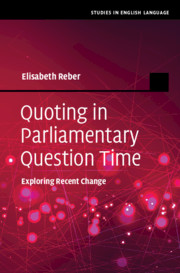
Why do recordings of speakers engaging in reported speech at British Prime Minister's Questions from the 1970s–80s sound so distant to us? This cutting-edge study explores how the practices of quoting have changed at parliamentary question time in light of changing conventions and an evolving media landscape. Comparing data from authentic audio and video recordings from 1978 to 1988 and from 2003 to 2013, it provides evidence for qualitative and quantitative changes at the micro level (e.g., grammaticalisation processes in the reporting clause) and in more global structures (e.g., rhetorical patterns, and activities). These analytic findings contribute to the theoretical modelling of evidentiality in English, our understanding of constructions, interaction, and change, and of PMQs as an evolving community of practice. One of the first large-scale studies of recent change in an interactional genre of English, this ground-breaking monograph offers a framework for a diachronic interactional (socio-) linguistic research programme.
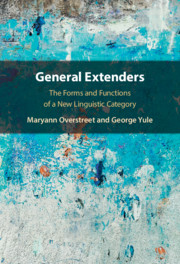
General extenders are phrases like 'or something', 'and everything', 'and things (like that)', 'and stuff (like that)', and 'and so on'. Although they are an everyday feature of spoken language, are crucial in successful interpersonal communication, and have multiple functions in discourse, they have so far gone virtually unnoticed in linguistics. This pioneering work provides a comprehensive description of this new linguistic category. It offers new insights into ongoing changes in contemporary English, the effect of grammaticalization, novel uses as associative plural markers and indicators of intertextuality, and the metapragmatic role of extenders in interaction. The forms and functions of general extenders are presented clearly and accessibly, enabling students to understand a number of different frameworks of analysis in discourse-pragmatic studies. From an applied perspective, the book presents a description of translation equivalents, an analysis of second language variation, and practical exercises for teaching second language learners of English.
Figurative communication (the use of metaphor, metonymy, hyperbole and irony) provides economy of expression, clarity, persuasiveness, politeness, evaluation, and communication of emotions. However, it also increases the potential for misunderstanding in situations when people lack shared background knowledge. This book combines theoretical frameworks with empirical studies that measure the effectiveness of different approaches to the use of figurative language in advertisements, to show how to maximise the benefits of creative metaphor and metonymy in global advertising. It highlights how subtle differences in colour, layout, and combinations of different kinds of figurative language affect the reception and appreciation of creative advertising, shedding new light on the nature of figurative communication itself. With a balance between theory, experiments and practical case studies, this book is accessible for academics in linguistics and communication studies, as well as advertising and marketing professionals.