To save content items to your account,
please confirm that you agree to abide by our usage policies.
If this is the first time you use this feature, you will be asked to authorise Cambridge Core to connect with your account.
Find out more about saving content to .
To save content items to your Kindle, first ensure no-reply@cambridge.org
is added to your Approved Personal Document E-mail List under your Personal Document Settings
on the Manage Your Content and Devices page of your Amazon account. Then enter the ‘name’ part
of your Kindle email address below.
Find out more about saving to your Kindle.
Note you can select to save to either the @free.kindle.com or @kindle.com variations.
‘@free.kindle.com’ emails are free but can only be saved to your device when it is connected to wi-fi.
‘@kindle.com’ emails can be delivered even when you are not connected to wi-fi, but note that service fees apply.
This Element outlines current issues in the study of the pragmatics of fiction. It starts from the premise that fictional texts are complex and multi-layered communicative acts which deserve attention in pragmatic research in their own right, and it highlights the need to understand them as cultural artefacts rich in possibilities to explore pragmatic effects and pragmatic theorising. The issues covered are (1) the participation structure of fictional texts, (2) the performance aspect of fictional texts, (3) the interaction between readers and viewers and the fictional texts, as well as (4) the pragmatic effects of drawing on indexical linguistic features for evoking ideologies in characterisation. This title is also available as Open Access on Cambridge Core.
This Element discusses the challenges and opportunities that different types of corpora offer for the study of pragmatic phenomena. The focus lies on a hands-on approach to methods and data that provides orientation for methodological decisions. In addition, the Element identifies areas in which new methodological developments are needed in order to make new types of data accessible for pragmatic research. Linguistic corpora are currently undergoing diversification. While one trend is to move towards increasingly large corpora, another trend is to enhance corpora with more specialised and layered annotation. Both these trends offer new challenges and opportunities for the study of pragmatics. This volume provides a practical overview of state-of-the-art corpus-pragmatic methods in relation to different types of corpus data, covering established methods as well as innovative approaches. This title is also available as Open Access on Cambridge Core.
This Element addresses translation issues within an interpersonal pragmatics frame. The aims of this Element are twofold: first, we survey the current state of the field of pragmatics in translation; second, we present the current and methodologically innovative avenues of research in the field. We focus on three pragmatics issues – relational work, participation structure, and mediality – that we foreground as promising loci of research on translational data. By reviewing the trajectory of pragmatics research on translation/interpreting over time, and then outlining our understanding of the Pragmatics in Translation as a field, we arrive at a set of potential research questions which represent desiderata for future research. These questions identify the paths that can be productively explored through synergies of the linguistic pragmatics framework and translation data. In two case study chapters, we offer two example studies addressing some of the questions we identified as suggestions for future research. This title is also available as Open Access on Cambridge Core.
This chapter examines sequences of offers by sellers in gourmet shops, video documented in a dozen cities across Europe, focusing on offers of a taste of cheese. Such offers to taste are shown to occur in two types of sequential contexts. They are made when a customer has expressed interest in a product but displays some hesitation in deciding whether to purchase it or not. Such offers to taste pursue sale of the cheese; they are not simple small gifts. Participants orient to this character of the offers by treating them as providing assistance in decision making. On the other hand, if the offer is made sequentially too late or too early, it is rejected, underlining the pursuit of sale at work in an offer of a taste. A contrasting environment of offers is also examined. In these cases, a plate of small pre-cut pieces of cheese are on the counter for anyone to try. The offers are typically accepted by the customer but without leading to buying. This enriches our understanding of the preference organization of offers and requests, and the relationships between benefactor/beneficiary, further supporting the relationship between the offer and the pursuit of the offerer’s interests.
A shop encounter is normatively closed when payment is made. This paper analyzes the ways in which the physical presence of money (whether as cash, or bank card) shapes the payment phase of the interaction at kiosks in Finland. This study demonstrates that customers orient to payment from the very beginning of the interaction and work to prepare their money and to make it observable to the seller from early on. Moreover, if the customer has made their money observable prior to the price announcement by the seller, the payment phase moves quickly and smoothly to completion. If, on the other hand, the money has not been made observable early in the interaction, payment can be delayed. Conversely, customers can put their money on the seller’s side of the counter before payment has been made relevant; in such cases, the seller adjusts his or her actions to speed up the interaction so that the payment phase arrives earlier than is typical. Thus, through money, especially displays of it early in the interaction, customers show their orientation to progressivity.
This study focuses on sequences in which shoes and other leather items are returned to customers at a shoe repair shop in North America after having been repaired in some way. Before customers’ final payment for the items, the staff engage in three different ways of presenting the returned items, each making relevant a different kind of response from the customer. First, most frequent type, the staff person places the item on the counter and then turns to ring up the sale; in the second, the staff person engages in manual displays of the repair work that has been done; and in the third, the staff person verbally pursues a response through questions. The first type of presentation does not make conditionally relevant any kind of inspection or assessment from the customer, although customers may still inspect and assess; in the second, the pursuit is a bit stronger; and in the third, through questions from the staff such as ‘good?’, an assessment is made conditionally relevant. The study queries the theoretical implications for the general lack of pursuit of assessment at the shoe shop, compared with, for example, hair salons, in which assessments are typically actively pursued by the stylist.
Focusing on supermarkets in a Swiss Italian city, this chapter explores the interactional work that couples shopping together do before finally arriving at the counter to make a request. While some requests arise from a need that was stated at the very beginning of the shopping expedition (e.g., ‘I need cheese’) and which then guide the pair to a specific counter at the store, other requests arise from something said or seen in the course of traversing the store. It is shown that even needs or wishes that were expressed at the beginning of the interaction can undergo transformation. Potential purchasable items proffered by one member of the pair may be modified or rejected by the other, and in this process the pair enacts a particular kind of relationship, being a committed couple, in which both parties have a say in food that is to be purchased and prepared for specific meals. The study shows that requests emerge incrementally over the course of interactions, and are situated in particular interactional, material, and economy-oriented environments
The chapter examine a normative orientations of packing items at a farmer’s market in Sweden. It shows that the orientations to who should pack and under what circumstances reveal the deeply moral and interactional character of packing. While customers are expected to pack most items on their own, bulk items – such as potatoes – are normatively packed by the seller. When these norms are violated, such as when customers ask to pack their own potatoes, moral indignation may result. The study further examines instances in which the seller displays difficulty in packing; customers’ careful offers of assistance in these cases display an orientation to the autonomy of the seller and call into question the universal desirability of offers of assistance.
The chapter sketches the panorama of research that has characterized shop encounters in order to situate the contributions of the book. It first adopts a broader multidisciplinary perspective on studies of language and talk in shop encounters, reviewing research conducted from a diversity of perspectives in linguistics, sociolinguistics, micro-sociology, linguistic anthropology, ethnography of communication, and discourse analysis. It then turns to introduce a more focused approach centered in ethnomethodological and conversation analytic (EMCA) studies of shop interactions, discussing studies on recurrent actions and sequences of actions in shop encounters, the centrality of the material ecology of shop encounters and embodied conduct, as well as orientation to the commercial core and economic consequences in the organization of shop encounters.
The chapter examines the formatting of initial turns by customers at the counter, before they decide and in order to select what to buy. On the basis of recordings in bakeries in Finland, France, and Switzerland, it is shown how customers may face a range of practical problems in making decisions as to what or whether to purchase, including seeing items that might look appealing but which they don’t recognize or for which they do not know the ingredients. Through the design of their questions, drawing on verbal, material, and embodied resources, customers make publicly available to the sellers their epistemic access to the products (e.g., they do not know enough about the item to formulate its identity with anything more than a demonstrative pronoun or demonstrative determiner plus ‘empty’ noun). With their answers sellers provide information that may be immediately useful for the customer in making their decision, or which may need further elaboration. The referential practices employed by both customers and sellers reveal features of items that are locally relevant for the practical purposes of buying, in particular sequential, material, and embodied locations in interaction.
The chapter examines the transfer of the item(s) from the customer’s hands into the hands of the seller. This transfer is a crucial part of many commercial transactions, as the seller must enter the item number into the shop’s inventory system, both to learn the price and to subtract the item from inventory. Exploring data from ‘kiosks’ or convenience stores across Europe, the precise details of this manual transfer of items are examined There are two general methods by which the transfer is enacted: in the first, the customer gives the item directly into the hand(s) of the seller; in the second, the customer places the item on the counter and the seller picks it up. Which method unfolds depends on a variety of factors, including the seller’s physical availability at the moment the customer approaches the counter, the kinds of items purchased, and whether the seller has anticipated the transfer by reaching out their hand, in a shape recognizable as ready to ‘take’. These two methods are seen to reveal the moral and commercial nature of the manipulation of objects, and ultimately of the transaction.
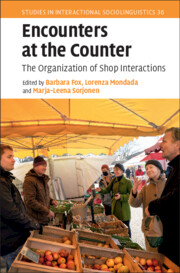
Bringing together a diverse collection of studies from a team of international scholars, this pioneering volume focuses on interactions in shops, exploring the dynamics of conversation between sellers and customers. Beginning with the emergence of a 'need' for a product before the request to a seller is actually made, all the way through to the payment phase, it explores the rich and deeply methodical practices employed by customers and sellers as they go about the apparently mundane work of buying and selling small items. It looks at how seller and customer interact both verbally, and by means of manipulating the material objects involved, across a range of different kinds of purchase. Providing new insights into multimodal human interaction and the organisation of the commercial activity, it aims to bring about a new understanding of the fundamental ways in which economic value, possession and ownership is achieved.
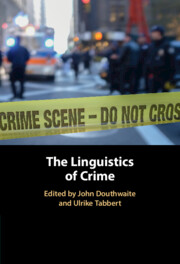
Bringing together scholars from a range of disciplines, this book explores the analysis of crime-related language. Drawing on ideas from stylistics, pragmatics, cognitive linguistics, metaphor theory, critical discourse analysis, multimodality, corpus linguistics, and intertextuality, it compares and contrasts the linguistic representation of crime across a range of genres, both fictitious (crime novels, and crime in TV, film and music), and in real life (crime reporting, prison discourse, and statements used in courts). It touches on current political topics like #BlackLivesMatter, human (child) trafficking, and the genocide of the Kurds among others, making it essential reading for linguists, criminologists and those with a general interest in crime-related topics alike. Covering a variety of text genres and methodological approaches, and united by the aim of deciphering how crime is portrayed ideologically, this book is the next step in developing research at the intersection of linguistics, criminology, literature and media studies.
Zupan identifies by means of in-depth analysis the stylistic features of a passage from ’The Murders in the Rue Morgue’ by Edgar Allan Poe. He then compares how these features have been preserved or changed in two translations of the novel into Slovenian.