To save content items to your account,
please confirm that you agree to abide by our usage policies.
If this is the first time you use this feature, you will be asked to authorise Cambridge Core to connect with your account.
Find out more about saving content to .
To save content items to your Kindle, first ensure no-reply@cambridge.org
is added to your Approved Personal Document E-mail List under your Personal Document Settings
on the Manage Your Content and Devices page of your Amazon account. Then enter the ‘name’ part
of your Kindle email address below.
Find out more about saving to your Kindle.
Note you can select to save to either the @free.kindle.com or @kindle.com variations.
‘@free.kindle.com’ emails are free but can only be saved to your device when it is connected to wi-fi.
‘@kindle.com’ emails can be delivered even when you are not connected to wi-fi, but note that service fees apply.
In this chapter we compare posts from the two countries which most posters identified as residing in. Within the forum, 38.84% of posts were made by people from the UK, 33.94% were made by those from the USA, 17.41% were made by people who did not specify a country and 9.81% consisted of all other countries. While the main language in the UK and USA is English, an analysis of keyword differences indicates numerous differences which point not only to spelling (favorite) and lexical choices (vacation) but also to ways that anxiety is understood. In addition, we consider the extent to which posters are influenced by external cultures; for example, is there evidence that British posters are adopting language and discourses used by American posters, or vice versa? As with the previous chapter, the analysis concludes by considering the role of culture on understandings of anxiety.
Willis J. Edmondson,Juliane House, Universität Hamburg and the Hungarian Research Centre for Linguistics,Daniel Z. Kadar, Dalian University of Foreign Languages, China and Hungarian Research Centre for Linguistics
Chapter 3 presents a comprehensive way of analysing and describing interaction, serving as a model for the descriptions offered in the rest of the book. In the descriptive system explicated in this chapter, we approach interaction through units of various size, including expressions, illocutionary acts and Types of Talk representing discourse. The system presented in this chapter was not derived in a top-down manner, but ratheremerged as an outcome of extensive empirical research.
The concluding chapter of this monograph summarises the main findings from the preceding chapters and brings those findings together to establish overall patterns and trends in online discourses of anxiety. Concordant with our Critical Discourse Studies approach, these representations are then related to the contexts in which they are situated as well as their implications for understanding mental health in wider society. The chapter also critically reflects on the approach we took, the questions that emerged as a result of engaging with the corpus of forum posts and potential extensions to our study.
Willis J. Edmondson,Juliane House, Universität Hamburg and the Hungarian Research Centre for Linguistics,Daniel Z. Kadar, Dalian University of Foreign Languages, China and Hungarian Research Centre for Linguistics
In this chapter we delve deeper into forum posters’ descriptions of anxiety by focusing on how they describe what it feels like to experience anxiety, what they believe causes their anxiety and how they best believe that their anxiety can be resolved. We consider also patient narratives around their anxiety. This chapter provides an overview of the linguistic content of the forum by carrying out a keywords analysis of the online corpus to identify words and phrases that are statistically salient in forum posts, comparing first posts with subsequent posts. These words are placed into thematic categories and a representative set are analysed in depth to illustrate different aspects of discussion around anxiety.
In this chapter we make use of the demographically tagged nature of the forum posts by comparing and contrasting posts made by female and male users. Some 52.02% of posts were made by posters who identified as female, 16.71% were made by male posters and 31.20% were made by posters who did not specify their sex. These figures are congruent with data on prevalence of anxiety by sex, which tends to indicate that women are more likely than men to be diagnosed with anxiety. We examine male and female keywords in the corpus, finding that men are more likely to use problem-solving language that focuses on explanations for anxiety and strategies for resolving it. On the other hand, women are more likely to use affiliative language to express empathy, sympathy and encouragement to others. The chapter also examines gendered discourses relating to anxiety by considering representations around words such as man, woman, macho and feminine. Our analysis concludes by linking our findings to consideration of gendered roles and societal stereotypes.
Willis J. Edmondson,Juliane House, Universität Hamburg and the Hungarian Research Centre for Linguistics,Daniel Z. Kadar, Dalian University of Foreign Languages, China and Hungarian Research Centre for Linguistics
In Chapter 5, we examine those expressions through which language users conventionally indicate illocutionary acts such as requesting. We define these expressions as Ritual Frame Indicating Expressions (RFIEs), arguing that they are recurrently used to indicate illocutionary acts in specific standard situations with preset rights and obligations for participants. Learning and teaching the use of such expressions can be particularly difficult due to their interactional load and linguacultural specificity.
Willis J. Edmondson,Juliane House, Universität Hamburg and the Hungarian Research Centre for Linguistics,Daniel Z. Kadar, Dalian University of Foreign Languages, China and Hungarian Research Centre for Linguistics
This chapter takes advantage of the fact that our corpus contains posts made over an eight-year period, along with the demographic information we have about patient age. We consider diachronic aspects of the forum in a range of ways. First, we look at how language has changed over the time, focusing on changes in anxiety discourses. We consider the corpus in terms of trends over the eight-year period. We also consider how the age of posters impacts on the ways they write about language, dividing the corpus into age-graded sections. We compare linguistic differences across these age groups, seeking to identify how language use reflects different understandings or representations of anxiety in relationship to age. Finally, we trace how posting behaviour ‘evolves’ over time; for example, early posts involve narrative histories, question seeking and expressions of emotional state whereas later ones involve advice-giving and expressions of affiliation as posters take on the role of ‘expert’. We also consider how participants leave the forum by looking at ‘final posts’. In what ways, if at all, do posters provide a sense of narrative ‘closure’ when they leave the group?
Willis J. Edmondson,Juliane House, Universität Hamburg and the Hungarian Research Centre for Linguistics,Daniel Z. Kadar, Dalian University of Foreign Languages, China and Hungarian Research Centre for Linguistics
In Chapter 7, we provide an introduction into the highest unit in this grammar, discourse, through the analytic unit of Types of Talk. Types of Talk consist of interactional structures, into which speech acts can be slotted. We propose an inventory of speech acts by means of which one can systematise Types of Talk.
Willis J. Edmondson,Juliane House, Universität Hamburg and the Hungarian Research Centre for Linguistics,Daniel Z. Kadar, Dalian University of Foreign Languages, China and Hungarian Research Centre for Linguistics
Chapter 1 introduces the background, scope and objectives of this interactional pedagogic grammar of English. A ‘grammar’ is commonly understood as a body of rules concerning the relations between different parts of sentences of a language. We are attempting to describe language in use, such that we are interested in what speakers do with it when they talk to each other, hence pursuing an essentially pragmatic approach to language.The chapter also summarises the contents of the book and the transcription conventions.
Willis J. Edmondson,Juliane House, Universität Hamburg and the Hungarian Research Centre for Linguistics,Daniel Z. Kadar, Dalian University of Foreign Languages, China and Hungarian Research Centre for Linguistics
Chapter 8 presents a case study of an important Type of Talk, namely Opening Talk. The chapter illustrates why the acquisition of speech acts and related Types of Talk is often challenging for learners of English. We report on experiments conducted with Chinese learners of English.
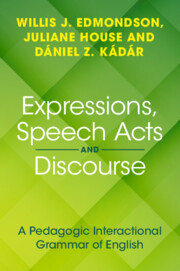
First published in 1981, Let's Talk and Talk About It is regarded as a cornerstone of research in pragmatics, which laid new and lasting foundations for the teaching of English. Forty years on, this extensively updated version is fully tailored for the 21st century. It provides a pedagogic interactional grammar of English, designed for learners and teachers of English and textbook writers, as well as experts of pragmatics and applied linguistics. The book includes a rigorous pragmatic system through which interaction in English and other languages can be captured in a replicable way, covering pragmatically important expressions, types of talk and other interactional phenomena, as well as a ground-breaking interactional typology of speech acts. The book is also illustrated with a legion of interactional and entertaining examples, showing how the framework can be put to use. It will remain a seminal work in the field for years to come.
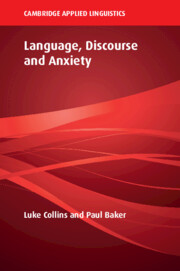
Why is language so important to the ways that we make sense of anxiety? This book uses corpus assisted discourse analysis to examine twenty-three million words of text posted to a forum for people with anxiety. It shows how linguistic techniques like catastrophisation and anthropomorphisation can result in very different conceptualisations of anxiety, as well as how aspects of identity like age, sex and cultural background can impact on understandings of anxiety and how it ought to be managed. It tracks the changing identities of posters, from their first posts to their last, and incorporates a range of corpus-based techniques to examine the language data, enabling consideration of interaction between participants and features associated with online forms of communication like emoji. It ultimately provides a step towards a better understanding of different responses to anxiety and aims to promote further engagement with this topic in the field of applied linguistics.