To save content items to your account,
please confirm that you agree to abide by our usage policies.
If this is the first time you use this feature, you will be asked to authorise Cambridge Core to connect with your account.
Find out more about saving content to .
To save content items to your Kindle, first ensure no-reply@cambridge.org
is added to your Approved Personal Document E-mail List under your Personal Document Settings
on the Manage Your Content and Devices page of your Amazon account. Then enter the ‘name’ part
of your Kindle email address below.
Find out more about saving to your Kindle.
Note you can select to save to either the @free.kindle.com or @kindle.com variations.
‘@free.kindle.com’ emails are free but can only be saved to your device when it is connected to wi-fi.
‘@kindle.com’ emails can be delivered even when you are not connected to wi-fi, but note that service fees apply.
Illustrated with examples from a rich range of languages and genres, this book provides a state-of-the-art introduction to the meanings and functions of connectives, and the discourse relations they communicate. It begins with theoretical chapters that illustrate the many interfaces present in the study of connectives and discourse relations, using diachronic data to illustrate how connectives incorporate such a wide range of functions in synchronic language use. The second half of the book presents the rapidly growing body of studies that have used empirical data to assess theories of connectives and discourse relations, spanning fields as diverse as discourse processing, first and second language acquisition, and cross-linguistic studies. End-of-chapter discussion questions and lists of further readings are included, along with a comprehensive glossary of key terms. This title is part of the Flip it Open Programme and may also be available open access. Check our website Cambridge Core for details.
This Element expands the horizon of sociopragmatic research by offering a first inquiry into the sociocultural norms that underlie the establishment and maintenance of interpersonal relations in a diasporic context. Based on accounts of the practices that Spanish-speaking Latin Americans engage in pursuit of employment, primarily gathered in life-story interviews, it captures the social reality of members of this social group as they build interpersonal relations and establish new contractual obligations with each other away from home. It examines occupational recommendations as a diasporic relational practice whereby the relationship between the recommender and the recommendee becomes part of the value being exchanged and the moral order on which the practice is established and maintained through an interlocked system of favours. The Element offers new social pragmatics insights beyond the dyad in a contemporary globalised context characterised by social inequality.
Humans produce utterances intentionally. Visible bodily action, or gesture, has long been acknowledged as part of the broader activity of speaking, but it is only recently that the role of gesture during utterance production and comprehension has been the focus of investigation. If we are to understand the role of gesture in communication, we must answer the following questions: Do gestures communicate? Do people produce gestures with an intention to communicate? This Element argues that the answer to both these questions is yes. Gestures are (or can be) communicative in all the ways language is. This Element arrives at this conclusion on the basis that communication involves prediction. Communicators predict the behaviours of themselves and others, and such predictions guide the production and comprehension of utterance. This Element uses evidence from experimental and neuroscientific studies to argue that people produce gestures because doing so improves such predictions.
This Element shows the basis for pragmatics/(im)politeness to become intergroup-oriented to be able to consider interactions in which social identities are salient or are essentially collective in nature, such as Cancel Culture (CC). CC is a form of ostracism involving the collective withdrawal of support and concomitant group exclusion of individuals perceived as having behaved in ways construed as immoral and thus displaying disdain for group normativity. To analyze this type of collective phenomenon, a three-layered model that tackles CC manifestations at the macro, meso, and micro levels is used. At the meso/micro levels, problematize extant conceptualizations of CC -mostly focused on the macro level and describe it as a Big C Conversation, whose meso-level practices need to be understood as genre-ecology, and where identity reduction, im/politeness, and moral emotions synergies are key to understand group entitativity and agency.
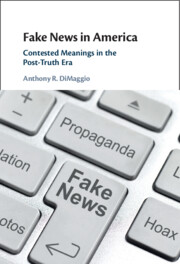
The term 'fake news' became a buzzword during Donald Trump's presidency, yet it is a term that means very different things to different people. This pioneering book provides a comprehensive examination of what Americans mean when they talk about fake news in contemporary politics, mass media, and societal discourse, and explores the various factors that contribute to this, such as the power of language, political parties, ideology, media, and socialization. By analysing a range of case studies across war, political corruption, climate change, conspiracy theories, electoral politics, and the Covid-19 pandemic, it demonstrates how fake news is a fundamentally contested phenomenon, and how its meaning varies depending on the person using the term, and the political context. It provides readers with tools to identify, talk about, and resist fake news, and emphasizes a need for education reform with an eye toward promoting critical thinking and information literacy.
Chapter 7 analyzes misinformation and conspiracy theories as contemporary examples of fake news. These include the “death panels” controversy, the Obama “birther” conspiracy, Pizzagate, QAnon, and Covid-19–related myths and conspiracies. Not all conspiracy theories originate from the American right, although this chapter documents how the highest profile ones are embraced by right-wing media and the Republican Party. These conspiracies rise to prominence after being indulged by Republican officials, right-wing media outlets, and in social media. Social media increasingly serve as prime disseminators of reactionary conspiracies. I also examine how traditional “agenda setting” news media have held the line against these conspiracies, with consumption of these venues associated with increased rejection of the conspiracies. In contrast, social media consumption – in general and particularly for Republican Americans – is regularly associated with embrace of conspiracies. This rising culture of conspiratorialism has reached crisis levels with movements like QAnon, and with the Covid-19 pandemic and the failure of millions of Americans to take the crisis seriously or think about it in factual ways. In an era when traditional media gatekeepers are being pushed aside in favor of social media venues, people curate their own information and construct echo chambers, allowing conspiracy theories free reign.
Chapter 3 documents how the meaning of fake news changes over time. I look at how fake news was understood during the 2000s and 2010s – prior to the Trump era – in the New York Times. I discuss how fake news was primarily understood in three ways – related to fabricated stories passed off as real news events, as entertainment content pertaining to current events, and as government propaganda masquerading as journalism. Further, the US media’s understanding of fake news has shifted over the years. My analysis of the New York Times’ coverage of fake news in the 2010s finds that the paper defined the concept in many ways, compared to Trump’s various definitions, with little overlap between the paper and the former president. Editorially, the paper emphasizes conventional definitions of fake news that avoid understanding it as a form of propaganda operating in service of governmental interests. I examine various competing definitions of fake news in other media venues, providing evidence that the social construction of fake news is a contested phenomenon. I examine US partisan cable media, alternative left- and right-wing media, and social media venues – each of which puts forward its own interpretations of what fake news means.
Chapter 4 analyzes public opinion surveys to understand how Americans define fake news. I show that concern with fake news is pervasive among Americans, despite a majority who struggle to define what it means. I identify various ways that the phenomenon of fake news is contested by Americans, with at least nine different definitions for the concept being embraced by large segments of the public. I examine where concerns with fake news are likely to originate, identifying statistical predictors of public concern with the phenomenon. Such concerns are more likely to be expressed by privileged sociodemographic groups, heavier media consumers, and those with high levels of media distrust – the last factor itself appearing to be a function of right-wing partisan and ideological socialization. I examine Americans’ thoughts about how to best combat fake news. I focus on various definitions of fake news that I argue are the most practically significant out of the nine identified in the chapter – those related to reporters’ overreliance on official (corporate and governmental) sources in producing the news, partisan biases in the news, and the rise of conspiracy content in media sources.
After summarizing the findings from the book, I discuss steps for how Americans can tackle the challenge of fake news. These include promoting more effective civic education and information literacy, guiding Americans in recognizing the value of empirical evidence and reasoning, identifying the value of reliable informational and news sources, and assessing potential governmental actions for combating rising misinformation. Mass disinformation and misinformation do not have to be facts of life in contemporary society, and there are steps that Americans can take to combat them.
Chapter 5 analyzes two cases of fake news as disinformation – the 2003 Iraq war and climate change. I look at how political and economic actors manipulate the news media to promote disinformation, in the process “manufacturing consent” for the public. With Iraq, I document the initial success of the Bush administration in selling the US invasion, producing growing support for the war, with the news-consuming public based on notions that Iraq possessed WMDs and ties to terrorism. Support for war declined over time, as the public was increasingly sensitized to rising casualties and the financial cost of the war, after the United States failed to find WMDs, and as the war was increasingly seen as unwinnable and immoral. I also examine how the fossil fuel industry utilized “false balancing” as a news management technique for encouraging mass confusion related to climate change, pitting climate-change skeptics against individuals recognizing planetary warming. Examining “climategate” and cap-and-trade legislation in the late 2000s, I show how reactionary narratives dominated the news, driving increased public opposition to efforts to address climate change. Public opposition receded by the mid-to-late 2010s as extreme weather and a warming planet undermined efforts to foster mass ignorance.
Chapter 6 examines two case studies from the Trump years involving allegations of “fake news” – Russiagate and Ukrainegate. I review the historical timelines of each case study, documenting the allegations made against Trump. With the social construction of reality, the way presidential scandals are reported is integral to reinforcing or contesting Americans’ beliefs regarding perceptions of a given scandal. With Russiagate, the president’s critics speculated with worst-case scenarios about collusion with Russia, and much of the media coverage of the controversy was heavily critical of Trump, despite right-wing media downplaying the notion that a scandal occurred. Regarding concerns with fake news, I document how critical reporting on Russiagate had significant consequences in terms of cultivating increased suspicion of a sitting president. For Ukrainegate, I document how the president engaged in an abuse of power, and that critical reporting recognized this abuse, thereby undermining Trump’s claim that reporting on the scandal was “fake news.” Critical reporting was associated with increased suspicion of the president among heavier media consumers. Finally, I document the role of social media in impacting how people think about scandals of the Trump era, with evidence of a balkanization–“echo chamber” effect between Democratic and Republican users.
The introduction provides an overarching discussion of the main contributions of the book. It reviews the main argument of the book, that the meaning of social construction theory varies dramatically depending on the sociopolitical context within which one engages, as related to partisanship, media consumption, socialization, and other factors. The book consists of two parts, the first exploring what fake news means to different groups of Americans, as related to Donald Trump’s rhetoric, media coverage and discourses on fake news, and public opinion of fake news. The second part of the book includes case studies of how fake news is discussed and understood in various contexts, related to US foreign policy, climate change, and conspiracy theories.