To save content items to your account,
please confirm that you agree to abide by our usage policies.
If this is the first time you use this feature, you will be asked to authorise Cambridge Core to connect with your account.
Find out more about saving content to .
To save content items to your Kindle, first ensure no-reply@cambridge.org
is added to your Approved Personal Document E-mail List under your Personal Document Settings
on the Manage Your Content and Devices page of your Amazon account. Then enter the ‘name’ part
of your Kindle email address below.
Find out more about saving to your Kindle.
Note you can select to save to either the @free.kindle.com or @kindle.com variations.
‘@free.kindle.com’ emails are free but can only be saved to your device when it is connected to wi-fi.
‘@kindle.com’ emails can be delivered even when you are not connected to wi-fi, but note that service fees apply.
When George William Rusden (1819–1903) was fourteen, his family emigrated from England to Australia, where he later became a prominent educationalist and civil servant. Already an author of numerous books and pamphlets, he began work on his History of Australia after his retirement, and it was published in 1883 in three volumes. Although the work is considered sympathetic to the Aboriginal people of Australia, it is also infused with Rusden's Tory politics, infuriating his critics – one wrote that the volumes were 'as untrustworthy as a partisan pamphlet well can be without deliberate dishonesty'. Despite initial criticism, these wide-ranging volumes form an important early contribution to the writing of Australian history. Volume 1 begins with the arrival of Europeans in Australia, and then examines each colonial governor, starting with Arthur Philip (1738–1814), who was the first, and ending the volume with Thomas Brisbane (1773–1860) in 1821.
This heavily illustrated book is an account of a German Arctic expedition, published in 1873–4 by its commander Karl Koldewey (1837–1908) and in this English translation in 1874. The states of northern Germany had a long tradition of trade and exploration in northern waters. As the German empire came into being, two major expeditions were launched, both commanded by Koldewey. The second, of 1869–70, consisted of two vessels, the Germania and the Hansa, a supply ship. The Hansa became separated in fog, failed to reach the fallback rendezvous, was icebound, and finally sank, while the crew survived for nine months on a diminishing ice floe until they reached the coast of Greenland in their surviving small boats. The Germania reached the north of Greenland before encountering pack ice, and was successful in surveying the coast and collecting botanical specimens, before returning safely in 1870.
Described by the London Chronicle as 'the genteelest thief ever remembered at the Old Bailey', during the 1770s the dandy, actor and pickpocket George Barrington acquired infamy throughout Great Britain. His prosecution and conviction in 1790 merely served to intensify popular interest and ensured that when in 1802 the account of his transportation to Australia was published, reading audiences responded with hearty enthusiasm. After prefacing his volume with a concise and useful history of New South Wales, the author regales readers with tales of murder, theft, punishment and retribution. These bloody episodes, combined with engaging, albeit prejudiced, notes on the indigenous population, found favour with European readers and twenty years of serialisations, new editions and translations followed. Punctuated by quirky vignettes and unusual coloured plates, Barrington's narrative continues to entertain and inform anyone with an interest in British colonial, maritime or criminal history.
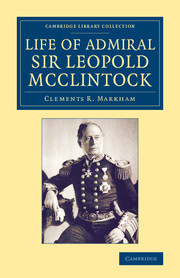
This biography of polar explorer Sir Leopold McClintock (his name is also spelled M'Clintock) was published in 1909 by his 'old messmate' Sir Clements Markham (1830–1916), later more famous as a historian. (Several works by both men have been reissued in the Cambridge Library Collection.) McClintock (1819–1907) gained experience of Arctic voyages on the expeditions of James Clark Ross and Edward Belcher, during which he undertook several arduous sledge journeys over the ice. In 1854, he took leave from the navy to command the Fox, a ship paid for by Lady Franklin to investigate the fate of her husband's expedition. He found the memorandum, written by his second-in-command, which confirmed Franklin's death in June 1847. McClintock was knighted for his services on his return, and he stayed in the navy, serving on different stations around the world, until his retirement with the rank of admiral in 1884.
Having urged political reforms in Britain, Richard Price (1723–91) turned to defending the cause of American independence. Born in Wales, Price became an influential moral philosopher, dissenting Protestant preacher, political pamphleteer, and economic theorist. Known for his trenchant defence of the freedom of the human will against philosophical sceptics, Price applied his justification of individual moral agency to political issues - particularly the American Revolution - during the latter part of his life. This tract on America first appeared in 1784. Defining the right of American colonists to oppose British corruption, it suggested that their independence would offer much 'benefit to the world'. But it also offered a relatively rare critique of the system of racial slavery that continued to develop in America. Reissued here is the 1785 publication that also contained translations from French of a letter to Price by the economist Turgot and a parody by Charles-Joseph Mathon de la Cour which had amused Benjamin Franklin.
In October 1854 the Taranaki Herald reported the return to New Zealand of Charles Hursthouse, who 'for years past has been in England the untiring advocate of New Zealand emigration, and by his writings and lectures has materially contributed to the colonization of the settlement'. In this updated 1861 version of his 1857 book, Hursthouse promises 'a fair and honest picture of New Zealand as she is today' and expresses his belief that thousands of struggling British people from all walks of life would be 'saved' by emigrating. He describes New Zealand's history, climate, natural history, population, government, exports and markets, agricultural pursuits and trades, and includes a revealing chapter on war and 'native policy'. Hursthouse explains his own reasons for emigrating, and provides practical advice on official regulations, travel insurance, choice of ship, the best times to sail and how to keep occupied during the voyage.
Basil Hall Chamberlain (1850–1935) first encountered Japan on a journey intended to promote the recovery of his health: he had suffered a nervous breakdown while working for Barings Bank. In May 1873, he arrived in Yokohama, and was immediately fascinated by traditional Japanese culture. The drive for modernisation had created a need for teachers of English, and Chamberlain was taken on as a tutor in the naval academy, at the same time studying the Japanese language to such good effect that in 1886 he was made professor of Japanese and philology of the Imperial University (later Tokyo University). This book, first published in 1890, and going into six editions over the next fifty years, is in the form of an encyclopaedia, with topics from 'abacus' to 'zoology'. It gives an affectionate account of aspects of Japanese culture which Chamberlain realised were disappearing under the relentless impact of Western influence.
This account by three American authors of one thousand years of exploration in the Arctic regions, culminating in the voyage and loss of the USS Polaris in 1872, was published in 1874. The work, which is derived from many earlier published accounts, begins with a short and highly sentimental biography of the famous American explorer Elisha Kane (whose own works are reissued in this series). It continues with the geography of the Arctic regions, and the voyages of the Vikings and early modern explorers, describing the activities of the whaling fleets as well as the oceanographic and scientific researches of the naval expeditions from many countries seeking the North-West Passage. This is a useful and readable synthesis, which ends with a stirring appeal to the British Admiralty to resume the work of polar exploration which had gone into decline after the end of the official search for Sir John Franklin.
Albert Hastings Markham (1841–1918) was the cousin of the subject of this biography, published in 1917, and greatly admired his older relative, who had acted as his mentor. Clements R. Markham (1830–1916) is remembered as a prolific writer on historical geography, many of whose works are reissued in the Cambridge Library Collection. As a boy, he showed great enthusiasm for both history and exploration, and after a chance encounter with an admiral, joined the navy as a cadet. After eight years, he determined to leave the service and pursue a career as an explorer and writer. His first expedition was to Peru, but his main interest was in the Arctic. As an active member of both the Royal Geographical Society and the Hakluyt Society, he both published accounts of early voyages and urged further exploration in the polar regions, including the 1901–4 Discovery expedition under Robert Scott.
Little is known about the life of Captain John Frederick Dennett, who published this compilation of travel narratives in 1826, with a second edition in 1835. A naval officer, he was clearly familiar with recent developments in polar exploration, but his writing also had an educational and moral purpose. 'It must be attended with advantage to become acquainted with the state of mankind in other parts of the world', but also it will be encouraging to the poor in Britain 'to find that the lowest state of comfort in this country is preferable to all the enjoyments within the reach of natives of other climes'. Emphasising encounters with native peoples rather than geographical or scientific discoveries, Dennett describes expeditions by Parry, Franklin and Sir John Ross in the Arctic seas and the Canadian north, and also includes a chapter on Giovanni Battista Belzoni's travels in Egypt and Nubia.
John Dundas Cochrane (1780–1825) was destined for the sea from an early age, but is best remembered as 'the Pedestrian Traveller'. At the end of the Napoleonic Wars, he set out on a six-year tour of France, Spain and Portugal on foot. When in 1820 the Admiralty turned down his offer to explore the river Niger, he decided instead to walk round the world via Russia, Siberia and North America. On his arrival in St Petersburg, the Russian government gave him money to continue his journey using sledges and canoes where necessary, but he abandoned it in Kamchatka, marrying a local woman and returning with her to England. This account of his travels was published in 1824 and was immediately popular, going into several editions. By no means a scientific survey, it is full of interesting anecdotes and observations about a then unknown and mysterious area of the world.
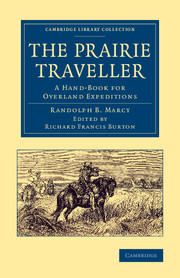
This work by Randolph B. Marcy (1812–87), who retired from the US Army as a brigadier general in 1881, was first published in 1859. Reissued here is the 1863 edition, edited with notes by the British explorer Sir Richard Burton (1821–90). The subtitle of the original edition describes it as A Hand-Book for Overland Expeditions, with Maps, Illustrations, and Itineraries of the Principal Routes between the Mississippi and the Pacific, and it was hugely influential, as an official US Government publication, in encouraging the great overland migrations which took European settlers to the American west. The book, based on Marcy's own experience of western travel, covers the routes to Oregon and California, the equipment needed, the treatment of animals, and the possibility of encounters with Native American tribes. This is a fascinating account of the practical steps necessary to enable emigrants to be self-reliant and to survive.
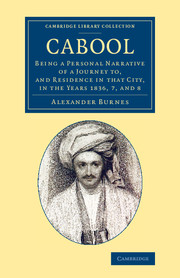
In the long and often disastrous history of British entanglement in Afghanistan, the name of Alexander Burnes (1805–41) deserves to be remembered. Aged sixteen, he went to India to take up a post in the army, and speedily learned both Hindustani and Persian. His skills led him to political work, and he himself proposed a covert expedition to Bukhara, to survey the country and to observe the expansionist activities of the Russians in central Asia. (Burnes' 1834 account of this journey is also reissued in this series.) In 1836, he was sent to Kabul, and became involved in the British plan to replace Dost Muhammad Khan with Shah Shuja (which he personally thought a mistake). The British became a focus of increasing local discontent, and in November 1841 Burnes was murdered in Kabul by a mob. This account of his stay in the city was published posthumously in 1842.