To save content items to your account,
please confirm that you agree to abide by our usage policies.
If this is the first time you use this feature, you will be asked to authorise Cambridge Core to connect with your account.
Find out more about saving content to .
To save content items to your Kindle, first ensure no-reply@cambridge.org
is added to your Approved Personal Document E-mail List under your Personal Document Settings
on the Manage Your Content and Devices page of your Amazon account. Then enter the ‘name’ part
of your Kindle email address below.
Find out more about saving to your Kindle.
Note you can select to save to either the @free.kindle.com or @kindle.com variations.
‘@free.kindle.com’ emails are free but can only be saved to your device when it is connected to wi-fi.
‘@kindle.com’ emails can be delivered even when you are not connected to wi-fi, but note that service fees apply.
Or, New Zealand and its Inhabitants, Illustrating the Origin, Manners, Customs, Mythology, Religion, Rites, Songs, Proverbs, Fables, and Language of the Natives
Reverend Richard Taylor (1805–1873) was an English missionary, who wrote extensively on Maori culture and the plant and animal life of New Zealand. Taylor graduated from Queens' College, Cambridge in 1828 and was ordained as an Anglican priest the same year. After serving as a curate in the Isle of Ely, Taylor was appointed as a missionary to New Zealand for the Church Missionary Society. He arrived in Australia in 1836 and landed in New Zealand in 1839. Taylor quickly became a peacekeeper between the different Maori tribes in his district. This volume, first published in 1855, provides a detailed account of Maori mythology and culture with a description of the plant life, animal life and geology of the North Island. Taylor strongly condemns contemporary (nineteenth-century) attitudes to Maori culture and demonstrates the complexity of their society in this sympathetic book.
Bernal Díaz del Castillo (1492–1584) was a foot soldier in the army of Mexico's conqueror Hernán Cortés. The first edition of his True History of the Conquest of New Spain (as it was entitled in a later English translation) was published in Madrid in 1632 from a manuscript copy sent to Spain shortly after the author's death. Written in a highly accessible style, and describing the experiences of the troops themselves, the work became even more successful than the official accounts and went through many editions and translations. The two-volume edition reissued here was first published in 1904 and is considered a more reliable text, as it was based on the original manuscript preserved in Guatemala City. Volume 1 contains an introduction by the editor, the influential Mexican historian and book-collector Genaro García (1867–1920), a table of variant readings, and chapters 1–139 of the text.
James Rennell (1742–1830) could be claimed as the father of historical geography. After a long career at sea and in India, during which he had learned surveying and cartography, he returned to England, and entered the circle of Sir Joseph Banks, who encouraged him to widen the his interests to include the geography of the ancient world. This two-volume work was published posthumously in 1831: Rennell had been working on the topic for many years, and had published a part of his findings in 1814, as Observations on the Topography of the Plain of Troy, also reissued in this series. The area covered in the treatise is a wide one, from Egypt to the Danube and from the Aegean to the Caspian Sea. In Volume 2, Rennell surveys the Greek and Roman territories of Asia Minor, and considers in detail the Roman road network of the area.
Major Dixon Denham (1786–1828) and Lieutenant Hugh Clapperton (1788–1827) were British explorers famous for their explorations in Africa. Between 1822 and 1825, they set out to investigate the lower course of the River Niger and the swamps and forests of the Guinea Coast, accompanied by the physician Dr Walter Oudney (1790–1824), who sadly died of a fever during the expedition. This important book, first published in 1826, brings together the memoirs of all three explorers to document their mission, which represented the first complete crossing of the Sahara by Europeans in recorded history. Diverse and insightful, it recounts phenomena such as the transportation of slaves from the Sudan, the salt industry in the heart of the desert, and encounters with native tribes. Providing unique insights into pre-colonial Africa, these vivid recollections remain of great interest to historians of Africa, cultural anthropologists and geographers alike.
James Grieve (1703–63), physician to Catherine the Great of Russia, and translator of this book, published posthumously in English in 1764, apologises in his 'Advertisement' for the crudeness and rambling nature of Stepan Krasheninnikov's original work, which nevertheless contains 'many very useful remarks, greatly contributing to the improvement of the trade, geography, and natural history, of the country he describes'. In 1755, Krasheninnikov (1711–55) had published his account of an expedition to Kamchatka between 1733 and 1743, under Vitus Bering, to increase knowledge of regions to the east, in particular whether a sea route to North America could be established. Krasheninnikov was to serve as a naturalist on the expedition, but he also took a keen interest in the geography, history and people of the lands he passed through. His narrative is a fascinating and detailed account of a huge area virtually unknown to the western world.
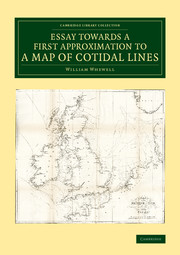
Cotidal lines are lines on a map which connect points at which the same tidal level occurs simultaneously. Isaac Newton had explained the movement of the tides by the action of the moon and sun, and Daniel Bernoulli had used Newton's findings to create tide tables for specific locations, but William Whewell wanted to take research further by gathering and analysing information which would link cotidal points or lines across the world. Fellow and eventually Master of Trinity College, Cambridge, Whewell (1794–1866) published this work in 1833. In it he proposes various observations that would need to be undertaken to produce a cotidal map, with detailed descriptions of the factors to be taken into account in computing the results. In 1837, Whewell, several of whose other works are also reissued in this series, was awarded a royal prize medal by the Royal Society for his work on 'tidology'.
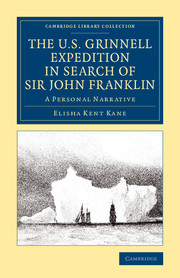
Dr Elisha Kane (1820–57), the most famous of American Arctic explorers before Peary, published this work in 1853. Having graduated from medical school, Kane joined the US Navy in 1843, and in 1850 was appointed senior medical officer on the expedition financed by the philanthropist Henry Grinnell to search for Sir John Franklin. Kane had departed on a second expedition while this book was in press, and he continued his Arctic travels, to the detriment of his health, until the year before his early death. In this work, Kane describes the origins of the expedition in the worldwide appeal by Lady Franklin, and, using his own journals, gives a vivid account of a winter spent icebound in the Arctic. Among the appendices is the official report of the expedition's commander, Lieutenant De Haven. Though Franklin's first winter camp was found, there were no further traces of his crew.
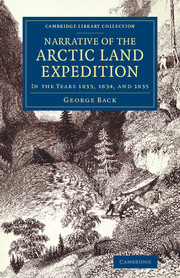
John Ross had disappeared while exploring the Northwest Passage in 1829. A lieutenant in the Royal Navy, George Back (1796–1878) had already served with John Franklin on two Arctic expeditions in 1819–22 and 1824–26. He volunteered to lead an expedition to find Ross, setting out in 1833. When Ross returned safely in 1834, Back continued his explorations down the unknown Great Fish River and mapped the Arctic coast westwards, travelling some 7,500 miles in total. Valuable observations on weather, geology, entomology, magnetics and aurora are included as appendices in this 1836 publication. Engravings of Back's own illustrations further enhance the narrative. Although described by some as an opportunist and a weak leader, Back was greeted as a hero on his return and awarded the gold medal of the Royal Geographical Society. The success of this expedition enabled him to head back to the Arctic in 1836.
When George William Rusden (1819–1903) was fourteen, his family emigrated from England to Australia, where he later became a prominent educationalist and civil servant. Already an author of numerous books and pamphlets, he began work on his History of Australia after his retirement, and it was published in 1883 in three volumes. Although the work is considered sympathetic to the Aboriginal people of Australia, it is also infused with Rusden's Tory politics, infuriating his critics – one wrote that the volumes were 'as untrustworthy as a partisan pamphlet well can be without deliberate dishonesty'. Despite initial criticism, these wide-ranging volumes form an important early contribution to the writing of Australian history. Volume 2 continues Rusden's examination of earlier governors, starting with Ralph Darling (1772–1858) and ending with George Gipps (1791–1847), before discussing immigration, the end of the practice of transporting prisoners, and the discovery of gold.
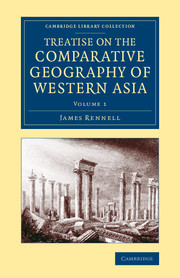
James Rennell (1742–1830) could be claimed as the father of historical geography. After a long career at sea and in India, during which he had learned surveying and cartography, he returned to England, and entered the circle of Sir Joseph Banks, who encouraged him to widen the his interests to include the geography of the ancient world. This two-volume work was published posthumously in 1831: Rennell had been working on the topic for many years, and had published a part of his findings in 1814, as Observations on the Topography of the Plain of Troy, also reissued in this series. The area covered in the treatise is a wide one, from Egypt to the Danube and from the Aegean to the Caspian Sea. In Volume 1, Rennell lays out his geographical findings, and begins to discuss the relations of the modern to the ancient world.
By the middle of the nineteenth century, the North-West Passage, a trade route from the Atlantic to the Pacific, had been sought for centuries without success. The Franklin expedition of 1845 became the latest victim, and Irish naval officer Sir Robert John Le Mesurier McClure (1807–73) took part in the attempts to ascertain its fate. His ship, H.M.S. Investigator, spent the years 1850–4 in the Arctic, and in the course of their search for the lost expedition, the crew discovered the North-West Passage. Upon his return to England, following the loss of the Investigator to pack ice, McClure handed over his journals to author and fellow officer Sherard Osborn (1822–75), who prepared this narrative of the pioneering expedition. First published in 1856, the work remains a compelling account of Arctic exploration, revealing how McClure and his men survived four forbidding winters.
In 1881, Adolphus Greely led a US Arctic expedition to gather meteorological, astronomical and magnetic data. It was poorly supported by the US Army, neither Greely nor his men had experience of Arctic conditions, and their ship, the Proteus, sailed home once they had landed in Greenland. An inadequately planned relief mission failed to reach them in 1882, and a second expedition in 1883, including the Proteus (which was crushed by ice), also failed to locate the men or to land sufficient supplies. This official report was published in 1884, and proposes a further rescue mission, much more carefully planned and equipped. It includes, as an appendix, detailed information about Arctic conditions and means of survival from the British naval explorers George Nares and Albert H. Markham. When eventually found, only seven of Greely's original team of twenty-five were still alive. Other accounts of the expeditions are also reissued in this series.