To save content items to your account,
please confirm that you agree to abide by our usage policies.
If this is the first time you use this feature, you will be asked to authorise Cambridge Core to connect with your account.
Find out more about saving content to .
To save content items to your Kindle, first ensure no-reply@cambridge.org
is added to your Approved Personal Document E-mail List under your Personal Document Settings
on the Manage Your Content and Devices page of your Amazon account. Then enter the ‘name’ part
of your Kindle email address below.
Find out more about saving to your Kindle.
Note you can select to save to either the @free.kindle.com or @kindle.com variations.
‘@free.kindle.com’ emails are free but can only be saved to your device when it is connected to wi-fi.
‘@kindle.com’ emails can be delivered even when you are not connected to wi-fi, but note that service fees apply.
Sir Clements R. Markham (1830–1916) had succumbed to smoke after accidentally igniting his bedclothes while reading by candlelight; the task of completing this history therefore fell to his friend and fellow geographer F. H. H. Guillemard (1852–1933), who published it in 1921. In the course of his long career, Markham had sailed to the Arctic in search of Sir John Franklin, jeopardised his job in the India Office by joining the British attempt to reach the North Pole in 1875–6, and served as president of the Royal Geographical Society, sending Robert Falcon Scott on his first expedition to Antarctica. His extensive knowledge of the prominent polar explorers and expeditions of his day lends this publication an especial interest and authority. Enhanced by a number of maps and illustrations, the book also considers certain scientific and economic developments, notably the growth of the whaling industry.
As first mate aboard an East India Company vessel, James Horsburgh (1762–1836) was shipwrecked in the Indian Ocean in 1786 after faulty charts steered the ship onto a reef. Thereafter he devoted himself to the production of accurate charts of the eastern seas, keeping meticulous notes on extensive voyages, and carefully scrutinising the accounts and journals of other mariners. For his efforts, Horsburgh was elected to the Royal Society in 1806, and appointed hydrographer to the East India Company in 1810. The present work, reissued here in its two-volume first edition of 1809–11, remained a standard navigational reference for half a century (it was aboard the Beagle during Darwin's famous voyage). For given locations, it provides a description of the area and landmarks, and lists prevailing winds and currents, as well as any navigational hazards. Volume 1 covers mostly places on the sailing route to India, via Brazil and the Cape of Good Hope.
Richard Hakluyt's 12-volume Principal Navigations Voyages Traffiques and Discoveries of the English Nation, originally published at the end of the sixteenth century, and reissued by the Cambridge Library Collection in the edition of 1903–5, was followed in 1625 by Hakluytus Posthumus or, Purchas his Pilgrimes, now reissued in a 20-volume edition published in 1905–7. When first published in four folio volumes, the work was the largest ever printed in England. An Anglican priest, Samuel Purchas (1577–1626) was a friend of Hakluyt, and based his great work in part on papers not published by Hakluyt before his death. As well as being a wide-ranging survey of world exploration, it is notable as an anti-Catholic polemic, and a justification of British settlement in North America. Volume 3 describes voyages sponsored by the East India Company, including those of David Middleton and the merchant Richard Cocks.
Following the mysterious disappearance of the La Pérouse expedition after it sailed out of Botany Bay in 1788, the French botanist Jacques-Julien Houtou de Labillardière (1755–1834) took part in the search that departed in 1791 from Brest in two ships, Recherche and Espérance. In the space of three years, the expedition's naturalists collected numerous specimens, with Labillardière focusing on Australian flora, but their missing countrymen were never found. Notwithstanding the later confiscation of the scientific collections by the British - Sir Joseph Banks helped to secure their return - Labillardière was able to publish this narrative to great acclaim in 1800. Reissued here is the English translation of the same year, complete with a volume of finely engraved plates. The work is especially notable for its descriptions and illustrations of the indigenous peoples of Australasia. This volume of illustrations contains more than forty plates depicting people, artefacts, plants and animals.
The Arctic explorer Sir John Richardson (1787–1865), who had accompanied both John Franklin and John Rae on major expeditions, expands here an article which had appeared in the Encyclopaedia Britannica. Organised in two parts, and published in 1861, this work covers first the Arctic and then the largely unexplored Antarctic. Adopting a chronological approach in the first part, Richardson covers Roman knowledge of the far north, Norse voyages, and later exploration by the British, Dutch and Russians. He then deals in detail with the search for the North-West Passage, including the expeditions in search of Sir John Franklin. Later chapters cover Spitsbergen, Arctic weather, ice, currents, geology, vegetation and zoology, as well as the three principal groups of native people: the Inuit, Lapps and Samoyeds. In the second part, Richardson outlines Antarctic exploration since 1576, providing an overview of what little was known of this part of the globe.
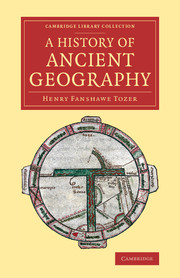
A pioneer in establishing the study of geography in British universities, Henry Fanshawe Tozer (1829–1916) sought to share his deep appreciation of the subject's ancient authorities, particularly Strabo. His keen understanding of historical geography rested on first-hand knowledge of physical landscapes, gained during travels through Italy, Greece and Turkey. While E. H. Bunbury had already produced an extensive work along similar lines, Tozer believed that classicists as well as other readers would welcome a more manageable, single-volume textbook. First published in 1897, it traces the progress of geographical writing in Greek and Latin from the Homeric age to the end of Rome's western empire. Due attention is given along the way to such writers as Hecataeus, Herodotus, Strabo and Ptolemy, with the inclusion of maps that show their respective conceptions of the world. The impact of conquest, notably by Alexander the Great and the Romans, is also highlighted.
The acclaimed Prussian naturalist Alexander von Humboldt (1769–1859) was referred to by Charles Darwin as 'the greatest scientific traveller who ever lived'. Several of his works were in the library aboard the Beagle, including the multi-volume Personal Narrative of Travels, two books on geology and Tableaux de la nature (all reissued in the Cambridge Library Collection). Darwin's copy of this two-volume 1811 New York edition of Humboldt's Political Essay (originally published in French earlier that year) is inscribed 'Buenos Ayres', suggesting he acquired it there in 1832–3, without its accompanying atlas (forthcoming). Humboldt had spent a year in Mexico in 1803–4, and was struck by its 'civilization' as compared to regions of South America that he had visited earlier on his expedition. Volume 1 of his account contains a 'geographical introduction' and discussions of physical geography, agriculture, and the ethnic diversity, distribution and health of the population.
Emily Eden's childhood prepared her well for her role as companion to her brother, the Governor-General of India. Outwardly all that a minor aristocrat should be, the observant and sharp-tongued Eden (1797–1869) never censored her letters for the sake of diplomacy. This two-volume collection of letters, edited by her niece Eleanor Eden, was published posthumously in 1872 after the success of her 1866 collection, Up the Country (also reissued in this series). In Volume 2, which also contains several letters from Emily's sister Frances (1801–49), the round of engagements, days in an opulent houseboat, and biting observations on Anglo-Indian society, continue, but the generally cheerful tone begins to darken: 'It is very odd that no letters whatever have come from Cabul for three weeks, but the reports are all favourable' she notes, at the outset of the disastrous Anglo-Afghan War, which led to her brother's dismissal from India.
Much of eastern England is below sea level, resulting in wide swathes of marshland that are easily flooded. In the seventeenth century, the Bedford Level Corporation was set up by Francis Russell, fourth earl of Bedford, in order to manage the drainage of the Great Level of the Fens, which became known as the Bedford Level and is the largest region of fenland in eastern England. Between 1828 and 1830, Samuel Wells, the corporation's registrar, published his well-documented history of the Bedford Level and the attempts made at various points to clear it of water using a variety of methods, from earthworks raised by the Romans to the strategies of Sir Cornelius Vermuyden and the eventual introduction of steam-powered technology. Volume 1, published in 1830, contains a historical account of the area and of the commission set up to address the perennial problem of flooding.
The Nautical Magazine first appeared in 1832, and was published monthly well into the twenty-first century. It covers a wide range of subjects, including navigation, meteorology, technology and safety. An important resource for maritime historians, it also includes reports on military and scientific expeditions and on current affairs. Under new editorship from 1871, the magazine grew substantially in length; the 1872 volume was the first to exceed 1,000 pages. Part 2 includes 'the first Christmas number', which is made up of several short stories and poems by popular writers, introduced by a promotional note mentioning that the circulation had quadrupled during the year. Poetry and fiction regularly appear, alongside other recently introduced material such as reports from learned societies, government departments and court cases, but the magazine also continues to report on steam technology, weather, wrecks and salvage, and distant regions such as Africa and Iceland.
Richard Hakluyt's 12-volume Principal Navigations Voyages Traffiques and Discoveries of the English Nation, originally published at the end of the sixteenth century, and reissued by the Cambridge Library Collection in the edition of 1903–5, was followed in 1625 by Hakluytus Posthumus or, Purchas his Pilgrimes, now reissued in a 20-volume edition published in 1905–7. When first published in four folio volumes, the work was the largest ever printed in England. An Anglican priest, Samuel Purchas (1577–1626) was a friend of Hakluyt, and based his great work in part on papers not published by Hakluyt before his death. As well as being a wide-ranging survey of world exploration, it is notable as an anti-Catholic polemic, and a justification of British settlement in North America. Volume 13 includes voyages to the north-east and Siberia, the travels of Henry Hudson, a history of Iceland, and a journey to the Crimea.
During the 1890s Elliott Coues (1842–1899), one of America's greatest ornithologists, edited several exploration narratives about the American Northwest, including Lewis and Clark's Travels. Coues tracked down the manuscript journals of two of Lewis and Clark's contemporaries, fur trader Alexander Henry (1765–1814) and geographer David Thompson (1770–1857), employees of the Northwest Company. Coues' abridged and edited version of Henry's text, accompanied by notes that draw heavily on Thompson's scientific records, appeared in 1897 in three volumes; in this reissue the index volume is included in Volume 2. Despite the deep prejudice evident in Henry's writing, Coues judged it a reliable account of his unscrupulous business dealings, and of the harsh realities he observed among many different First Nations peoples. Volume 1 covers the period from 1799 to 1808, when Henry travelled along the Red River and set up the Pembina River trading post.
Richard Hakluyt's 12-volume Principal Navigations Voyages Traffiques and Discoveries of the English Nation, originally published at the end of the sixteenth century, and reissued by the Cambridge Library Collection in the edition of 1903–5, was followed in 1625 by Hakluytus Posthumus or, Purchas his Pilgrimes, now reissued in a 20-volume edition published in 1905–7. When first published in four folio volumes, the work was the largest ever printed in England. An Anglican priest, Samuel Purchas (1577–1626) was a friend of Hakluyt, and based his great work in part on papers not published by Hakluyt before his death. As well as being a wide-ranging survey of world exploration, it is notable as an anti-Catholic polemic, and a justification of British settlement in North America. Volume 17 concentrates on South America, with a voyage through the Straits of Magellan, the conquest of Peru, and historical material on the Incas.
As a Reference to Nichols, Priestley and Walker's New Map of Inland Navigation, Derived from Original and Parliamentary Documents in the Possession of Joseph Priestley, Esq.
This account of the waterways and railways of Great Britain covers those transport routes and systems of inland navigation that had been completed or were in construction at the time of publication in 1831. Not to be confused with his polymath namesake, Joseph Priestley (1766–1852) entrenched his expertise as manager of the Aire and Calder Navigation. Here he provides alphabetical entries ranging from the Aberdare Canal in Glamorganshire to the Wyrley and Essington Canal in the Midlands. Details are given regarding location, construction, relevant Acts of Parliament, and even tonnage rates. Published to accompany a huge map of British inland navigation (a smaller version is featured here as the frontispiece), the book became a standard reference work in its day. Shedding light on the development of commercially crucial infrastructure, it remains valuable to readers and researchers interested in the history of British transport and technology.
Richard Hakluyt's 12-volume Principal Navigations Voyages Traffiques and Discoveries of the English Nation, originally published at the end of the sixteenth century, and reissued by the Cambridge Library Collection in the edition of 1903–5, was followed in 1625 by Hakluytus Posthumus or, Purchas his Pilgrimes, now reissued in a 20-volume edition published in 1905–7. When first published in four folio volumes, the work was the largest ever printed in England. An Anglican priest, Samuel Purchas (1577–1626) was a friend of Hakluyt, and based his great work in part on papers not published by Hakluyt before his death. As well as being a wide-ranging survey of world exploration, it is notable as an anti-Catholic polemic, and a justification of British settlement in North America. Volume 1 considers ancient exploration, beginning with the navy of King Solomon, and moving to the classical period, before discussing the world's religions.
Much of eastern England is below sea level, resulting in wide swathes of marshland that are easily flooded. In the seventeenth century, the Bedford Level Corporation was set up by Francis Russell, fourth earl of Bedford, in order to manage the drainage of the Great Level of the Fens, which became known as the Bedford Level and is the largest region of fenland in eastern England. Between 1828 and 1830, Samuel Wells, the corporation's registrar, published his well-documented history of the Bedford Level and the attempts made at various points to clear it of water using a variety of methods, from earthworks raised by the Romans to the strategies of Sir Cornelius Vermuyden and the eventual introduction of steam-powered technology. Volume 2, published in 1828, contains the necessary documents and appendices for the proper understanding of Volume 1, which appeared two years later.
Thomas Southey (1777–1838) joined the navy at the age of twelve, saw action during the French Revolutionary Wars, and was first posted to the West Indies in early 1804. Promoted to captain in 1811 and later employed as a customs officer, he died on the voyage home from his last posting in Demerara. His only book, published in 1827, is dedicated to his older brother, Robert, a Romantic poet, who also wrote on historical subjects (his books on Nelson, the Duke of Wellington, and Brazil are also available in the Cambridge Library Collection). Thomas's three-volume work draws on extensive reading, with substantial passages quoted verbatim from his sources. He concludes that the history of the West Indies presents 'little more than a melancholy series of calamities and crimes', but commends the British government's efforts to put an end to slavery. Volume 2 covers the period from 1655 to 1783.