To save content items to your account,
please confirm that you agree to abide by our usage policies.
If this is the first time you use this feature, you will be asked to authorise Cambridge Core to connect with your account.
Find out more about saving content to .
To save content items to your Kindle, first ensure no-reply@cambridge.org
is added to your Approved Personal Document E-mail List under your Personal Document Settings
on the Manage Your Content and Devices page of your Amazon account. Then enter the ‘name’ part
of your Kindle email address below.
Find out more about saving to your Kindle.
Note you can select to save to either the @free.kindle.com or @kindle.com variations.
‘@free.kindle.com’ emails are free but can only be saved to your device when it is connected to wi-fi.
‘@kindle.com’ emails can be delivered even when you are not connected to wi-fi, but note that service fees apply.
The Nautical Magazine first appeared in 1832, and was published monthly well into the twenty-first century. It covers a wide range of subjects, including navigation, meteorology, technology and safety. An important resource for maritime historians, it also includes reports on military and scientific expeditions and on current affairs. The 1871 volume, beginning a 'new series' under a new editor, opens by announcing certain changes to the magazine 'to bring it more into harmony with the spirit of this advancing age … enlarging its usefulness' so as to be 'a means of adding to the honour and prosperity of England, and to the welfare of humanity at large'. Hydrography and navigation would continue to be prominent, but leisure reading would also feature. Other new departures include substantial articles analysing topics relating to a planned Shipping Bill, reports of the meetings of learned societies, and regular articles on competitive yachting and rowing.
The Nautical Magazine first appeared in 1832, and was published monthly well into the twenty-first century. It covers a wide range of subjects, including navigation, meteorology, technology and safety. An important resource for maritime historians, it also includes reports on military and scientific expeditions and on current affairs. The 1875 volume is again dominated by reports on the Merchant Shipping Bill and debates on seaworthiness, with the editor continuing to prefer 'personal responsibility' to 'Plimsolecisms' and 'grandmotherly supervision' by the government. Serials focus on the economies of the British colonies, Atlantic shipping lines and emigration to South America, but fiction no longer features. Other topics include the opening of the Royal Naval Museum at Greenwich, innovations such as steel hawsers and desalination apparatus for producing drinking water, a proposal for generating power from wave action, and suggestions for using rats as a tasty and economical food source.
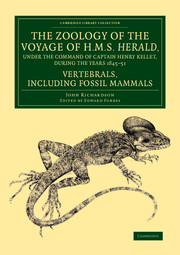
Naval surgeon, Arctic explorer and natural historian, Sir John Richardson (1787–1865) published many works, several of which are reissued in the Cambridge Library Collection, notably the four-volume Fauna Boreali-Americana. At the Haslar Royal Naval Hospital, where he worked towards the end of his career, Richardson built up a library and museum that became renowned for natural history research. His published work was fuelled by his own voyages and the specimens sent back from other expeditions, as was the case for this illustrated work, completed in 1854. Richardson describes the zoological specimens collected during the 1845–51 voyage of the survey ship H.M.S. Herald, which had sailed into Arctic seas and took part in the search for Sir John Franklin. The collected fauna include fossil mammals from the ice cliffs at Eschscholtz Bay in Alaska, first discovered in 1816 by Otto von Kotzebue and his naturalists.
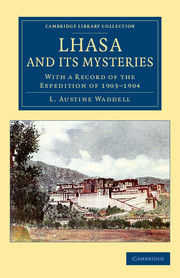
A successful officer in the colonial Indian Medical Service, Glasgow-educated Laurence Austine Waddell (1854–1938) was fascinated by the landscapes and cultures of Darjeeling and Tibet, studied local languages, and spent his leisure time researching and writing on Tibetan topics. His earlier books The Buddhism of Tibet (1895) and Among the Himalayas (1899) are also reissued in the Cambridge Library Collection. Waddell had attempted to enter Lhasa (then closed to foreigners) in disguise in 1892, but did not succeed until he accompanied the controversial British expedition to Tibet in 1903–4; he describes his arrival there as 'the realisation of a vivid and long-cherished dream'. His eyewitness account of how the 'peaceful mission' became an 'invasion' occupies the first half of this 1905 publication. The later chapters vividly portray the city and its inhabitants. The book includes more than a hundred of Waddell's own photographs, as well as maps and line drawings.
Nathaniel Parker Willis (1806–67) came from a publishing family and began his writing career with contributions to magazines. He also wrote poetry and plays but is best remembered as a travel writer. In this two-volume work of 1840, his contribution (described on the title page as 'the literary department') was to provide a narrative for prints from the engravings of William Henry Bartlett (1809–54), the famous British landscape artist, who followed already established tourist routes in the United States to make his drawings. Each of Bartlett's 119 engravings is accompanied by a short essay by Willis, who states in the preface that it is his intention to bring to the reader at home 'at small cost' the sensations of travel which 'those whose lot is domestic and retired' would never be in a position to experience for themselves. The extremely popular work remained in print for thirty years.
Although the author Anthony Trollope (1815–82) enjoyed great success as a novelist, he was also an eager and perceptive travel writer. In this account of his voyage to the West Indies and Central America, published in 1859, he recounts the many places he visited, including Jamaica, Cuba, Barbados, Trinidad, Panama and Costa Rica. Trollope brings his eye for detail to these islands at an important time: slavery had been abolished in the British colonies, but persisted in Cuba, and he depicts this complex region and its people with all the vividness of his novels. Though sometimes reflecting the beliefs and prejudices of the Victorian period, the work remains essential and engaging reading for those interested in the nineteenth-century Caribbean. Trollope's writings on North America and on Australia and New Zealand are also reissued in the Cambridge Library Collection.
The Nautical Magazine first appeared in 1832, and was published monthly well into the twenty-first century. It covers a wide range of subjects, including navigation, meteorology, technology and safety. An important resource for maritime historians, it also includes reports on military and scientific expeditions and on current affairs. The 1874 volume continues the previous year's attacks on attempts by Samuel Plimsoll to introduce seaworthiness inspections and other safety regulations, arguing for 'individual responsibility' rather than 'maternal interference by the State in the business concerns of daily life'. In addition to covering these debates, this volume concludes the series of articles on 'great ports' and begins one on 'our colonies'. It also contains the latest statistics on shipbuilding, substantial updates on steam technology, notes on a fascinating selection of court cases, and a song claimed to be highly effective in teaching trainee seamen the 'rule of the road at sea'.
Richard Hakluyt's 12-volume Principal Navigations Voyages Traffiques and Discoveries of the English Nation, originally published at the end of the sixteenth century, and reissued by the Cambridge Library Collection in the edition of 1903–5, was followed in 1625 by Hakluytus Posthumus or, Purchas his Pilgrimes, now reissued in a 20-volume edition published in 1905–7. When first published in four folio volumes, the work was the largest ever printed in England. An Anglican priest, Samuel Purchas (1577–1626) was a friend of Hakluyt, and based his great work in part on papers not published by Hakluyt before his death. As well as being a wide-ranging survey of world exploration, it is notable as an anti-Catholic polemic, and a justification of British settlement in North America. Volume 2 covers the first circumnavigations, including those of Magellan and the Dutchmen Noort and Spilbergen, and the founding of the East India Company.
The botanist and explorer John Bartram (1699–1777) is regarded as having created the first true botanical collection in North America. Alongside Benjamin Franklin, he was also in 1743 a founding member of the American Philosophical Society. In the summer of the same year, he set out from Philadelphia on an expedition through Iroquois lands. Published in London in 1751 through the efforts of Bartram's correspondent and fellow botanist Peter Collinson, this short work chronicles the six-week journey, offering an important early insight into the region's ecology. As well as providing observations on flora, fauna and geography, Bartram includes insightful descriptions of the activities of the Native American population. The expedition members were able to travel further than was previously possible owing to the participation of the agent and interpreter Conrad Weiser, who had earned the respect of the Iroquois. The work concludes with a brief description of Niagara Falls by the naturalist Peter Kalm.
Laurence Austine Waddell (1854–1938) spent twenty-five years as a medical officer in the colonial Indian Medical Service. Fascinated by the landscapes and cultures of Darjeeling and Tibet, and inspired by reports from British spies surveying the remote Himalayan valleys, Waddell studied local languages, and spent his leisure time researching and writing on Tibetan topics. His books The Buddhism of Tibet (1895) and Lhasa and its Mysteries (1905) are also reissued in the Cambridge Library Collection. This 1899 publication, illustrated with photographs and drawings, claims to describe 'the grandest part of the grandest mountains in the world', for the first time since Hooker (whose 1854 Himalayan Journals are also reissued), and anticipates today's trekking industry. Waddell's colourful account of jungles, snakes, glaciers, yaks, dizzying mountain ridges, rickety bamboo bridges, tribal peoples and unfamiliar food aims to 'bring home to the reader a whiff of the bracing breezes of the Himalayas'.
Richard Hakluyt's 12-volume Principal Navigations Voyages Traffiques and Discoveries of the English Nation, originally published at the end of the sixteenth century, and reissued by the Cambridge Library Collection in the edition of 1903–5, was followed in 1625 by Hakluytus Posthumus or, Purchas his Pilgrimes, now reissued in a 20-volume edition published in 1905–7. When first published in four folio volumes, the work was the largest ever printed in England. An Anglican priest, Samuel Purchas (1577–1626) was a friend of Hakluyt, and based his great work in part on papers not published by Hakluyt before his death. As well as being a wide-ranging survey of world exploration, it is notable as an anti-Catholic polemic, and a justification of British settlement in North America. Volume 15 focuses on the West Indies, Mexico, and 'New Spain', and especially on the narratives of José de Acosta.
Richard Hakluyt's 12-volume Principal Navigations Voyages Traffiques and Discoveries of the English Nation, originally published at the end of the sixteenth century, and reissued by the Cambridge Library Collection in the edition of 1903–5, was followed in 1625 by Hakluytus Posthumus or, Purchas his Pilgrimes, now reissued in a 20-volume edition published in 1905–7. When first published in four folio volumes, the work was the largest ever printed in England. An Anglican priest, Samuel Purchas (1577–1626) was a friend of Hakluyt, and based his great work in part on papers not published by Hakluyt before his death. As well as being a wide-ranging survey of world exploration, it is notable as an anti-Catholic polemic, and a justification of British settlement in North America. Volume 14 describes voyages to Greenland, Scandinavia and Russia (including a journey of two Cossacks to China), and begins an account of the West Indies.
The Nautical Magazine first appeared in 1832, and was published monthly well into the twenty-first century. It covers a wide range of subjects, including navigation, meteorology, technology and safety. An important resource for maritime historians, it also includes reports on military and scientific expeditions and on current affairs. The exceptionally long volume for 1876 devotes much space to the Merchant Shipping Act of that year, and to other legal matters including the recent history of legislation relating to merchant ships, rules for the loading of cargos, and the prevention of collisions at sea. It contains statistics on the year's shipbuilding activity, details of the fleets of several Atlantic shipping lines, and discussion of the recruitment, health and pensions of sailors. Other topics covered include the Suez Canal, Nares' Arctic expedition, the exhibition of scientific apparatus in Kensington, proposals for a Channel tunnel and railway, and solar steam generation.
Richard Hakluyt's 12-volume Principal Navigations Voyages Traffiques and Discoveries of the English Nation, originally published at the end of the sixteenth century, and reissued by the Cambridge Library Collection in the edition of 1903–5, was followed in 1625 by Hakluytus Posthumus or, Purchas his Pilgrimes, now reissued in a 20-volume edition published in 1905–7. When first published in four folio volumes, the work was the largest ever printed in England. An Anglican priest, Samuel Purchas (1577–1626) was a friend of Hakluyt, and based his great work in part on papers not published by Hakluyt before his death. As well as being a wide-ranging survey of world exploration, it is notable as an anti-Catholic polemic, and a justification of British settlement in North America. Volume 19 continues with British exploration and settlement in North America, including Newfoundland and the colonies of Jamestown and Plymouth.
Richard Hakluyt's 12-volume Principal Navigations Voyages Traffiques and Discoveries of the English Nation, originally published at the end of the sixteenth century, and reissued by the Cambridge Library Collection in the edition of 1903–5, was followed in 1625 by Hakluytus Posthumus or, Purchas his Pilgrimes, now reissued in a 20-volume edition published in 1905–7. When first published in four folio volumes, the work was the largest ever printed in England. An Anglican priest, Samuel Purchas (1577–1626) was a friend of Hakluyt, and based his great work in part on papers not published by Hakluyt before his death. As well as being a wide-ranging survey of world exploration, it is notable as an anti-Catholic polemic, and a justification of British settlement in North America. Volume 9 deals with travels throughout the Ottoman empire, including Egypt, and overland journeys to India, together with translations of Arabic books of geography.
A Benedictine scholar and naturalist, Antoine-Joseph Pernety (1716–96) produced this early and invaluable description of the natural history of the Falkland Islands (or isles Malouines). He had arrived there as part of the 1763–4 expedition led by Louis-Antoine de Bougainville, claiming the islands for France. A small colony was established, allowing Pernety to provide an account of an ecosystem as yet unaffected by a human population. He spent some months studying the landscape, flora, fauna and climate, and his observations and drawings were published in these two volumes in 1770 (a one-volume English translation of 1771 is also reissued in this series). Additional material from other voyages, to Patagonia and the Straits of Magellan, provides information on contact with indigenous peoples in South America. Volume 1 discusses the inspiration behind the 1763–4 expedition, detailing the journey itself before continuing to an in-depth study of the natural history of the Falklands.
The Nautical Magazine first appeared in 1832, and was published monthly well into the twenty-first century. It covers a wide range of subjects, including navigation, meteorology, technology and safety. An important resource for maritime historians, it also includes reports on military and scientific expeditions and on current affairs. The volume for 1873 continues the new policy of reporting on learned societies and legal matters. Technical aspects of iron ships, steam engines and lifeboats feature prominently, and scientific discussions cover the polar regions, the transit of Venus, and tsunamis. A series of articles describes 'our great ports', including Liverpool, Newcastle, Dublin and Southampton. However, the volume is dominated by an increasingly scathing editorial response to Samuel Plimsoll's proposed legislation against unseaworthiness and overloading, while Lloyds of London's new rule of freeboard is described as 'a dead imposition on shipowners and of no real benefit to the sailor'.
Richard Hakluyt's 12-volume Principal Navigations Voyages Traffiques and Discoveries of the English Nation, originally published at the end of the sixteenth century, and reissued by the Cambridge Library Collection in the edition of 1903–5, was followed in 1625 by Hakluytus Posthumus or, Purchas his Pilgrimes, now reissued in a 20-volume edition published in 1905–7. When first published in four folio volumes, the work was the largest ever printed in England. An Anglican priest, Samuel Purchas (1577–1626) was a friend of Hakluyt, and based his great work in part on papers not published by Hakluyt before his death. As well as being a wide-ranging survey of world exploration, it is notable as an anti-Catholic polemic, and a justification of British settlement in North America. Volume 12 contains Anthony Jenkinson's account of Russia, and narratives on China, Japan and the Philippines, by both merchants and Jesuit missionaries.
The H.M.S. Investigator spent the years 1850–4 in the Western Arctic engaged in a search for the lost expedition of the explorer Sir John Franklin. In this 1857 publication Alexander Armstrong (1818–99), surgeon and naturalist to the ship, gives a first-hand account of life on board during the voyage, as testimony to the 'heroism, devotion, and endurance' of his shipmates. He describes the harsh conditions that the crew had to endure, and argues convincingly that no travel 'more thoroughly tests man's powers of endurance, both morally and physically' than travelling in the Arctic. He also notes that lemon juice proved the most effective remedy against scurvy. Armstrong's natural history research was cut short when the ship was abandoned and his collections left behind, but he includes an appendix listing the animals and birds observed on the voyage, and the Arctic plants collected by a friend and colleague.
The publications of the Hakluyt Society (founded in 1846) made available edited (and sometimes translated) early accounts of exploration. The first series, which ran from 1847 to 1899, consists of 100 books containing published or previously unpublished works by authors from Christopher Columbus to Sir Francis Drake, and covering voyages to the New World, to China and Japan, to Russia and to Africa and India. Volumes 88–89 (1884) contain accounts of two captains' searches for a North-West Passage to Asia in 1631. Their explorations were beset by bad weather. Foxe circumnavigated Hudson's Bay before retreating, while James became ice-bound for the winter, losing several members of his crew before retuning to England a year after Foxe. No new attempts were made for another century, as their accounts of the harrowing conditions they endured discouraged further voyages of exploration for the desired trade route.