To save content items to your account,
please confirm that you agree to abide by our usage policies.
If this is the first time you use this feature, you will be asked to authorise Cambridge Core to connect with your account.
Find out more about saving content to .
To save content items to your Kindle, first ensure no-reply@cambridge.org
is added to your Approved Personal Document E-mail List under your Personal Document Settings
on the Manage Your Content and Devices page of your Amazon account. Then enter the ‘name’ part
of your Kindle email address below.
Find out more about saving to your Kindle.
Note you can select to save to either the @free.kindle.com or @kindle.com variations.
‘@free.kindle.com’ emails are free but can only be saved to your device when it is connected to wi-fi.
‘@kindle.com’ emails can be delivered even when you are not connected to wi-fi, but note that service fees apply.
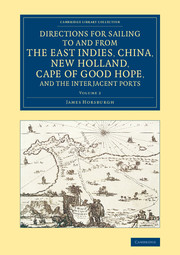
As first mate aboard an East India Company vessel, James Horsburgh (1762–1836) was shipwrecked in the Indian Ocean in 1786 after faulty charts steered the ship onto a reef. Thereafter he devoted himself to the production of accurate charts of the eastern seas, keeping meticulous notes on extensive voyages, and carefully scrutinising the accounts and journals of other mariners. For his efforts, Horsburgh was elected to the Royal Society in 1806, and appointed hydrographer to the East India Company in 1810. The present work, reissued here in its two-volume first edition of 1809–11, remained a standard navigational reference for half a century (it was aboard the Beagle during Darwin's famous voyage). For given locations, it provides a description of the area and landmarks, and lists prevailing winds and currents, as well as any navigational hazards. Volume 2 covers mainly the seas between India and China, including those around Indonesia and the Philippines.
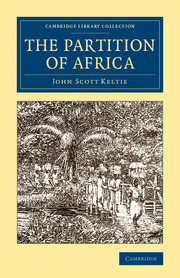
In the latter part of the nineteenth century, as technological progress enabled the exploration of hitherto neglected territory, the powers of Western Europe embarked on a process of imperial expansion into the African continent. As a journalist for The Times, geographer John Scott Keltie (1840–1927) wrote articles on the 'scramble' at the time, and in 1893 published this authoritative text on the subject, here reissued in its revised and augmented second edition of 1895. Keltie's presentation of the topic was well received and remained of lasting relevance, being described in his obituary as 'the best text-book of that exploration and division of a forgotten continent'. Early chapters address certain aspects of African history, but the bulk of the book deals with European attempts at settlement, partition and commercial exploitation. The future of Africa, as a site of ongoing European contention and competition, is also considered.
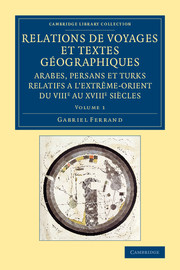
Gabriel Ferrand (1864–1935) travelled widely as a French diplomat and pursued scholarly passions as a polyglot orientalist. He served as consul to Madagascar and published several works about the island, noting the Arab influence that preceded the arrival of Europeans. A member of the Société Asiatique, and editor of its journal from 1920 until his death, Ferrand sought in particular to make Arabic geographical and nautical writings more accessible to fellow scholars and students. Forming part of that project, this work appeared in two volumes in 1913–14. It presents annotated French translations of mainly Arabic texts relating to the Far East. Brief biographical notes on the authors are given for the benefit of non-specialists. Volume 1 contains the preliminary matter explaining Ferrand's approach to transcription and translation. This is followed by texts up to the thirteenth century, including extracts from the ninth-century author Sulaiman al-Tajir.
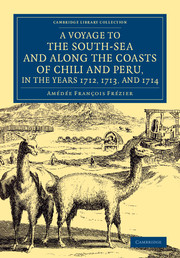
The first reliable maps of the Chilean and Peruvian coasts were drawn by the French explorer Amédée-François Frézier (1682–1773). In 1712, he was sent on a spying mission to the Spanish ports and fortifications of South America, travelling along the Pacific coastline as far as Callao, the port of Lima. His maps were later used by two of France's most famous explorers, Bougainville and Lapérouse. Frézier also took a keen interest in botany, mineralogy, economics and anthropology. His most celebrated achievement is the introduction to Europe of the Chilean strawberry, which was used to create the hybrid species known today as the garden strawberry. Frézier's observations and illustrations of the people, plants and animals he encountered on his South American travels are given in this popular account, published in Paris in 1716 and reissued here in the English translation of 1717.
Richard Hakluyt's 12-volume Principal Navigations Voyages Traffiques and Discoveries of the English Nation, originally published at the end of the sixteenth century, and reissued by the Cambridge Library Collection in the edition of 1903–5, was followed in 1625 by Hakluytus Posthumus or, Purchas his Pilgrimes, now reissued in a 20-volume edition published in 1905–7. When first published in four folio volumes, the work was the largest ever printed in England. An Anglican priest, Samuel Purchas (1577–1626) was a friend of Hakluyt, and based his great work in part on papers not published by Hakluyt before his death. As well as being a wide-ranging survey of world exploration, it is notable as an anti-Catholic polemic, and a justification of British settlement in North America. Volume 7 describes expeditions to Ethiopia, and various pilgrimages to the Holy Land.
Emily Eden's childhood prepared her well for her role as companion to her brother, the Governor-General of India. Outwardly all that a minor aristocrat should be, the observant and sharp-tongued Eden (1797–1869) never censored her letters for the sake of diplomacy. This two-volume collection of letters, edited by her niece Eleanor Eden, was published posthumously in 1872 after the success of her 1866 collection, Up the Country (also reissued in this series). Volume 1 begins in England, with an account of preparations (including lessons in Hindi) for the voyage and subsequent seven-year stay in India, about which Emily was originally apprehensive. In spite of suffering from the heat (and from considerable boredom at her formal duties as Lord Auckland's hostess) she produces a series of light-hearted and engaging letters to friends and family, from 'At Sea, Nowhere in Particular' to the Governor-General's palatial residence in Calcutta.
A Benedictine scholar and naturalist, Antoine-Joseph Pernety (1716–96) produced this early and invaluable description of the natural history of the Falkland Islands (or isles Malouines). He had arrived there as part of the 1763–4 expedition led by Louis-Antoine de Bougainville, claiming the islands for France. A small colony was established, allowing Pernety to provide an account of an ecosystem as yet unaffected by a human population. He spent some months studying the landscape, flora, fauna and climate, and his observations and drawings were published in these two volumes in 1770 (a one-volume English translation of 1771 is also reissued in this series). Additional material from other voyages, to Patagonia and the Straits of Magellan, provides information on contact with indigenous peoples in South America. Volume 2 includes this material from other authors. A series of detailed maps and drawings conclude the volume.
A Narrative of the Search for Lieut-Commander De Long and his Companions, Followed by an Account of the Greely Relief Expedition and a Proposed Method of Reaching the North Pole
George W. Melville (1841–1912) was a member of an 1879 American Arctic expedition seeking a northern passage from the Bering Strait to the Atlantic. Its ship was trapped in ice for nearly two years, and was eventually crushed and sank. The crew, stranded in three small boats, were left with few provisions and little hope of rescue. Melville was the only boat commander to bring his men to safety, assuming leadership of the survivors after landing in Siberia in 1881. He returned to search for other survivors, trekking over a thousand miles, but found only the bodies of his former companions in a frozen campsite, from which, however, he recovered the expedition's records. This account also includes details of Melville's role in the Greely Relief Expedition of 1884, from which he returned shortly before the book's British publication in 1885, and a detailed proposal for reaching the North Pole.
The acclaimed Prussian naturalist Alexander von Humboldt (1769–1859) was referred to by Charles Darwin as 'the greatest scientific traveller who ever lived'. Several of his works were in the library aboard the Beagle, including the multi-volume Personal Narrative of Travels, two books on geology and Tableaux de la nature (all reissued in the Cambridge Library Collection). Darwin's copy of this two-volume 1811 New York edition of Humboldt's Political Essay (originally published in French earlier that year) is inscribed 'Buenos Ayres', suggesting he acquired it there in 1832–3, without its accompanying atlas (forthcoming). Humboldt had spent a year in Mexico in 1803–4, and was struck by its 'civilization' as compared to regions of South America that he had visited earlier on his expedition. Volume 2 of his account contains information about the population, language and key features of each district of Mexico, and about the country's agriculture.
Richard Hakluyt's 12-volume Principal Navigations Voyages Traffiques and Discoveries of the English Nation, originally published at the end of the sixteenth century, and reissued by the Cambridge Library Collection in the edition of 1903–5, was followed in 1625 by Hakluytus Posthumus or, Purchas his Pilgrimes, now reissued in a 20-volume edition published in 1905–7. When first published in four folio volumes, the work was the largest ever printed in England. An Anglican priest, Samuel Purchas (1577–1626) was a friend of Hakluyt, and based his great work in part on papers not published by Hakluyt before his death. As well as being a wide-ranging survey of world exploration, it is notable as an anti-Catholic polemic, and a justification of British settlement in North America. Volume 8 contains narratives of travel through Syria and Persia, including the story of Benjamin of Tudela, who visited Jewish communities in Europe and the Middle East.
This 1911 publication, translated from the French, vividly describes the varied hardships and satisfactions of Antarctic exploration and scientific research in the early twentieth century. Son of the famed neurologist, Jean-Baptiste Charcot (1867–1936) commanded the Pourquoi-Pas? on its hazardous journey into the ice-bound regions south of Cape Horn. Illustrated with numerous photographs, his journal entries provide a rich account of daily life aboard the ship and out on the ice, including encounters with seals and penguins, and Christmases gathered around a cardboard tree. Building on the advances made by previous expeditions, including his own on the Français (1903–5), Charcot and his men, ranging in their expertise from astronomy to zoology, set out to further push back the boundaries of the unknown 'for the honour of French science'. The precise mapping of more than a thousand miles of Antarctic coastline ranked as one of the expedition's foremost achievements.
The preface to this work describes how its authors, Charles Irby (1789–1845) and James Mangles (1786–1867), both officers in the Royal Navy, left England in 1816 for a tour of the continent. 'Curiosity at first, and an increasing admiration of antiquities as they advanced, carried them at length through several parts of the Levant.' On their return to England, interest in Egypt being at its height, they were persuaded to compile this book from their letters to friends and family at home, and had it privately printed in 1823. Their account begins in Cairo, whence they made a journey down the Nile, meeting with Giovanni Belzoni at Abu Simbel. They then travelled from Cairo across the desert and along the coast of the Holy Land, reaching Aleppo and exploring Syria. This detailed account of their two-year travels provides much information of continuing interest to archaeologists and historians.
Richard Hakluyt's 12-volume Principal Navigations Voyages Traffiques and Discoveries of the English Nation, originally published at the end of the sixteenth century, and reissued by the Cambridge Library Collection in the edition of 1903–5, was followed in 1625 by Hakluytus Posthumus or, Purchas his Pilgrimes, now reissued in a 20-volume edition published in 1905–7. When first published in four folio volumes, the work was the largest ever printed in England. An Anglican priest, Samuel Purchas (1577–1626) was a friend of Hakluyt, and based his great work in part on papers not published by Hakluyt before his death. As well as being a wide-ranging survey of world exploration, it is notable as an anti-Catholic polemic, and a justification of British settlement in North America. Volume 18 moves from South to North America, with accounts of French expeditions including that of Champlain, British planned colonies and John Smith's description of Virginia.
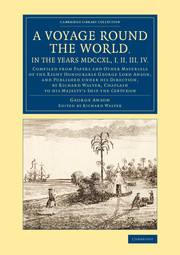
Compiled from Papers and Other Materials of the Right Honourable George Lord Anson, and Published under his Direction, by Richard Walter, Chaplain to his Majesty's Ship the Centurion
Compiled by the naval chaplain Richard Walter (1717–85), though the extent of his editorial contribution is not certain, this 1748 publication documents the extraordinary circumnavigation accomplished by the British naval officer George Anson (1697–1762) between 1740 and 1744. During the Anglo-Spanish conflict which Thomas Carlyle later described as the War of Jenkins' Ear, Anson was chosen to command a squadron to raid and plunder the Pacific coast of South America. After a delayed departure, the expedition struggled with terrible weather, rough seas and outbreaks of scurvy as it rounded Cape Horn. Hundreds of men were lost and eventually only the warship Centurion remained, badly battered and undermanned. Despite the disaster, the expedition became famous for its capture in 1743 of a Spanish treasure galleon laden with silver. Anson won much acclaim for this feat, and he entered into politics. This account, meanwhile, became a bestseller.
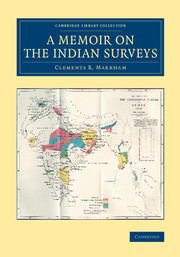
Sir Clements R. Markham (1830–1916), the doyen of historical geography in the late nineteenth century, published this comprehensive work on British surveys of India in 1871, at the request of the Indian Office. As he states in his preface, the object of his book is 'to furnish a general view of all the surveying and other geographical operations in India from their first commencement', so that there was a ready source of information on work already done, both for readers of current surveys and also for the surveyors themselves. Markham begins with the earliest European exploration of the Indian Ocean, including the earliest voyages of the East India Company. Systematic land surveying in India, begun by Major James Rennell, remained in military hands through the period of the trigonometric and topographical surveys, and Markham also covers the geological, archaeological and astronomical surveys of the subcontinent in the nineteenth century.
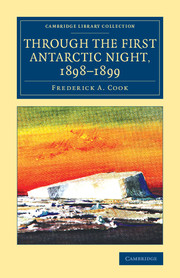
In this illustrated 1900 publication, Frederick Cook (1865–1940) gives a detailed account of his experiences on the Belgian Antarctic Expedition, the first to endure the harsh winter of the Antarctic. The goal of the expedition was scientific discovery, and Cook, the ship's doctor, tells an engaging story of 'new human experience in a new, inhuman world of ice'. Boarding the Belgica in Rio de Janeiro, he joined a crew that included Roald Amundsen, who would later lead a Norwegian expedition to the South Pole. Cook describes the challenging conditions in the Antarctic Circle, where the ship became ice-bound for almost a year, with over two months of total darkness. When crew members developed scurvy, Cook took over command from the Belgian naval officer Adrien de Gerlache. Notably, he helped save lives by promoting the consumption of penguin and seal meat at a time when Vitamin C had yet to be discovered.
Richard Hakluyt's 12-volume Principal Navigations Voyages Traffiques and Discoveries of the English Nation, originally published at the end of the sixteenth century, and reissued by the Cambridge Library Collection in the edition of 1903–5, was followed in 1625 by Hakluytus Posthumus or, Purchas his Pilgrimes, now reissued in a 20-volume edition published in 1905–7. When first published in four folio volumes, the work was the largest ever printed in England. An Anglican priest, Samuel Purchas (1577–1626) was a friend of Hakluyt, and based his great work in part on papers not published by Hakluyt before his death. As well as being a wide-ranging survey of world exploration, it is notable as an anti-Catholic polemic, and a justification of British settlement in North America. Volume 16 includes accounts of the West Indies, Puerto Rico, Guiana, and Brazil, and of the discovery of the river Amazon.
Following the mysterious disappearance of the La Pérouse expedition after it sailed out of Botany Bay in 1788, the French botanist Jacques-Julien Houtou de Labillardière (1755–1834) took part in the search that departed in 1791 from Brest in two ships, Recherche and Espérance. In the space of three years, the expedition's naturalists collected numerous specimens, with Labillardière focusing on Australian flora, but their missing countrymen were never found. Notwithstanding the later confiscation of the scientific collections by the British - Sir Joseph Banks helped to secure their return - Labillardière was able to publish this narrative to great acclaim in 1800. Reissued here is the English translation of the same year, complete with a volume of finely engraved plates. The work is especially notable for its descriptions and illustrations of the indigenous peoples of Australasia. Volume 1 covers the expedition from September 1791 through to January 1793, when it reached Tasmania.
Gabriel Ferrand (1864–1935) travelled widely as a French diplomat and pursued scholarly passions as a polyglot orientalist. He served as consul to Madagascar and published several works about the island, noting the Arab influence that preceded the arrival of Europeans. A member of the Société Asiatique, and editor of its journal from 1920 until his death, Ferrand sought in particular to make Arabic geographical and nautical writings more accessible to fellow scholars and students. Forming part of that project, this work appeared in two volumes in 1913–14. It presents annotated French translations of mainly Arabic texts relating to the Far East. Brief biographical notes on the authors are given for the benefit of non-specialists. Volume 2 contains texts from the thirteenth century onwards, and includes a section of translated extracts from Chinese, Japanese, Tamil, Kawi and Malay texts.
Richard Hakluyt's 12-volume Principal Navigations Voyages Traffiques and Discoveries of the English Nation, originally published at the end of the sixteenth century, and reissued by the Cambridge Library Collection in the edition of 1903–5, was followed in 1625 by Hakluytus Posthumus or, Purchas his Pilgrimes, now reissued in a 20-volume edition published in 1905–7. When first published in four folio volumes, the work was the largest ever printed in England. An Anglican priest, Samuel Purchas (1577–1626) was a friend of Hakluyt, and based his great work in part on papers not published by Hakluyt before his death. As well as being a wide-ranging survey of world exploration, it is notable as an anti-Catholic polemic, and a justification of British settlement in North America. Volume 5 includes accounts and journals describing voyages to the East Indies, and the rivalry between the British and the Dutch in the region.