To save content items to your account,
please confirm that you agree to abide by our usage policies.
If this is the first time you use this feature, you will be asked to authorise Cambridge Core to connect with your account.
Find out more about saving content to .
To save content items to your Kindle, first ensure no-reply@cambridge.org
is added to your Approved Personal Document E-mail List under your Personal Document Settings
on the Manage Your Content and Devices page of your Amazon account. Then enter the ‘name’ part
of your Kindle email address below.
Find out more about saving to your Kindle.
Note you can select to save to either the @free.kindle.com or @kindle.com variations.
‘@free.kindle.com’ emails are free but can only be saved to your device when it is connected to wi-fi.
‘@kindle.com’ emails can be delivered even when you are not connected to wi-fi, but note that service fees apply.
Commercial escitalopram oxalate crystallizes as a hydrated adduct with oxalic acid, in the space group P21 with a = 8.029897(21), b = 25.09397(6), c = 11.138930(31) Å, β = 106.7759(2)°, V = 2148.992(7) Å3, and Z = 4. The agreement of the Rietveld and previous single-crystal structures is excellent; the root-mean-square Cartesian displacements of the non-H atoms of the two independent cations are 0.076 and 0.067 Å, respectively. The water molecule refined to a slightly different position and occupancy. The pattern is included in the Powder Diffraction File™ (PDF®) as entry 00-064-1507.
The crystal structure of loteprednol etabonate Form II has been solved and refined using synchrotron X-ray powder diffraction data, and optimized using density functional techniques. Loteprednol etabonate Form II crystallizes in the space group P21 (#4) with a = 11.96312(6), b = 14.91862(5), c = 6.75715(3) Å, β = 94.1584(3)°, V = 1202.796(6) Å3, and Z = 2. The crystal structure is characterized by herringbone layers in the ab-plane. The anisotropic displacement ellipsoid of the Cl atom is not oriented in a way which corresponds to a chemically sensible motion of this atom. The sample suffered damage in the X-ray beam, probably involving photolysis of the C–Cl bond. The most prominent hydrogen bond is the O–H⋯O hydrogen bond between the hydroxyl group and the carbonyl group of the steroid A ring. This hydrogen bond links the molecules into C1,1(9) chains along the b-axis. The powder pattern is included in the Powder Diffraction File™ (PDF®) as entry 00-066-1602; this study will allow inclusion of the atomic coordinates to the PDF entry.
In the present work, LaNi0.5Ti0.45Co0.05O3, LaNi0.45Co0.05Ti0.5O3, and LaNi0.5Ti0.5O3 perovskites were synthesized by the modified Pechini method. These materials were characterized using X-ray fluorescence, scanning electron microscopy, and powder X-ray diffraction coupled to the Rietveld method. The crystal structure of these materials is orthorhombic, with space group Pbnm (No 62). The unit-cell parameters are a = 5.535(5) Å, b = 5.527(3) Å, c = 7.819(7) Å, V = 239.2(3) Å3, for the LaNi0.5Ti0.45Co0.05O3, a = 5.538(6) Å, b = 5.528(4) Å, c = 7.825(10) Å, V = 239.5(4) Å3, for the LaNi0.45Co0.05Ti0.5O3, and a = 5.540(2) Å, b = 5.5334(15) Å, c = 7.834(3) Å, V = 240.2(1) Å3, for the LaNi0.5Ti0.5O3.
Several benzothiophene-based compounds, including 1-benzothiophene-2-carboxylic acid, exhibit a wide variety of pharmacological activities. They have been extensively used to treat various types of diseases with high therapeutic effectiveness. In this contribution, the crystal structure of a new polymorph of 1-benzothiophene-2-carboxylic acid (BTCA) was determined from laboratory X-ray powder diffraction data with DASH, refined by the Rietveld method with TOPAS-Academic, and optimized using DFT-D calculations. The new form of 1-benzothiophene-2-carboxylic acid crystallizes in space group C2/c (No. 15) with a = 14.635(4), b = 5.8543(9), c = 19.347(3) Å, β = 103.95(1)°, V = 1608.8(6) Å3, and Z = 8. The structure is a complex 3D arrangement which can be described in terms of hydrogen-bonded dimers of BTCA molecules, joined by the acid–acid homosynthon, which interact through C–H⋯O hydrogen bonds to produce tapes further connected through head-to-tail π⋯π and edge-to-face C–H⋯π interactions. A comparison with a previously reported triclinic polymorph and with the related 1-benzofuran-2-carboxylic acid (BFCA) is also presented.
Pinaverium bromide (C26H41Br2NO4) is an active pharmaceutical ingredient (API) usually prescribed for the relief of spasm and functional gastrointestinal disorders. This work reports its powder diffraction data, Raman and FT-IR spectroscopy and thermal characterization. Indexing of the powder diffraction pattern showed this material crystallizes in a monoclinic unit cell with a = 16.00(4) Å, b = 8.901(2) Å, c = 19.225(4) Å, β = 98.68(3)°, and V = 2808.2(6) Å3.
X-ray powder diffraction data, unit-cell parameters, and space group for norethisterone enanthate, C27H38O3, are reported [a = 6.191(4) Å, b = 12.711(3) Å, c = 31.396(2) Å, α = 90°, β = 90°, γ = 90°, unit-cell volume V = 2471.16 Å3, Z = 4, ρcal = 1.104 g cm−3, and space group P212121]. All measured lines were indexed and are consistent with the P212121 space group. No detectable impurities were observed.
Severe COVID-19 cases place immediate pressure on hospital resources. To assess this, we analysed survival duration in the first 39 fatal cases in Wuhan, China. Time from onset and hospitalization to death declined rapidly, from ~40 to 7 days, and ~25 to 4 days, respectively, in the outbreak’s first month.
COVID-19 has challenged the mental health of healthcare workers confronting it world-wide. Our study identifies the prevalence and risk of anxiety among emergency healthcare workers confronting COVID-19 in Pakistan. We conducted a cross-sectional survey in an Emergency Department using the Generalized Anxiety Scale (GAD-7), and questions about sources of anxiety. Of 107 participants, 61.7% were frontline workers. The prevalence of anxiety was 50.5%. Nonparametric tests determined that nurses, younger and inexperienced staff, developed significant anxiety. Multivariate ordinal regression determined independent risk factors for developing anxiety were younger age (OR 2.11, 95% CI 0.89–4.99) and frontline placement (OR 1.34, 95% CI 0.33–1.66). Significant sources of stress were fear of infecting family (P = 0.003), lack of social support when the health care providers were themselves unwell (P = 0.02) and feelings of inadequate work performance (P = 0.05). Our study finds that HCWs’ anxiety is considerable. Appropriate measures for its alleviation and prevention are required.
The ten-item short form of the Autism-Spectrum Quotient (AQ-10) has been used to efficiently assess autistic traits in the general population; however, the psychometric properties of the AQ-10 in terms of its internal reliability and its unifactorial structure have recently been questioned. In the present study (N = 797), whether the internal reliability is increased when the AQ-10 is applied with six rather than the conventional four response categories has been investigated. Moreover, correlational and confirmatory factor analyses were conducted to examine the reason for potential inhomogeneity within the AQ-10. The results suggest that the internal reliability of the AQ-10 was slightly increased but is still unsatisfactory, likely due to the incompatibility of items from two subdimensions: attention to detail and imagination. With six of the AQ-10 items, crucial aspects of the autistic personality may be measured, but other important aspects would be neglected; thus, the measure requires further psychometric development.
Expansion of cultivated lands and field management impacts greenhouse gas (GHG) emissions from agriculture soils. Soils naturally cycle GHGs and can be sources or sinks depending on physical and chemical properties affected by cultivation and management status. We looked at how cultivation history influences GHG emissions from subtropical soils. We measured CO2, N2O, and CH4 fluxes, and soil properties from newly converted and continuously cultivated lands during the summer rainy season in calcareous soils from south Florida. Newly converted soils had more soil organic matter (OM), more moisture, higher porosity, and lower bulk density, leading to more GHG emissions compared to historically cultivated soils. Although more nutrients make newly converted lands more desirable for cultivation, conversion of new areas for agriculture was shown to release more GHGs than cultivated lands. Our data suggest that GHG emissions from agricultural soils may decrease over time with continued cultivation.
We created a new, 8-item scale called “Career Student Planning Scale (CSPS)” for a valid and reliable measure regarding college students’ career planning during a traumatic event, such as a pandemic. CSPS is conceptually similar to the career decision-making difficulty questionnaire (CDDQ) and the career decision self-efficacy (CDSE) scale. CSPS leans towards questions about college students’ perceptions about career planning, rather than intuitions about career decision-making; it also inquires about how participants conceptualize about their career plans to be correct, rather than the more extreme idea about how their intuitions are correct: we developed this scale to capture the latter construct. We included the coronavirus anxiety scale (CAS), CDDQ, the general procrastination scale (GPS), and the CDSE short form (CDSE-SF) as covariates to ensure that CSPS has distinct effects on their career paths. Our findings indicate the CSPS has acceptable psychometric properties and demonstrates a valuable input to those measures.
Recent work in structure–processing relationships of polymer semiconductors have demonstrated the versatility and control of thin-film microstructure offered by meniscus-guided coating (MGC) techniques. Here, we analyze the qualitative and quantitative aspects of solution shearing, a model MGC method, using coating blades augmented with arrays of pillars. The pillars induce local regions of high strain rates—both shear and extensional—not otherwise possible with unmodified blades, and we use fluid mechanical simulations to model and study a variety of pillar spacings and densities. We then perform a statistical analysis of 130 simulation variables to find correlations with three dependent variables of interest: thin-film degree of crystallinity and transistor field-effect mobilities for charge-transport parallel (μpara) and perpendicular (μperp) to the coating direction. Our study suggests that simple fluid mechanical models can reproduce substantive correlations between the induced fluid flow and important performance metrics, providing a methodology for optimizing blade design.
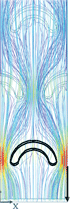
Blood-side resistance to oxygen transport in extracorporeal membrane blood oxygenators (MBO) depends on fluid mechanics governing the laminar flow in very narrow channels, particularly the hemodynamics controlling the cell free layer (CFL) built-up at solid/blood interfaces. The CFL thickness constitutes a barrier to oxygen transport from the membrane towards the erythrocytes. Interposing hemicylindrical CFL disruptors in animal blood flows inside rectangular microchannels, surrogate systems of MBO mimicking their hemodynamics, proved to be effective in reducing (ca. 20%) such thickness (desirable for MBO to increase oxygen transport rates to the erythrocytes). The blockage ratio (non-dimensional measure of the disruptor penetration into the flow) increase is also effective in reducing CFL thickness (ca. 10–20%), but at the cost of risking clot formation (undesirable for MBO) for disruptors with penetration lengths larger than their radius, due to large residence times of erythrocytes inside a low-velocity CFL formed at the disruptor/wall edge.
The use of natural pozzolans in concrete applications is gaining more attention because of the associated environmental, economic, and technical benefits. In this study, reference cemented mine backfill samples were prepared using Portland cement, and experimental samples were prepared by partially replacing Portland cement with 10 or 20 wt.% fly ash as a byproduct (artificial) pozzolan or pumice as a natural pozzolan. Samples were cured for 7, 14, and 28 days to investigate uniaxial compressive strength development. Backfill samples containing 10 wt.% pumice had almost a similar compressive strength as reference samples. There is strong potential for pumice to be used in cemented backfill to minimize costs, improve backfill properties, and promote the sustainability of the mining industry.