To save content items to your account,
please confirm that you agree to abide by our usage policies.
If this is the first time you use this feature, you will be asked to authorise Cambridge Core to connect with your account.
Find out more about saving content to .
To save content items to your Kindle, first ensure no-reply@cambridge.org
is added to your Approved Personal Document E-mail List under your Personal Document Settings
on the Manage Your Content and Devices page of your Amazon account. Then enter the ‘name’ part
of your Kindle email address below.
Find out more about saving to your Kindle.
Note you can select to save to either the @free.kindle.com or @kindle.com variations.
‘@free.kindle.com’ emails are free but can only be saved to your device when it is connected to wi-fi.
‘@kindle.com’ emails can be delivered even when you are not connected to wi-fi, but note that service fees apply.
CVD-coated cemented carbides are widely used for various metal cutting applications. It has been established that the textures of the coating materials especially that of the α-Al2O3 greatly affect the cut performance for some applications. The characterization of the coating texture is thus very important. In this paper, inverse pole figures of α-Al2O3 based on XRD with Bragg Brentano geometry were calculated for several metal cutting inserts available in the market. This method is simple, less time-consuming and can be applied to previously collected data and is compared with that of the EBSD. Despite several differences, IPF maps based on XRD powder diffraction represent the texture of metal cutting inserts.
Biotechnology has the potential to solve some of the biggest problems that contribute to local and global inequalities. Thus, it is imperative to increase the participation of diverse communities in the development, implementation and adoption of biotechnology. Biotechnology has been applied as long as we have domesticated plants and animals, produced cheese, yogurt, bread and alcoholic drinks. Today, it is being used in numerous disciplines including medicine, bioremediation, agriculture, energy and material production. Artists and designers have had a role in challenging research and its societal questions. Education must prepare individuals for a future of complex challenges providing creative problem-solving and critical thinking skill as well as the ability to innovate in a technology-driven world. Furthermore, teacher pedagogies should allow students and teachers to critically debate the political, ethical and social issues from the practice of biotechnology. This question invites a wide range of research contributions in which we identify, evaluate and speculate on the role that multidisciplinary education has on the future of biotech. We invite both experimental works on the latest methodologies in this area but also critique and reflection beyond the ‘hype’ of these, potentially transformative pedagogical approaches.
The 10-item Autism-Spectrum Quotient (AQ10) is a measure of autistic traits used in research and clinical practice. Recently, the AQ10 has garnered critical attention, with research questioning its psychometric properties and clinical cutoff value. To help inform the utility of the measure, we conducted the first network analysis of the AQ10, with a view to gain a better understanding of its individual items. Using a large dataset of 6,595 participants who had completed the AQ10, we found strongest inter-subscale connections between communication, imagination, and socially relevant items. The nodes with greatest centrality concerned theory of mind differences. Together, these findings align with cognitive explanations of autism and provide clues about which AQ10 items show greatest utility for informing autism-related clinical practice.
This chapter focus on describing the science and technology related to the use of UNCD films for fabricating MEMS and NEMS structures suitable for use in various devices for medical applications. Topics discussed include: 1) description of the materials science involved in the integration of UNCD films with dissimilar materials in film form, such as piezoelectric oxides, for development of piezo-actuated UNCD-based MEMS/NEMS, and integration with metal films for contacts, and biological matter (e.g., heart cells) for cell bit-induced mechanical deformation of piezo/UNCD cantilevers to generate power via the converse piezoelectric effect, whereby mechanical deformationof cantilevers is transduced into power generation, via mechanical displacement in opposite directions of + and - ions in the piezoelectric layer, thus voltage generation between two electrode layers sandwiching the piezoelectric layer for a new generation of biomedicalenergy generation devices and biosensors). Piezoelectric/UNCD integrated films-based MEMS/NEMS power generation device can power a new generation of defibrillator/pacemaker, eliminating relatively short live batteries in current devices.
This chapter focus on a description of pathways undertaken to transfer the UNCD film technology from the laboratory into the market, through Original Biomedical Implants (OBI-USA) and OBI-México, founded by O. Auciello and colleagues. Topics discussed in this chapter include: 1) Summary of regulatory pathways in different regions of the worldfor approval of medical devices and prostheses; 2) description of pathway to bring to the market a UNCD-coated microchip (artificial retina) implantable inside the eye to restore partial vision to blind people), 2) description of the process to bring to the market a new generation of long life superior performance UNCD-coated prostheses (artificial hips, knees, dental implants, and more); 3) description of pathway to bring into the market a novel retina reattachment process using combined UNCD-coated magnet outside the eye and injection of super-paramagnetic nanoparticles inside the eye, pushing the retina backon to the inner eye’ layer, when attracted by the magnetic field created by the external magnet.
This chapter focuses on a description of a novel UNCD film-based technology enabling a new generation of Li-ion batteries (LIB) with orders of magnitude longer stable specific capacity vs. charge/discharge cycles and safer performance than current devices, to power a new generation of miniaturized defibrillators/pacemakers to improve the quality of life of people receiving them.The UNCD film technology provides three new key components of the LIB, namely: 1) Electrically conductive Nitrogen atoms-grain boundary incorporated ultrananocrystalline diamond (N-UNCD) films encapsulating natural graphite (NG)/copper composite LIB anodes, providing order of magnitude superior cycle performance and capacity retention than for NG/Cu anodes (the N-UNCD layer suppresses reactions of NG with the electrolyte and the development of insulating solid-electrolyte-interphase (SEI) on the anode, which retards anode conductivity and induces stresses, leading to cracks in the NG particles inducing loss of contact between them); 2) UNCD-coated Si-based membranes with orders of magnitude higher resistance to chemical attack than membranes in current LIBs; and 3) UNCD coatings for the inner walls of battery cases to enable use of less expensive case materials than current ones.
This chapter describes the science and technology to develop extremely biocompatible UNCD coatings for encapsulation of devices to treat the glaucoma condition, related to clogging of natural tubes in the human eye’ trabecular mesh, which continuously drain the eye’ fluid from the inner part to keep the internal eye pressure constant. Clogging of the tubes produce overpressure in the eye, resulting in the destruction of the optical nerve and blindness. Two types of devices are being developed by the authors of this chapter, namely: 1) Hydrophobic (no eye fluid adsorption) UNCD coating on commercial polymer-based drain valves (hydrophilic-eye’ fluid adsorption), to practically eliminate attachment of proteins on hydrophilic polymer surface, thus fibrosis that reduce implant lifetime. 2)The second device consists of a novel metallic multi-hole circular grid, made of Ti, coated with a UNCD film and implanted in the eye’ trabecular region, providing efficient drainage of the eye’ fluid through the many holes existing in the structure. The UNCD-coated grid provides a smaller, less intrusive and more efficient device for treatment of glaucoma than the current commercial much larger valves based on polymers, which exhibit extensive biofouling.
This chapter focus on describing the science and technology related to the use of UNCD films for fabricating microelectromechanical systems (MEMS) and nanoelectromechanical systems (NEMS) structures suitable for use in various devices for medical applications. Topics discussed include: 1) Design and fabrication of UNCD-based micro-turbines for chemical lab on a chip, 2) description of the materials science involved in the integration of UNCD films with dissimilar materials in film form, such as piezoelectric nitrides for development of piezo-actuated UNCD-based MEMS/NEMS, and integration with metal films for contacts, and biological matter (e.g., heart cells) for cell bit-induced mechanical deformation of piezo/UNCD cantilevers to generate power via the converse piezoelectric effect, whereby mechanical deformationof cantilevers is transduced into power generation, via mechanical displacement in opposite directions of + and - ions in the piezoelectric layer, thus voltage generation between two electrode layers sandwiching the piezoelectric layer for a new generation of biomedicalenergy generation devices and biosensors.
Biomaterials are being investigated to produce platform as scaffolds for cell/tissue growth and differentiation/regeneration. Cell-materials, chemical and biological interactions enable the application of more functional materials in the area of bioengineering, providing a pathway to novel treatment of humans suffering from tissue/organ damage and facing limitation of donation organs. Many studies were done on the tissue/organ regeneration. Development of new scaffolds for cell/tissue regeneration is a key R&D field. This chapter focuses on describing R&D on the novel ultrananocrystalline diamond (UNCD) film as a unique biomaterial for scaffolds for developmental biology. Recent research showed that cells grown on the surface of UNCD-coated culture dishes are similar to cell culture dishes with little retardation, indicating UNCD films have no or little inhibition on cell proliferation and are potentially appealing as substrate/scaffold materials. The mechanisms of cell adhesion on UNCD surfaces are proposed based on the experimental results. The comparisons of cell cultures on diamond-powder-seeded culture dishes and on UNCD-coated dishes with matrix-assisted laser desorption/ionization - time-of-flight mass spectroscopy (MALDI-TOF MS) and X-ray photoelectron spectroscopy (XPS) analyses provided valuable data to support the mechanisms proposed to explain the adhesion and proliferation of cells on the surface of UNCD scaffolds.
This chapter focuses on describing the work done to develop UNCD films as hermetic, bio-inert/biocompatible (made of C atoms-element of life in human DNA) coatings for encapsulation of Si-based microchips implantable inside the eye on the human retina, as the main component of an artificial retina to restore partial vision to people blinded by genetically-induced degeneration of the retina photoreceptors. The UNCD coating enables implantation of the Si microchips inside the eye, since diamond is totally inert to chemical attack by the eye humor, as opposed to Si, which is chemically etched. The chapter describes the synthesis of the UNCD films with focus on using a novel low temperature (≤ 400 ˚C) UNCD growth process to make it compatible with encapsulation of the Si microchip without destroying the CMOS transistors, in the chip, which exhibit a thermal budget of 400 ˚C, i.e., they cannot be heated beyond those temperatures since they would be destroyed. The chapter also the extremely smooth and dense surface needed for the UNCD coating to be hermetic.
This chapter describes the fundamental and applied science underlying the synthesis of UNCD films, using microwave plasma chemical vapor deposition (MOCVD) and hot filament chemical vapor deposition (HFCVD), and systematic characterization of the mechanical (hardness), tribological (coefficient of friction and surface resistance to wear), chemical (resistance to chemical attach by corrosive liquids and other environments, including body fluids), electrical, and biocompatibility properties of the UNCD films, which make UNCD coatings a multifunctional material for a new generation of external and implantable medical devices and prostheses with order of magnitude superior performance than current metals and polymers used in current medical devices and prostheses.
Retinal detachment is the separation of the sensory retinal tissue from the underlying pigmented epithelium, resulting in partial or total loss of human vision. Worldwide, 1:10,000 people per year suffer retina’s detachment. Current treatments include: 1) repositioning the sensory retina onto the rest of the retinal tissue, sealing the gap via laser heating or external freezing treatment. Current therapies for retina’s reattachment include using a silicone ring or a gas bubble to push the retina back into place. These modalities suffer from drawbacks such as choroidal detachment when using the silicone ring, or postoperative positioning of the patient. These techniques are not optimal for treating retinal detachment in the lower part of the eye. Thus, this chapter describes R&D that demonstrated a revolutionary method for retina reattachment, using a solution containing iron oxide super-paramagnetic nanoparticles (FDA approved) injected in the vitreous space of a rabbit eye and a rare earth magnet implanted on the sclera region outside the eye. Superparamagnetic particles, magnetic only when exposed to a magnetic field, are attracted to the magnet area pushing the retina back into place, then dissolve when the magnet is extracted.The magnet is coated with a biocompatible Ultrananocrystalline Diamond (UNCD) coating.
Pure titanium/titanium alloys are used in orthopedic and dental implants because of previously identified mechanical properties and biocompatibility. However, recent work shoed that these materials suffer from electrochemical corrosion when implanted in the body or the mouth, releasing metallic-oxide particles from oxidized surface, promoting inflammation around the implant, and implant failure. The novel UNCD coating discussed throughout this book exhibits excellent biocompatible and strong resistance to chemical attach by body fluids. This chapter describes the R&D performed to develop UNCD-coated commercial dental implants, hips and knees. The UNCD coating acts as a protective barrier between the implant and the biological environment, preventing release of metallic-oxide particles into the body. Research focused on investigating the osteointegration rate of titanium, UNCD-coated titanium, and UNCD/W-coated titanium implants, using the rat diaphyseal tibia as a model. Optical and SEM pictures showed superior osseointegration and resistance to chemical attach from body fluids, for UNCD-coated metal dental implantsover uncoated ones,
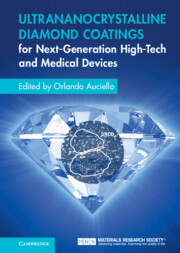
A comprehensive guide to the science of a transformational ultrananocrystalline-diamond (UNCDTM) thin film technology enabling a new generation of high-tech and external and implantable medical devices. Edited and co-authored by a co-originator and pioneer in the field, it describes the synthesis and material properties of UNCDTM coatings and multifunctional oxide/nitride thin films and nanoparticles, and how these technologies can be integrated into the development of implantable and external medical devices and treatments of human biological conditions. Bringing together contributions from experts around the world, it covers a range of clinical applications, including ocular implants, glaucoma treatment devices, implantable prostheses, scaffolds for stem cell growth and differentiation, Li-ion batteries for defibrillators and pacemakers, and drug delivery and sensor devices. Technology transfer and regulatory issues are also covered. This is essential reading for researchers, engineers and practitioners in the field of high-tech and medical device technologies across materials science and biomedical engineering.