To save content items to your account,
please confirm that you agree to abide by our usage policies.
If this is the first time you use this feature, you will be asked to authorise Cambridge Core to connect with your account.
Find out more about saving content to .
To save content items to your Kindle, first ensure no-reply@cambridge.org
is added to your Approved Personal Document E-mail List under your Personal Document Settings
on the Manage Your Content and Devices page of your Amazon account. Then enter the ‘name’ part
of your Kindle email address below.
Find out more about saving to your Kindle.
Note you can select to save to either the @free.kindle.com or @kindle.com variations.
‘@free.kindle.com’ emails are free but can only be saved to your device when it is connected to wi-fi.
‘@kindle.com’ emails can be delivered even when you are not connected to wi-fi, but note that service fees apply.
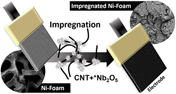
This study reports the fabrication of high mass loading (32 mg/cm2) electrodes of niobium pentoxide (Nb2O5) nanoparticles and carbon nanotubes (CNTs) using a facile procedure. The as-obtained Nb2O5 nanoparticles by microwave-assisted hydrothermal synthesis presented pseudohexagonal (TT) phase, and when exposed to the thermal treatment, the Nb2O5 nanoparticles changed to orthorhombic (T) phase. Distinct morphologies were obtained, which exhibited a specific surface area of 216 m2/g and 47 m2/g to pseudohexagonal and orthorhombic phases, respectively. Cyclic voltammetry and electrochemical impedance spectroscopy techniques were performed in a three-electrode system using 1 M Li2SO4 as electrolyte with a potential window of 0–0.9 V (versus standard calomel electrode). Both materials showed capacitive behavior with a specific capacitance of 0.11 F/cm2 and 0.09 F/cm2 to nanocomposites CNT + TT-Nb2O5 and CNT + T-Nb2O5 at 2 mV/s, respectively. Thus, an efficient, simple, and promising process to produce electrodes for supercapacitors was demonstrated.
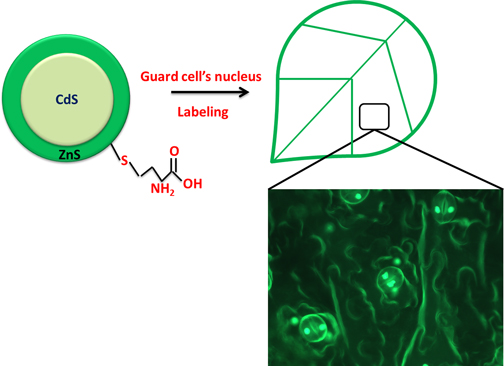
CdS/ZnS core shell quantum dots (QDs) were synthesized and functionalized by methionine and characterized by standard techniques. The prior QD-based phytotoxicity assay was helpful to find out the maximum tolerant level of the plant cells. The successful transport and phytotoxic mechanism of QDs were elaborated in detail. Methionine functionalities on the QDs were helpful in specific binding of QDs with the nucleus of stomata in plant cells. Target specific interaction with the nucleus of stomata cells was a novel breakthrough that can be used in many biologic applications.
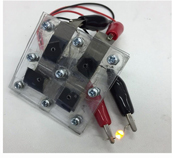
Direct urea fuel cells were fabricated using CuNi-plated polymer cloth for anode catalyst and current collector, and Pt-black for cathode catalyst. The output power was significantly enhanced by coating the CuNi cloth with a conducting polymer, poly(3,4-ethylenedioxythiophene)polystyrene sulfonate (PEDOT*PSS). The open circuit voltage, 0.80 V and the maximum output power, 3.0 mW/cm2 were obtained for the fuel of 0.5 M urea water solution under ambient conditions. Improvement over the cell structure demonstrated to lighten a light emitting diode.
Nickel thin films were prepared by electroless plating in a foam of electrolyte generated by bubbling nitrogen into a hypophosphite-based electroless plating solution added with surfactants of sulfuric acid monododecyl ester sodium salt and ammonium pentadecafluorooctanoate (APFO). Ferroxyl test revealed that the films deposited in foam had substantially higher corrosion resistance than those deposited in liquid. Even with a film thickness of only 1.5 µm, the fraction of corroded area was as small as 0.002% when the film was deposited in the foam. The notable improvement in the corrosion resistance was made possible by adding APFO as the surfactant.
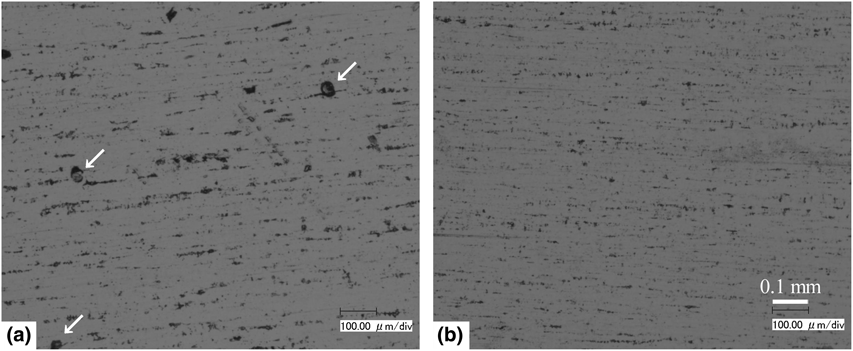
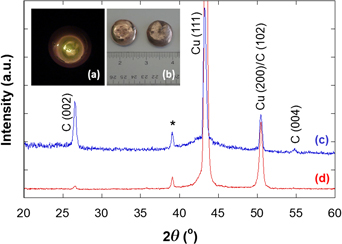
By electron-beam (e-beam) melting, we prepared 0.4 wt% carbon-infused copper (CuCv4), and a copper control without carbon addition (CuCv0). Scanning electron microscopy and helium ion microscopy (HIM) were performed on the as-solidified surface, fracture surface, and ion-polished surface of the CuCv4 sample. The results revealed that graphitic carbon flakes cover the as-solidified surface, and carbon nanoparticles and clusters exist in the fracture and ion-polished surfaces. HIM on the ion-polished surface revealed a unique ripple-shaped feature, which is possibly associated with the infusion of carbon nanoribbons in the copper matrix. The bulk densities were measured to be 8.86 and 8.53 g/cm3, which correspond to relative densities of 98.9% and 96.4% for the CuCv0 and CuCv4 samples, respectively. In addition, apparent electrical conductivities were measured to be 56.9 and 57.5 MS/m, respectively, for the e-beam melted CuCv0 and CuCv4 samples. These values correspond to true electrical conductivities of 100.5% IACS (International Annealed Copper Standard) and 107.4% IACS after correction for the porosity. Our results reveal remarkable promise of using covetic copper for the next generation conductors in energy applications from microelectronic devices to high-power transmission cables.
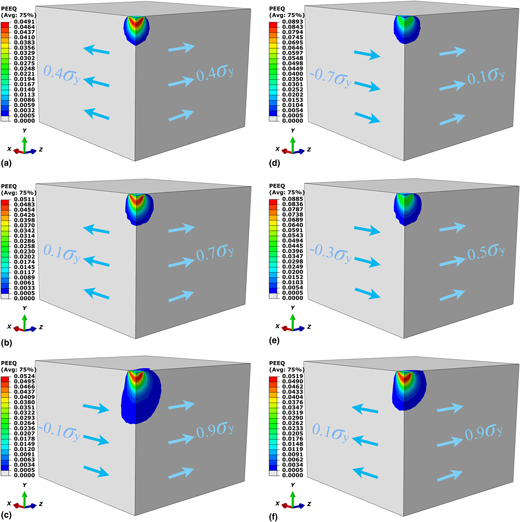
The finite element simulations show that non-equibiaxial residual stresses (RS) can shift the load–depth curve from the unstressed curve and cause elliptical remnant indentation in spherical indentation. Thus the relative load change between stressed and unstressed samples and the asymmetry of elliptical remnant indentation were employed as characteristic parameters to evaluate the magnitude and directionality of RS. Through theoretical and numerical analysis, the effects of RS on indentation load and remnant impression as well as the affect mechanism were systematically discussed. Finally, two equations which could provide foundations for establishing spherical indentation method to evaluate non-equibiaxial RS were obtained.
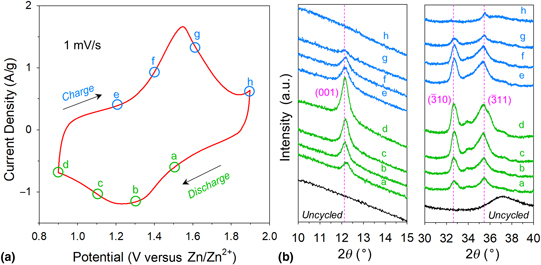
We previously demonstrated that electrode architectures comprising nanoscale birnessite-like MnOx affixed to three-dimensional carbon nanofoam (CNF) scaffolds offer performance advantages when used as cathodes in rechargeable zinc-ion cells. To discern chemical and physical changes at the MnOx@CNF electrode upon deep charge/discharge in aqueous Zn2+-containing electrolytes, we deploy electroanalytical methods and ex situ characterization by microscopy, elemental analysis, x-ray photoelectron spectroscopy, x-ray diffraction, and x-ray pair distribution function analyses. Our findings verify that redox processes at the MnOx are accompanied by reversible precipitation/dissolution of crystalline zinc hydroxide sulfate (Zn4(OH)6(SO4)·xH2O), mediated by the more uniformly reactive electrode structure inherent to the CNF scaffold.
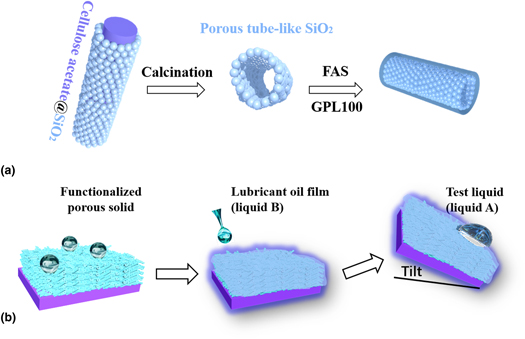
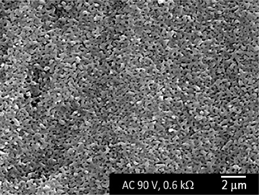
The glass surfaces used for optical devices are necessary to have high transparency. Here we propose to take advantage of tube-like SiO2 textures to trap lubricant liquid inside aiming to prepare novel slippery liquid-infused porous surfaces (SLIPS). As a consequence, SLIPS with high transparency were synthesized on glass substrate successfully. The capillary action of unique tubular structure induces the ion migration of adjacent Krytox 100, thus endowing SLIPS with the self-healing property. Moreover, the remarkable slip behavior enables these surfaces to possess the self-cleaning and anti-biofouling performances. The current work might provide a promising candidate for long-term transparent optical devices.
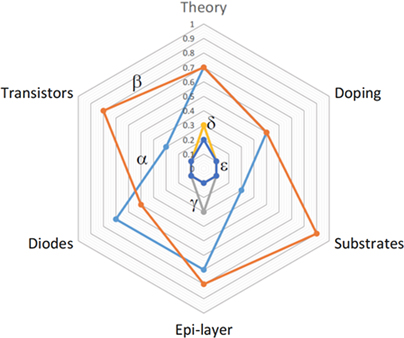
A review is given of the future device processing needs for Ga2O3 power electronics. The two main devices employed in power converters and wireless charging systems will be vertical rectifiers and metal oxide semiconductor field effect transistors (MOSFETs). The rectifiers involve thick epitaxial layers on conducting substrates and require stable Schottky contacts, edge termination methods to reduce electric field crowding, dry etch patterning in the case of trench structures, and low resistance Ohmic contacts in which ion implantation or low bandgap interfacial oxides are used to minimize the specific contact resistance. The MOSFETs also require spatially localized doping enhancement for low source/drain contact resistance, stable gate insulators with acceptable band offsets relative to the Ga2O3 to ensure adequate carrier confinement, and enhancement mode capability. Attempts are being made to mitigate the absence of p-type doping capability for Ga2O3 by developing p-type oxide heterojunctions with n-type Ga2O3. Success in this area would lead to minority carrier devices with better on-state performance and a much-improved range of functionality, such as p-i-n diodes, Insulated Gate Bipolar Transistors, and thyristors.
The formation of nanosized porous oxide layers on titanium (Ti) by asymmetric alternating current anodizing in sulfuric acid has been studied using electrochemical techniques. In order to prevent spark discharge at Ti electrode upon its anodization in 1.0 M H2SO4 solution, the magnitude of the cathodic current is reduced using a special electrical circuit consisting of a variable resistor and two diodes. The unique surface treatment approach gives rise to the formation of nanosized porous layer in a very short period of time and without spark discharge. The surface of porous layers thus obtained has in vitro apatite-forming ability.
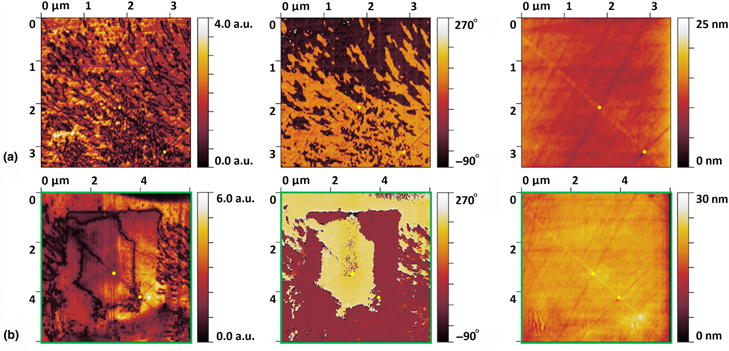
Ferroelectric single-crystal-architecture-in-glass is a new class of metamaterials that would enable active integrated optics if the ferroelectric behavior is preserved within the confines of glass. We demonstrate using lithium niobate crystals fabricated in lithium niobosilicate glass by femtosecond laser irradiation that not only such behavior is preserved, the ferroelectric domains can be engineered with a DC bias. A piezoresponse force microscope is used to characterize the piezoelectric and ferroelectric behavior. The piezoresponse correlates with the orientation of the crystal lattice as expected for unconfined crystal, and a complex micro- and nano-scale ferroelectric domain structure of the as-grown crystals is revealed.
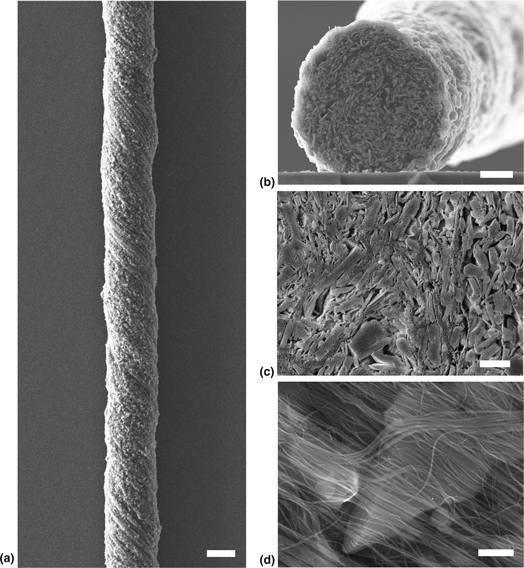
Yarn-type supercapacitors should have high energy density in small given spaces, and the one attempt among many is to comprise the electrodes asymmetrically. However, the low capacitance of conventional materials causes the widened operating voltage useless. In this study, we have utilized a novel material MXene with carbon nanotubes (CNTs) to make highly loaded MXene/CNT yarn electrodes, which exhibited a remarkable areal capacitance. With MnO2/CNT biscrolled cathode and PVA/LiCl gel electrolyte, the plied asymmetric yarn supercapacitor had energy density of 100 µWh/cm2. The yarn supercapacitor could operate under mechanical deformations without performance degradation.
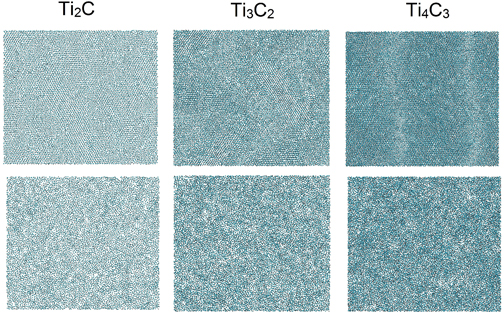
We report the classical molecular dynamics (MD) study of thermal stability of three two-dimensional (2D) titanium carbides Ti2C, Ti3C2, and Ti4C3 (MXenes). Thermal properties of 2D nanomaterials are of fundamental importance and raise particular interest due to their potential applications in nanoelectronics. To investigate the behavior of Tin+1Cn MXenes during heating, structural parameters such as Lindemann indexes, radial distribution functions, and atomistic configurations were calculated. The analysis of MD data allowed us to obtain approximate values of MXene degradation temperatures that are 1050, 1500, and 1700 K for Ti2C, Ti3C2, and Ti3C4 MXenes, respectively.
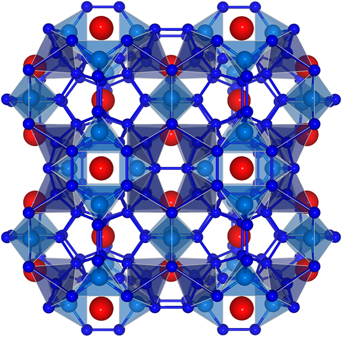
Clathrates based on Si and Ge have very low lattice thermal conductivity (~1 W/m-K). This value can potentially be further reduced by alloying and nano-structuring. In this work, the thermal conductivity of Si and Ge clathrates alloy have been investigated using model based on the relaxation time approximation. By including alloy scattering, we find that the lattice thermal conductivity of Ba8Cu6Si40 is reduced by 50% from 1.64 to 0.80 W/m-K in Ba8Cu6Si40(1−x)Ge40x alloy. Further ~90% reduction of the thermal conductivity is possible for nanowire clathrate alloys. The ultra-low thermal conductivity in the nanowire will be very suitable for the thermoelectric application.
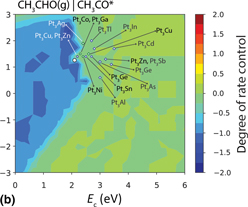
Ab initio microkinetic modeling was performed to study ethanol conversion to acetaldehyde on Pt-based bimetallic alloys in a non-oxidative environment. Alloying Pt with Au, Ag, Cu, Co, Ni, Zn, Cd, Al, Ga, In, Tl, Ge, Sn, Pb, As, and Sb showed an increase in product turnover by at least an order of magnitude compared with Pt at 423 K. This was correlated to the increased stabilization of CH3CHO species over these alloys. Among the alloy candidates; Pt3Cu, Pt3Zn, Pt3Ga, Pt3Ge, Pt3Sb, and Pt3Pb were found to be more active than Pt.
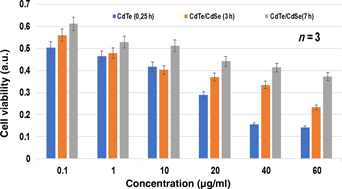
LM-8 is a murine osteosarcoma cell line associated with bone tumor in young adult and children. It contains the nuclear factor-κB which make this cell high resistance to irradiation thus limiting its treatment only to chemotherapy and surgery which has become a source of concerned for cancer therapy. In addressing this problem, we herein report the synthesis of CdTe/CdSe core/shell quantum dots (QDs) via a simple, reproducible method and its cytotoxic action against the LM-8 cell line. The cell viability study shows that the as-synthesized QDs are toxic to the LM-8 cell line in a concentration- and time-dependent manner.
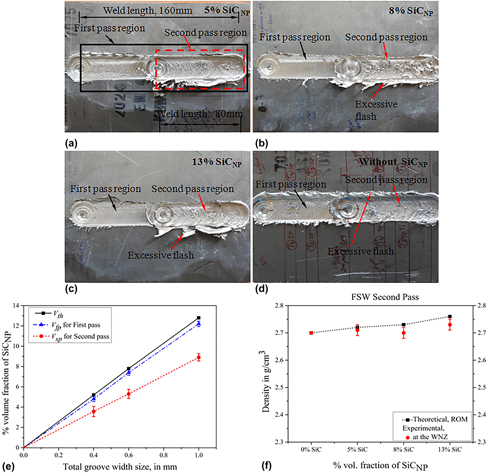
Effects of varying volume fractions of SiC nanoparticle (SiCNP) reinforcement on microstructure and mechanical properties of dissimilar AA2024-T351 and AA7075-T651 joints by friction stir welding (FSW) have been investigated experimentally. A rectangular section edge groove was prepared at the adjoining surfaces of the two plates with the butt configuration before FSW. Initially, four fractional volumes with 0, 5, 8, and 13% of SiCNP are reinforced into the grooves of width, 0, 0.2, 0.3, and 0.5 mm and the FSW was performed with the first and second pass to obtain metal matrix nanocomposite (MMNC) at the weld nugget zone (WNZ). The characterization of microstructure specimens was investigated using optical microscopy (OM), scanning electron microscopy (SEM) and X-ray diffraction technique (XRD). The FSW joint specimen produced with 5 vol% fraction of SiCNP for second pass processing observes a defect-free, homogeneous distribution of SiCNP with a mean grain size of about 2–3 µm at the WNZ and weld joints higher in tensile strength, 411 MPa, yield strength, 252 MPa, and percentage elongation, 14.3. The result shows that varying volume fractions (5, 8, 13%) of the SiCNP after the FSW second pass led to significant grain refinement at the WNZ and higher mechanical properties compared with FSW specimens prepared without SiCNP. Higher hardness of 150 Hv was observed in the WNZ for specimen produced with 13 vol% fraction SiCNP.