To save content items to your account,
please confirm that you agree to abide by our usage policies.
If this is the first time you use this feature, you will be asked to authorise Cambridge Core to connect with your account.
Find out more about saving content to .
To save content items to your Kindle, first ensure no-reply@cambridge.org
is added to your Approved Personal Document E-mail List under your Personal Document Settings
on the Manage Your Content and Devices page of your Amazon account. Then enter the ‘name’ part
of your Kindle email address below.
Find out more about saving to your Kindle.
Note you can select to save to either the @free.kindle.com or @kindle.com variations.
‘@free.kindle.com’ emails are free but can only be saved to your device when it is connected to wi-fi.
‘@kindle.com’ emails can be delivered even when you are not connected to wi-fi, but note that service fees apply.
In the early 1850s the French diplomat and engineer Ferdinand de Lesseps (1805–1894) revived earlier French plans to build a canal through the Isthmus of Suez, and, thanks to his good relations with the Viceroy of Egypt, won approval for the project in the face of British and Turkish opposition. This 1870 lecture reveals de Lesseps' enchantment with the desert and its people, his determination to complete the canal, and his annoyance at British antagonism. By 1875, when this English translation by Sir Henry Wolff was published, the canal had been open for six years and the British position had shifted dramatically. The government bought Egypt's shares in the Canal Company, and Wolff was chosen by Disraeli to speak in Parliament in support of the purchase. De Lessep's book remains an invaluable source on the canal, the politics of the major powers, and European attitudes towards the Middle East.
Polymath Alexander von Humboldt (1769–1859), a self-described 'scientific traveller', was one of the most respected scientists of his time. Humboldt's wanderlust led him across Europe and to South America, Mexico, the U.S., and Russia, and his voyages and observations resulted in the discovery of many species previously unknown to Europeans. Originating as lectures delivered in Berlin and Paris (1827–1828), his multi-volume Cosmos: Sketch of a Physical Description of the Universe (1845–1860) represented the culmination of his lifelong interest in understanding the physical world. As Humboldt writes, 'I ever desired to discern physical phenomena in their widest mutual connection, and to comprehend Nature as a whole, animated and moved by inward forces.' Volume 1 (1846) investigates celestial and terrestrial phenomena, from nebulae to the temperature of the earth, as well as 'organic life'. Throughout, he stresses the method of, and limits to, describing the universe's physical nature.
Jane Haldimand Marcet (1769–1858) was a pioneer in the field of education who wrote accessible introductory books on science and economics. Noting that women's education 'is seldom calculated to prepare their minds for abstract ideas', she resolved to write books that would inform, entertain and improve a generation of female readers. First published anonymously in 1805, her two-volume work Conversations on Chemistry swiftly became a standard primer going through sixteen editions in England alone, and is credited with having influenced the young Michael Faraday. Presented as a series of discussions between a fictional tutor, Mrs. Bryan, and her two female students, the flighty Caroline and earnest Emily, Conversations combines entertaining banter with a clear and concise explanation of scientific theories of the day. In Volume 1 the girls are introduced to 'Simple Bodies' through such colourful examples as hot air balloons and the spa waters of Harrogate.
Sir James Jeans' well-known treatise covers the topics in electromagnetic theory required by every non-specialist physicist. It provides the relevant mathematical analysis and is therefore useful to those whose mathematical knowledge is limited, as well as to the more advanced physicists, engineers and applied mathematicians. A large number of examples are given.
This 1893 publication is a central text in the work of the Nobel prize winning physicist Sir Joseph John Thomson (1858–1940). Intended as an extension of James Clerk Maxwell's Treatise on Electricity and Magnetism, it documents the important shift in Thomson's thinking towards the model of the atomic electric field, a theory that would eventually lead to his discovery of the electron. In Chapter 1, Thomson documents his experiments with Faraday tubes, using them to physically demonstrate a 'molecular theory of electricity'. Chapter 2 considers the discharge of electricity through gases, Chapter 3 theories of electrostatics, and Chapters 4–6 are primarily concerned with alternating currents. In addition to providing crucial insight into Thomson's evolving theory of the atom, Recent Researches underscores his commitment to experimental physics, which offers 'all the advantages in vividness which arise from concrete qualities rather than abstract symbols'.
The Royal Society has been dedicated to scientific inquiry since the seventeenth century and has seen a long line of illustrious scientists and thinkers among its fellowship. The society's Assistant Secretary and Librarian, Charles Richard Weld (1813–1869), spent four years writing this two-volume History of the Royal Society, published in 1848, which also includes illustrations by his wife, Anne. Weld's aim was to document the 'rise, progress, and constitution' of the society. He charts how the informal meetings of like-minded men engaged in scientific pursuits in the mid-1600s developed into a prestigious society that by 1830 counted as one of the world's most influential scientific institutions. Volume 1 covers the period to 1755, describing the society's origins and key moments in its growth, with a focus on its governance, benefactors and organisation. It also contains biographies of presidents including Samuel Pepys and Isaac Newton.
James Clerk Maxwell (1831–1879) was a Scottish physicist well-known for his extensive work with electromagnetism, colour analysis, and kinetic theory. Considered by many to be a giant in his field with significant influence on the physicists who would follow, Maxwell spent time as a professor at Aberdeen University, King's College, London, and Cambridge. This 1882 Life by his friend Lewis Campbell and natural philosopher William Garnett represents an important – and lengthy – investigation into Maxwell's life and thought. Part I is concerned with biographical matters while the second section focuses upon his scientific mind. A third part contains Maxwell's poetry, so included because the poems are 'characteristic of him' and have 'curious biographical interest'. At nearly 700 pages, the Life represents an important starting point for those curious about the state of theoretical physics and the person in whom it reached its culmination in the nineteenth century.
Arguably the most influential nineteenth-century scientist for twentieth-century physics, James Clerk Maxwell (1831–1879) demonstrated that electricity, magnetism and light are all manifestations of the same phenomenon: the electromagnetic field. A fellow of Trinity College Cambridge, Maxwell became, in 1871, the first Cavendish Professor of Physics at Cambridge. His famous equations - a set of four partial differential equations that relate the electric and magnetic fields to their sources, charge density and current density - first appeared in fully developed form in his 1873 Treatise on Electricity and Magnetism. This two-volume textbook brought together all the experimental and theoretical advances in the field of electricity and magnetism known at the time, and provided a methodical and graduated introduction to electromagnetic theory. Volume 2 covers magnetism and electromagnetism, including the electromagnetic theory of light, the theory of magnetic action on light, and the electric theory of magnetism.
Henry Cavendish (1731–1810), the grandson of the second duke of Devonshire, wrote papers on electrical topics for the Royal Society, but the majority of his electrical experiments did not become known until they were collected and published by James Clerk Maxwell a century later, in 1879, long after other scientists had been credited with the same results. Among Cavendish's discoveries were the concept of electric potential, which he called the 'degree of electrification'; an early unit of capacitance, that of a sphere one inch in diameter; the formula for the capacitance of a plate capacitor; the concept of the dielectric constant of a material; the relationship between electric potential and current, now called Ohm's Law; laws for the division of current in parallel circuits, now attributed to Charles Wheatstone; and the inverse square law of variation of electric force with distance, now called Coulomb's Law.
Arguably the most influential nineteenth-century scientist for twentieth-century physics, James Clerk Maxwell (1831–1879) demonstrated that electricity, magnetism and light are all manifestations of the same phenomenon: the electromagnetic field. A fellow of Trinity College Cambridge, Maxwell became, in 1871, the first Cavendish Professor of Physics at Cambridge. His famous equations - a set of four partial differential equations that relate the electric and magnetic fields to their sources, charge density and current density - first appeared in fully developed form in his 1873 Treatise on Electricity and Magnetism. This two-volume textbook brought together all the experimental and theoretical advances in the field of electricity and magnetism known at the time, and provided a methodical and graduated introduction to electromagnetism. Volume 1 covers the first elements of Maxwell's electromagnetic theory: electrostatics, and electrokinematics, including detailed analyses of electrolysis, conduction in three dimensions, and conduction through heterogeneous media.
Jeans's primary aim with the first edition of his book, originally published in 1904, was to 'develop the theory of gases upon as exact a mathematical basis as possible'. Twenty years later and those theories were being revolutionised by Quantum Theory. In this fourth edition, Jeans does not attempt to avoid the discoveries of this topical science, but rather exposes the many difficulties that classical theory was experiencing, and how those problems disappeared with Quantum Theory. This edition therefore offers a fascinating insight into a field of physics in transition between two great models of physical science.
The renowned English chemist and meteorologist John Dalton (1766–1844) published A New System of Chemical Philosophy in two volumes, between 1808 and 1827. Dalton's discovery of the importance of the relative weight and structure of particles of a compound for explaining chemical reactions transformed atomic theory and laid the basis for much of what is modern chemistry. Volume 2 was published in 1827. It contains sections examining the weights and structures of two-element compounds in five different groups: metallic oxides; earthly, alkaline and metallic sulphurets; earthly, alkaline and metallic phosphurets; carburet; and metallic alloys. An appendix contains a selection of brief notes and tables, including a new table of the relative weights of atoms. A planned second part was never published. Dalton's work is a monument of nineteenth-century chemistry. It will continue to be read and enjoyed by anybody interested in the history and development of science.
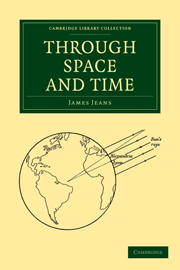
Through Space and Time is based upon the 1933 Christmas Lectures that James Jeans gave at the Royal Institution, London. Intended to appeal to a wide readership and presenting a broad understanding of the Earth, solar system and the universe, the book begins its journey with the history, structure and main features of our planet, and ends in the vast expanses of space among the nebulae.
Sir George Darwin (1845–1912) was the second son of Charles Darwin. After studying mathematics at Cambridge he read for the Bar, but soon returned to science and to Cambridge, where in 1883 he was appointed Plumian Professor of Astronomy and Experimental Philosophy. His work was concerned primarily with the effect of the sun and moon on tidal forces on Earth, and with the theoretical cosmogony which evolved from practical observation: he formulated the fission theory of the formation of the moon (that the moon was formed from still-molten matter pulled away from the Earth by solar tides). He also developed a theory of evolution for the Sun–Earth–Moon system based on mathematical analysis in geophysical theory. This volume, published in 1916 after the author's death, includes a biographical memoir by his brother Sir Francis Darwin, his inaugural lecture and his lectures on George W. Hill's lunar theory.
The authors analyze how the structure of a package determines its developmental complexity according to such measures as bug search times and documentation information content. The work presents arguments for why these issues impact solution cost and time more than does scalable performance. The final chapter explores the question of scalable execution and shows how scalable design relates to scalable execution. The book's focus is on program organization, which has received considerable attention in the broader software engineering community, where graphical description standards for modeling software structure and behavior have been developed by computer scientists. These discussions might be enriched by engineers who write scientific codes. This book aims to bring such scientific programmers into discussion with computer scientists. The authors do so by introducing object-oriented software design patterns in the context of scientific simulation.
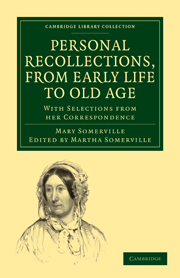
These Personal Recollections contain the memoirs and a selection of the correspondence of the nineteenth-century polymath Mary Somerville (1780–1872). The book was first published in 1873, a year after Mary's death, by her daughter Martha, who wrote brief introductions to the text. Mary Somerville is best known for her pioneering scientific publications which include her translation of Laplace's Mécanique Céleste (1831: also resissued in this series); On the Connection of the Physical Sciences (1834); Physical Geography (1848); and On Molecular and Microscopic Science (1869). Through these publications, Somerville made a lasting contribution to the dissemination of scientific knowledge. Somerville's correspondence deals primarily with her public life, while the memoirs offer insight into her private sphere: the discouragement she faced in pursuit of learning; her passion for women's education and suffrage; family life; and personal faith. Her story is compelling, and her experiences may resonate with many women today.
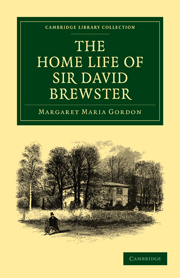
The Home Life of Sir David Brewster, originally published in 1869, records the remarkable life of inventor, physicist, mathematician and astronomer, Sir David Brewster (1781–1868). Written by his daughter, Mrs Margaret M. Gordon, the book is aimed at a non-academic audience, and details the extraordinary life and work of this amazing scientist, who began his studies at Edinburgh University at the age of just twelve, and who is best known for his invention of the kaleidoscope and of the apparatus that initially formed the structure of the core of the lighthouse, and thus his work on the polarization of light. Mrs. Gordon cites Brewster's many activities, including the publication of over 2,000 scientific papers, though she stresses that she has written about her father as the man, and not the scientist. The book will appeal to anyone interested in the life and career of this undoubtedly brilliant Scotsman.