To save content items to your account,
please confirm that you agree to abide by our usage policies.
If this is the first time you use this feature, you will be asked to authorise Cambridge Core to connect with your account.
Find out more about saving content to .
To save content items to your Kindle, first ensure no-reply@cambridge.org
is added to your Approved Personal Document E-mail List under your Personal Document Settings
on the Manage Your Content and Devices page of your Amazon account. Then enter the ‘name’ part
of your Kindle email address below.
Find out more about saving to your Kindle.
Note you can select to save to either the @free.kindle.com or @kindle.com variations.
‘@free.kindle.com’ emails are free but can only be saved to your device when it is connected to wi-fi.
‘@kindle.com’ emails can be delivered even when you are not connected to wi-fi, but note that service fees apply.
William Tulloch Jeans (1848–1907) was a parliamentary journalist with an interest in economics and technology. This book was first published in 1884, and comprises biographies of six men whom Jeans believed to have made significant contributions to the development of modern steel technology. The Bessemer process revolutionised steel-making, reducing the cost and allowing steel to replace the much more brittle iron in civil engineering projects such as bridges. Siemens' regenerative furnace allowed much more fuel-efficient manufacture of steel. Sir Joseph Whitworth developed a method of producing stronger steel by removing blowholes in the ingots. Sir John Brown's rolled steel was used in almost all the British navy's armour-plated ships. The work of Sidney Gilchrist Thomas and George Snelus on reducing phosphorus content in steel meant low-grade ores could be used. The combined researches of these men transformed modern industrial and engineering methods.
John Joseph Fahie (1846–1934) was an engineer for the Electric and International Telegraph Company before being posted overseas in the Indo-European Government Telegraph Department. He was also a respected historian whose History of Wireless Telegraphy (1899) sold out two impressions in little over a year. In this second edition (1901), he traces the development of wireless communication during the nineteenth century, drawing extensively from the correspondence and technical illustrations of inventors themselves. This edition was fully updated to take account of the latest advances in radio technology, including Marconi's latest public demonstrations. As a practising telegraph engineer, Fahie was in the perfect position not only to understand the significance of these developments, but to explain them to a non-specialist audience. Contemporary reviews indicate he did this with great success. His book gives an eyewitness account of the rise of radio technology that still fascinates scholars and enthusiasts today.
The mathematician and physicist William Thomson, 1st Baron Kelvin, (1824–1907) was one of Britain's most influential scientists, famous for his work on the first and second laws of thermodynamics and for devising the Kelvin scale of absolute temperature. Silvanus P. Thompson (1851–1916) began this biography with the co-operation of Kelvin in 1906, but the project was interrupted by Kelvin's death the following year. Thompson, himself a respected physics lecturer and scientific writer, decided that a more comprehensive biography would be needed and spent several years reading through Kelvin's papers in order to complete these two volumes, published in 1910. Volume 1 covers Kelvin's life to 1871, including his student days, his election (aged 22) as professor in Glasgow, his ground-breaking theoretical research on thermodynamics, his applied work on telegraphs including the Atlantic cable, and his involvement in a geological controversy about the age of the earth.
Josiah Wedgwood (1730–1795) was a master potter who pioneered the industrialisation of pottery manufacture during the early Industrial Revolution. His experimental work on ceramics resulted in many innovations in the production and decoration of pottery. This three-volume work, edited by his great-granddaughter Katherine Eufemia Farrer and published between 1903 and 1906, contains Wedgwood's letters to his business partner Thomas Bentley (1730–1780) and others. Wedgwood's highly successful partnership with Bentley is credited with the expansion and development of Wedgwood's reputation across Europe. The letters cover the years 1762 to 1794 and provide a lively account both of the growth of the business partnership and of Wedgwood's domestic life. Wedgwood maintained a keen interest in current affairs, and these volumes provide a fascinating glimpse into the society and domestic life of the late eighteenth century. Volume 3 covers 1781–1794.
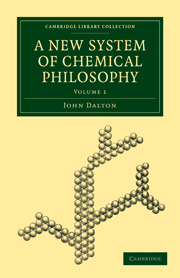
The chemist and meteorologist John Dalton (1766–1844) published A New System of Chemical Philosophy in two volumes, between 1808 and 1827. Dalton's discovery of the importance of the relative weight and structure of particles of a compound for explaining chemical reactions transformed atomic theory and laid the basis for much of what is modern chemistry. Volume 1 was published in two parts, in 1808 and 1810. Part 1 offers an account of Dalton's atomic theory. It contains chapters on temperature, the constitution of bodies, chemical synthesis and a number of plates including his famous table of symbols for the atoms of various elements. Part 2 contains a chapter on elementary principles and twelve sections on different groups of two-element compounds. Dalton's work is a monument of nineteenth-century chemistry. It will continue to be read and enjoyed by anybody interested in the history and development of science.
Josiah Wedgwood (1730–1795) was a master potter who pioneered the industrialisation of pottery manufacture during the early Industrial Revolution. His experimental work on ceramics resulted in many innovations in the production and decoration of pottery. This three-volume work, edited by his great-granddaughter Katherine Eufemia Farrer and first published between 1903 and 1906, contains Wedgwood's letters to his business partner, the Liverpool merchant Thomas Bentley (1730–1780). Wedgwood's highly successful partnership with Bentley is credited with the expansion and development of Wedgwood's reputation across Europe. The letters cover the years 1762 to 1794 and provide a lively account both of the growth of the business partnership and of Wedgwood's domestic life. Wedgwood and Bentley also maintained a keen interest in current affairs, and these volumes provide a fascinating glimpse into the society and domestic life of the late eighteenth century. Volume 2 covers 1772–1780.
The mathematician and physicist William Thomson, 1st Baron Kelvin, (1824–1907) was one of Britain's most influential scientists, famous for his work on the first and second laws of thermodynamics and for devising the Kelvin scale of absolute temperature. Silvanus P. Thompson (1851–1916) began this biography with the co-operation of Kelvin in 1906, but the project was interrupted by Kelvin's death the following year. Thompson, himself a respected physics lecturer and scientific writer, decided that a more comprehensive biography would be needed and spent several years reading through Kelvin's papers in order to complete these two volumes, published in 1910. Volume 2, beginning in 1871, covers not only Kelvin's mature research, but also more personal aspects of his life, including his love of music and sailing, his experiments with compasses and navigation, and the relationship between his scientific discoveries and his religious beliefs.
Robert Louis Stevenson (1850–1894), novelist and poet, was descended from a famous Scottish engineering family. His grandfather Robert, his father Thomas, two uncles and a cousin were all noted engineers, particularly known for their lighthouses. This family history, focusing particularly on his grandfather, was written while R. L. Stevenson was living in Samoa, and was published posthumously in 1912. It first outlines the history of the name 'Stevenson' from the thirteenth century. Chapter 1 begins in the mid-eighteenth century, and records Robert Stevenson's birth in 1772, and his father's death. The young Robert worked with his stepfather for the Northern Lighthouse Board and was its sole Engineer from 1808 to 1843. Chapter 2 describes his experiences in that role. Chapter 3 reproduces substantial extracts from Robert's own diary of the construction (1807–1811) of his most famous structure, the Bell Rock lighthouse off Arbroath, which revolutionised lighthouse design.
Robert Willis (1800–1875) was a scientist, inventor and architectural historian of international repute. As Jacksonian Professor of Natural and Experimental Philosophy at Cambridge, he demonstrated specially made mechanical devices to huge audiences. First published in 1841, Principles of Mechanism provided the theory behind the demonstrations. He defined mechanism as the means by which any relations of motion could be realised. The book was extremely influential, with all books in English, French, and German on the subject for the next generation adopting Willis' classification and nomenclature. He worked closely with William Whewell, whose Mechanics of Engineering was published in the same year. These two books established the science of mechanism, and provided study materials for the rapidly growing engineering profession. The work became a standard textbook for engineering and mathematics students, with a second edition issued in 1870.
Roger Bacon, the medieval natural philosopher who broke new ground in promoting scientific method, produced the encyclopedic Opus Majus or 'Greater Work' in the mid-thirteenth century. This 1897 publication in two volumes was the first complete edition of the work to appear in print. Written at the request of Pope Clement IV, the Opus Majus is the most significant and most influential of Bacon's works, containing his observations of the natural world and theories on knowledge acquisition. Bacon's text appears in the original Latin, and Bridges includes a substantial introduction and brief analysis of each chapter in English, as well as extensive footnotes and an analytical table to aid the reader. Volume 2 contains the last three parts of Bacon's treatise, on Optics, Experimental Science, and Moral Philosophy. This volume also incorporates a later supplement containing additional material and corrections.
Joseph Priestley (1733–1804) was an eighteenth-century English polymath with accomplishments in the fields of science, pedagogy, philosophy and theology. Among his more notable achievements were the discovery of oxygen and his work in establishing Unitarianism. Often a controversialist, Priestley's efforts to develop a 'rational' Christianity and support for the French Revolution eventually made him unwelcome in his native land. His 1807 Memoirs relate the story of his life until the time of his 1794 emigration to America and include other biographical materials written by his son. This first volume also contains five appendices discussing his philosophy, scientific work and religious opinions. Priestley's memoirs are an important source for anyone interested in the state of epistemology, rationalism, and religious belief in the age of the Enlightenment, and in a man who, in the words of his son, 'gave unremitting exertions in the cause of truth'.
What are the ways in which credit can be given for research contributions when writing a research report?
Credit for research contributions is assigned in three principal ways in research publications: by authorship (of the research being published), citation (of previously published or formally presented work), and via a written acknowledgment (of some contribution to the present research).
Good research practice also requires fulfilling responsibilities. As was discussed in the introduction, fulfilling responsibilities typically requires both creativity and more exercise of judgment than do fulfilling obligations, respecting others’ rights, or following rules of the form “Do X” or “Do not do Y.” Responsible authorship requires the concept of forward-looking responsibility. Forward-looking responsibility specifies the end (i.e., the good result) that is to be achieved, such as “the responsibility for the integrity of the research record.” To fulfill a responsibility one must figure out what to do or avoid doing to achieve the specified ends.
When people speak of the “end-use problem” in engineering ethics, they are speaking about the question of whether or to what extent engineers are responsible for what others do with the technologies that the engineers have helped to design, manufacture, or maintain.
In Chapter 4, we examined an argument that engineers, at least those who worked on medical life-support technology, bear guilt because of the harm resulting from the overuse of life-support technology. That was a stringent argument that engineers are accountable for the end use of their work. I argued that it was too demanding because engineers are not in a position to foresee that the technology would be so misused and in fact there are other interventions, such as the requirement that health care facilities respect living wills and other so-called advance care directives, that directly address the problem of misuse and allow life-support technology to continue to benefit patients with whom it is appropriately used.
What do you do when you realize that your work or your company's work has resulted in a serious threat to life and health, and how do you go about it?
Roger Boisjoly's Attempts to Avert theDisaster
What do safety problems look like to the engineer who encounters them? How do they develop over time? What are good ways of responding to such problems at each stage of their development? Much can be learned from the attempts of Roger Boisjoly, an engineer at Morton Thiokol, to avert the Challenger disaster of January 1986. His care and diligence in coping with the uncertainties about the nature and extent of the threat to the shuttle flights and his courageous persistence in raising issues exemplify responsible behavior.
Like others who have spent time with Roger Boisjoly, I have been impressed with his sincerity and forthrightness. These are matters of moral character over and above the particular acts he performed. Boisjoly's integrity and openness make his personal account of events especially illuminating, but at this point in our investigation we are concerned with his actions, what he did at various points in the unfolding story of the Challenger disaster, rather than with his character.
As we saw in Chapter 3, it is in everyone's interest that engineers be heeded when they recognize risks and threats to the public welfare. It is in a client or employer's interest to see that engineers’ concerns are heard within their organization, so that no dangers or defects will be overlooked. Those organizations that disregard their engineers or even try to silence them, leaving them no alternative to “blowing the whistle” (i.e., going outside their organization to get attention to their concerns), lose the benefit of their engineers’ expertise and the respect of the public.
In prior chapters, we have focused on the moral skills that enable engineers to fulfill their responsibilities both in responsive and unresponsive organizations. In countries like the United States where employee engineers usually have no written employment contracts that protect engineers against retaliatory discharge, less reputable companies may retaliate against engineers for pursuing ethical concerns that clash with the company's short-term business objectives. Therefore, creating a workplace that is relatively free of the risk of such retaliation is a much larger ethical issue for engineering in a country like the United States than in countries where employee contracts are the norm.