To save content items to your account,
please confirm that you agree to abide by our usage policies.
If this is the first time you use this feature, you will be asked to authorise Cambridge Core to connect with your account.
Find out more about saving content to .
To save content items to your Kindle, first ensure no-reply@cambridge.org
is added to your Approved Personal Document E-mail List under your Personal Document Settings
on the Manage Your Content and Devices page of your Amazon account. Then enter the ‘name’ part
of your Kindle email address below.
Find out more about saving to your Kindle.
Note you can select to save to either the @free.kindle.com or @kindle.com variations.
‘@free.kindle.com’ emails are free but can only be saved to your device when it is connected to wi-fi.
‘@kindle.com’ emails can be delivered even when you are not connected to wi-fi, but note that service fees apply.
A renowned chemist, photographer and scholar, Robert Hunt was a passionate advocate of popular education and the ideal choice to write an accessible but informative handbook to the Great Exhibition of 1851. Published while the event was still welcoming visitors in Hyde Park, Hunt's Hand-Book is an encyclopaedia of Victorian material science, chemistry, engineering and design. Aided by small sectional plans of the building and tables of classification, in Volume 2 readers continue their vicarious journey through the Crystal Palace, while receiving clear and lucid lessons on the physics, mechanics and chemistry that enable such innovations as the hydro-pneumatic elevator and the railway system. Including exhibits as varied as enamelled glassware, woven flax, upholstery, diamonds and cement, Hunt's work constitutes one of the most valuable sources available on an age defined by innovation, industry and empire.
A renowned chemist, photographer and scholar, Robert Hunt was a passionate advocate of popular education and the ideal choice to author an accessible and informative handbook to the greatest educational event of the nineteenth century. Published in 1851, while the Great Exhibition was still welcoming visitors in Hyde Park, Hunt's Hand-Book is an encyclopaedia of Victorian material science, chemistry, engineering and design. While an array of catalogues, pamphlets and guides told the story of the exhibition's conception and construction, Hunt reserved his pages for a detailed and comprehensive account of the exhibits themselves. Consequently, this two-volume work quickly established itself as the authoritative guide to the exhibits, their manner of manufacture and practical application in the modern world. Aided by a series of meticulous plans, Volume 1 leads readers through the celebrated Medieval Court and spectacular and varied displays of agricultural produce, weaponry, and porcelain.
Stephen Michell's 1881 work covers the full range of engines and steam-pumps available for draining mines in the nineteenth century. An expert on contemporary mining technology, Michell co-authored the essays 'The Best Mining Machinery' and 'The Cornish System of Mine Drainage' prior to writing this comprehensive survey. Mine Drainage represents the first attempt to gather in one book information previously located in various journals (and therefore difficult to find), and documentation about engines by their (possibly biased) manufacturers. The book also contains almost 140 illustrations of the diverse pumps and engines discussed. After a short introduction, the material is organised into two main sections, focusing on horizontal and vertical engines. Within those categories it discusses rotary and non-rotary engines, and simple and compound steam-pumps. The book will interest historians of technology, science, engineering, and mining in the Victorian period.
The discovery of gold in the Witwatersrand hills and the Transvaal region of South Africa sparked a rush in the late 1880s. Competition between the British and Boer settlers for access and control of this valuable commodity was one of the underlying causes of the second Anglo-Boer war (1899–1902) in which the British eventually won control of the territory. In this work, published in 1898, the mining engineer and Fellow of the Geological Society of London John Yates outlines the state of the booming industry on the eve of war. He discusses the work of key companies and includes technical specifications and illustrations of the equipment used in the new gold mines, such as the shafts, mills and cyanide works. An appendix by his fellow engineer Hennen Jennings addresses the question of government assistance in subsidising the huge start-up costs of these mining projects.
Richard Lovell Edgeworth (1744–1817) was a noted Irish educationalist, engineer and inventor. This two-volume autobiography, begun in 1808, was completed by his novelist daughter Maria, and published in 1820. Edgeworth's interest in education is evidenced by his reflections about how his childhood shaped his character and later life. Volume 1, written by Edgeworth himself and covering the period to 1781, reveals that his interest in science began early; he was shown an orrery (a moving model of the solar system) at the age of seven. As a young man, Edgeworth attended university in Dublin and Oxford, studied law, and eloped while still in his teens. He experimented with vehicle design, winning several awards, and was introduced by Erasmus Darwin to the circle of scientists, innovators and industrialists later known as the Lunar Society of Birmingham. In 1781 Sir Joseph Banks sponsored his election to the Royal Society.
Isambard Kingdom Brunel (1806–1859) was one of the outstanding civil engineers of the nineteenth century. He began his professional life while still in his teens, as his father's chief assistant engineer on the Thames Tunnel, and remains famous for projects including the Clifton Suspension Bridge and the SS Great Eastern. This study by his elder son, who was assisted in technical details by his engineer brother and by colleagues of their father, was published in 1870. The opening and closing chapters discuss Brunel's childhood and his private life, but the main body of the book presents Brunel's work thematically, with sections on bridges, railways, steamships, and dock and pier works. In all these areas Brunel was an innovator, pioneering the use of new materials and revolutionising early Victorian transport networks. The book also includes reports to the directors of the Great Western Railway and Great Western Steamship Company.
Sir Robert Kane (1809–1890) was a noted Irish chemist, becoming a professor at the age of twenty-two. His work on compounds of ammonia were considered internationally important. His 1,200-page textbook, Elements of Chemistry (1841) was considered 'the best extant in the English language' and was widely used in England and America. The Industrial Resources of Ireland, published in 1844 and reissued in 1845, had originated in a series of lectures to the Royal Dublin Society, and contains a mass of factual detail on the energy, mineral, agricultural, capital and labour resources of the country. Kane believed that Ireland did not lack natural resources so much as the knowledge of how to exploit them, and technical education was necessary. The book outlines an ambitious plan to harness the raw materials which Ireland possessed, or was believed to possess. However, the outbreak of the Famine overtook his schemes.
James Moore Swank (1832–1914) was a US expert on iron and steel, and wrote widely about the industry. In 1873 he became secretary of the American Iron and Steel Association. This second edition (1892) of his influential book on iron manufacture was significantly expanded compared to the 1884 original, with 132 more pages, 15 extra chapters, and revisions throughout the text. Swank aimed to move away from the highly technical approach and European focus that had dominated previous works. Instead, he would emphasise names, dates, facts and results, and give special attention to the growth of the industry in the United States while providing an international context. He includes every country and US state that produced iron. The book is organised chronologically, and provides a fascinating account of the manufacture of iron from the ancient Egyptian period through early modern Britain to late nineteenth-century America.
Charles Wilkins (1831–1913) was a Welsh postmaster and librarian who had a deep interest in local and regional history, especially of the town of Merthyr Tydfil where he lived. He wrote prolifically for many of the local newspapers, and produced histories of the town, Welsh literature, and the region's coal trade before tackling this work, published in 1903, which examines the rise of the iron and steel industries across the region, and gives a lively account of the notable families who were behind this industrial expansion from the eighteenth century onwards. Wales was a hub of steel, iron and tin production, which became much in demand during the Industrial Revolution. Wilkins also considers the workers' lives, devoting space to the riots of 1831, and paints a broad social and economic portrait of Wales at a time of great transition.
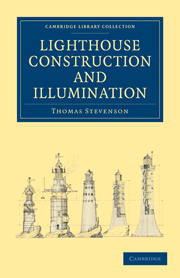
Thomas Stevenson (1818–1887) was the son of the engineer Robert Stevenson, and father of the writer Robert Louis Stevenson. Like his brothers David and Alan, he became a lighthouse designer, being responsible for over thirty examples around Scotland. Throughout his career he was interested in the theory as well as the practice of his profession, and published over sixty articles on engineering and meteorology. He was an international expert on lighthouses, and advised on projects in India, China, Japan, New Zealand and Canada. Lighthouse Construction and Illumination, published in 1881, was an expanded version of his Lighthouse Illumination of 1859, and remained a standard text. Many of his improvements in illumination came into universal use. According to his son, as a result of Thomas' work 'the great sea lights in every quarter of the world now shine more brightly'.
Frederick Overman (1810–1852) was a German-born engineer who emigrated to Pennsylvania in the United States and worked in the booming field of iron manufacturing. He wrote that his book, first published in Philadelphia and then in London in 1850, was designed to be of 'practical utility' to engineers working in the industry. It includes 150 woodcuts to illustrate fully the many different aspects of making iron. Overman covers every part of the process, from the mining of iron ore to the variety of forges that were used, and also includes a chapter about the related steel industry. Today this historic engineering text sheds light on nineteenth-century industrial processes on both sides of the Atlantic during the height of Victorian innovation, making it essential reading for scholars, students, and enthusiasts of this period.
James Erskine-Murray (1868–1927) was a Scots expert in wireless technology who studied under Lord Kelvin for six years at Glasgow University before arriving at Trinity College, Cambridge as a research student. He eventually became a telegraphy consultant and published this work in 1907. Its aim was to inform engineers, students, and radio operators about many aspects of a rapidly changing technology. The book covers recent developments of the time, and a whole chapter is dedicated to the issue of transmission. Erskine-Murray also provided a chapter of tables containing data which he calculated himself and which had not appeared in print before. The work stands as a classic in the field of early engineering texts, and offers contemporary students and radio enthusiasts a useful guide to early wireless technology.
First published in 1873, this co-authored biography of the Scottish physicist, Alpine explorer, and university leader James David Forbes (1809–1868) includes extracts from Forbes' letters. John Campbell Shairp, Forbes' successor as principal of the United College of the University of St Andrews, writes of Forbes' personal, family, and professional life, including his years at St Andrews. Forbes' student and his successor in the Natural Philosophy chair at the University of Edinburgh, Peter Guthrie Tait, himself an accomplished mathematical physicist who co-wrote, with Lord Kelvin, Treatise on Natural Philosophy (1867), discusses Forbes' scientific achievements and contributions. A. Adams-Reilly, a celebrated Irish mountaineer, cartographer, and friend of Forbes, writes of the latter's Alpine travels and his work and interest in glaciers. In Shairp's words, in addition to all of his academic accomplishments, Forbes was also Britain's 'father of Alpine adventure'.
This book has one purpose: to help you understand vectors and tensors so that you can use them to solve problems. If you're like most students, you first encountered vectors when you took a course dealing with mechanics in high school or college. At that level, you almost certainly learned that vectors are mathematical representations of quantities that have both magnitude and direction, such as velocity and force. You may also have learned how to add vectors graphically and by using their components in the x-, y- and z-directions.
That's a fine place to start, but it turns out that such treatments only scratch the surface of the power of vectors. You can harness that power and make it work for you if you're willing to delve a bit deeper – to see vectors not just as objects with magnitude and direction, but rather as objects that behave in very predictable ways when viewed from different reference frames. That's because vectors are a subset of a larger class of objects called “tensors,” which most students encounter much later in their academic careers, and which have been called “the facts of the Universe.” It is no exaggeration to say that our understanding of the fundamental structure of the universe was changed forever when Albert Einstein succeeded in expressing his theory of gravity in terms of tensors.
If you were tracking the main ideas of Chapter 1, you should realize that vectors are representations of physical quantities – they're mathematical tools that help you visualize and describe a physical situation. In this chapter, you can read about a variety of ways to use those tools to solve problems. You've already seen how to add vectors and how to multiply vectors by a scalar (and why such operations are useful); this chapter contains many other “vector operations” through which you can combine and manipulate vectors. Some of these operations are simple and some are more complex, but each will prove useful in solving problems in physics and engineering. The first section of this chapter explains the simplest form of vector multiplication: the scalar product.
Scalar product
Why is it worth your time to understand the form of vector multiplication called the scalar or “dot” product? For one thing, forming the dot product between two vectors is very useful when you're trying to find the projection of one vector onto another. And why might you want to do that? Well, you may be interested in knowing how much work is done by a force acting on an object. The first instinct of many students is to think of work as “force times distance” (which is a reasonable starting point).
The previous chapter contains several ideas that are important to a full understanding of tensors. The first is that any vector may be represented by components that transform between coordinate systems in one of two ways. “Covariant” components transform in the same manner as the original basis vectors pointing along the coordinate axes, and “contravariant” components transform in the inverse manner of those basis vectors. The second main idea is that coordinate basis vectors are tangent to the coordinate axes, and that there also exist reciprocal or dual basis vectors that are perpendicular to the coordinate axes; these dual basis vectors transform inversely to the coordinate basis vectors. The third idea is that combining contravariant components with original basis vectors and combining covariant components with dual basis vectors produces a result that is invariant under coordinate transformation. That result is the vector itself, and the vector is the same no matter which coordinate system you use for its components.
This chapter extends the concepts of covariance and contravariance beyond vectors and makes it clear that scalars and vectors are members of the class of objects called “tensors.”
Definitions (advanced)
In the basic definitions of Chapter 1, scalars, vectors, and tensors were defined by the number of directions involved: zero for scalars, one for vectors, and more than one for tensors.
This chapter provides examples of how to apply the tensor concepts contained in Chapters 4 and 5, just as Chapter 3 provided examples of how to apply the vector concepts presented in Chapters 1 and 2. As in Chapter 3, the intent for this chapter is to include more detail about a small number of selected applications than can be included in the chapters in which tensor concepts are first presented.
The examples in this chapter come from the fields of Mechanics, Electromagnetics, and General Relativity. Of course, there's no way to comprehensively cover any significant portion of those fields in one chapter; these examples were chosen only to serve as representatives of the types of tensor application you're likely to encounter in those fields.
The inertia tensor
A very useful way to think of mass is this: mass is the characteristic of matter that resists acceleration. This means that it takes a force to change the velocity of any object with mass. You may find it helpful to think of moment of inertia as the rotational analog of mass. That is, moment of inertia is the characteristic of matter that resists angular acceleration, so it takes a torque to change the angular velocity of an object.
Many students find that rotational motion is easier to understand by keeping the relationships between translational and rotational quantities in mind.