To save content items to your account,
please confirm that you agree to abide by our usage policies.
If this is the first time you use this feature, you will be asked to authorise Cambridge Core to connect with your account.
Find out more about saving content to .
To save content items to your Kindle, first ensure no-reply@cambridge.org
is added to your Approved Personal Document E-mail List under your Personal Document Settings
on the Manage Your Content and Devices page of your Amazon account. Then enter the ‘name’ part
of your Kindle email address below.
Find out more about saving to your Kindle.
Note you can select to save to either the @free.kindle.com or @kindle.com variations.
‘@free.kindle.com’ emails are free but can only be saved to your device when it is connected to wi-fi.
‘@kindle.com’ emails can be delivered even when you are not connected to wi-fi, but note that service fees apply.
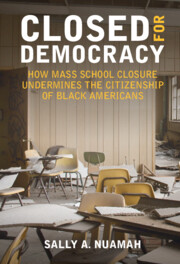
Every year, over 1,000 public schools are permanently closed across the United States. And yet, little is known about their impacts on American democracy. Closed for Democracy is the first book to systematically study the political causes and democratic consequences of mass public school closures in the United States. The book investigates the declining presence of public schools in large cities and their impacts on the Americans most directly affected – poor Black citizens. It documents how these mass school closure policies target minority communities, making them feel excluded from the public goods afforded to equal citizens. In response, targeted communities become superlative participators to make their voices heard. Nevertheless, the high costs and low responsiveness associated with the policy process undermines their faith in the power of political participation. Ultimately, the book reveals that when schools shut down, so too does Black citizens' access to, and belief in, American democracy.
Several studies have found that virtual exchange (VE) has a positive impact on intercultural effectiveness (IE) development. However, few VE studies have measured and unpacked perceived learning gains from VE in this area using data from multiple VEs and mixed-methods approaches. In this study, we explored the impact of VE on perceived IE development among pre-service teachers in two exchanges. Using k-means cluster analysis of reported gains in IE, we identified three groups of students who reported high-medium-low IE gains. Cluster analysis informed our qualitative analysis of students’ reflections on VE. Having analysed data from 486 diary entries at four successive time measurements, we identified three factors critical to students’ perceived IE development: students’ ability to overcome challenges during VE, level of engagement with their partners, and engagement with cultural difference. These findings shed light on what experiences in VE influence participants’ perceptions of their intercultural learning. The study provides recommendations for the design of online collaborative learning programmes, such as VE, that might help address students’ diverse needs.
Studies with an explicit focus on dropouts in blended language learning (BLL) are rare and non-existent in the Asian context. This study replicates the early qualitative interview study by Stracke (2007), who explored why foreign language learners drop out of a BLL class. While the 2007 study was carried out in the German higher education context, we conducted this study at a university in Vietnam, where we conducted semi-structured interviews with five students who had left their blended English course after the first semester of study. Our findings indicate that the successful complementarity and integration of the blend components, the crucial role of teacher support and feedback within a learner-centred environment, interactive learning materials, a high level of interaction, and a good relationship between students and teachers are key for students’ perception of a successful blended class and retention. The lack of complementarity between the components of the blend remains a major reason for students’ dissatisfaction that resulted in them leaving the course in both the 2007 study and this study. Our study allows for a deep understanding of the reasons why Vietnamese EFL students leave a BLL course, thus providing some evidence for pedagogical adjustments for the delivery of current BLL classes in Vietnam and similar contexts. Understanding the reasons why students drop out can help improve the effectiveness of these programs and lead to higher retention rates, a reduction of costs (both financial but also emotional), an increase in student satisfaction, and a better student experience.
The current study is an approximate replication of Gray and DiLoreto’s (2016) study, which proposed a model predicting that course structure, learner interaction and instructor presence would influence students’ perceived learning and satisfaction in online learning, with student engagement acting as a mediator between two of the predictors and the outcome variables. Using mixed methods, the current study investigated whether Gray and DiLoreto’s model would be able to explain the relationships among the same variables in a computer-assisted language learning environment. A mediation analysis was conducted using survey responses from a sample of 215 college-level students, and qualitative analysis was conducted on the survey responses from a subsample of 50 students. Similar to Gray and DiLoreto’s study, positive correlational relationships emerged between the variables. However, the model proposed by Gray and DiLoreto did not fit our data well, leading us to suggest alternative path-analytic models with both student engagement and learner interaction as mediators. These models showed that the role of course organization and instructor presence were pivotal in explaining the variation in students’ perceived learning and satisfaction both directly and indirectly via student engagement and learner interaction. Moreover, qualitative analysis of students’ responses to open-ended questions suggested that from students’ perspectives, course structure was the most salient factor affecting their experiences within online language learning contexts, followed by learner interaction, and then by instructor presence.
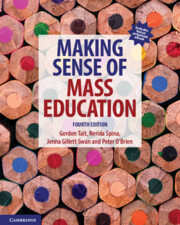
Making Sense of Mass Education provides a contemporary analysis of the ideas and issues that have traditionally dominated education research, challenging outdated preconceptions with fundamental theory and discussion. It takes a demythologising approach in assessing these issues and their relevance to schooling and education in Australia. This text examines the cultural context of education and the influence of external media and new technologies, and highlights the many forms of discrimination in education, including social class, race and gender. It looks at alternative approaches to education, including the repercussions of gathering data to measure school performance, and considers the intersection of ethics and philosophy in classroom teaching. The fourth edition expands on these issues with three new chapters: on sexuality, children's rights, and neoliberalism and the marketisation of education. Each chapter challenges and breaks down common myths surrounding these topics, encouraging pre-service teachers to think critically and reflect on their own beliefs.
We start with a silenced woman. In one of the most notorious discussions of Romantic children’s literature, Charles Lamb’s comments in his letter to Coleridge of 1802, his sister’s voice is absent. Yet Mary Lamb is at the heart of the anecdote, with her attempt to purchase books for the infant Derwent Coleridge:
Goody Two Shoes is almost out of print. Mrs. Barbauld[’s] stuff has banished all the old classics of the nursery; & the Shopman at Newbery’s hardly deign’d to reach them off an old exploded corner of a shelf, when Mary ask’d for them. Mrs. B’s & Mrs. Trimmer’s nonsense lay in piles about. Knowledge insignificant & vapid as Mrs. B’s books convey, it seems, must come to a child in the shape of knowledge, & his empty noddle must be turned with conceit of his own powers, when he has learnt, that a Horse is an Animal, & Billy is better than a Horse, & such like: instead of that beautiful Interest in wild tales, which made the child a man, while all the time he suspected himself to be no bigger than a child. Science has succeeded to Poetry no less in the little walks of Children, than with Men. —: Is there no possibility of averting this sore evil? Think what you would have been now, if instead of being fed with Tales and old wives’ fables in childhood, you had been crammed with Geography & Natural History.?
Charles Lamb’s vituperative comments are well known; Mary’s presence in the scene is overlooked. Yet we might assume, from her specific request to the shopman, that she had her own opinions about the sort of literature which would be suitable for a child to learn to read. She had, after all, taught Charles, her junior by ten years; she
would continue tutoring children until late in life, among them the Shakespeare scholar Mary Cowden Clarke. But her voice is drowned out by Charles’ exuberant damnation of ‘the cursed Barbauld Crew, those Blights & Blasts of all that is Human in man & child’. Partly, this is misogynist bravado, as, after an uncomfortable rift of two years, Charles Lamb re-establishes his friendship with Coleridge: he aims to recall the homosociality of their young London years together, fuelled by tobacco and egg-hot in the Salutation and Cat.
Before she became a professional writer, Mary Wollstonecraft was an educator: mistress of a school in Newington Green in the mid-1780s and later governess to the children of Irish Ascendancy aristocrats. Her first published works were explicitly pedagogical, but in almost every text in her extensive corpus, she reflects on how best to form self-governing moral subjects capable of committed (world) citizenship. This emphasis on moral autonomy finds political expression through her republican resistance to arbitrary rule, which informs both A Vindication of the Rights of Men (1790) and A Vindication of the Rights of Woman (1792). In the year between the publication of these famous political tracts, she produced illustrated second editions of two educational works, Original Stories from Real Life (1788) and Elements of Morality, for the Use of Children (1790). Elements is a translation from the German of Christian Gotthilf Salzmann’s Moralisches Elementarbuch (1782–3; new edition 1785), but, as I have argued elsewhere, Wollstonecraft’s interventionist translational strategy gives her version the status of a creative work in its own right. In her preface, she invites the reader to make intertextual connections between Original Stories and Elements, both of which feature pedagogical figures who give children the freedom to learn from experience instead of submitting blindly to authority. For Wollstonecraft, the resulting independence lays the groundwork for the fulfilment of our moral potential. She goes further than Salzmann, however, in modelling virtue as benevolence impervious to race, culture or creed – a cosmopolitan philanthropy, in the predominant eighteenth-century sense of ‘love of humankind’. This philosophy shapes both her pedagogy and her politics. In her first published work, Thoughts on the Education of Daughters (1787), she enjoins her young readers to practise charity because ‘goodwill to all the human race should dwell in our bosoms’.
In Rights of Men, she declares that ‘all feelings are false and spurious, that do not rest on justice as their foundation and are not concentred by universal love’. In Rights of Woman, she describes her feminism as the outgrowth of ‘affection for the whole human race’, and in An Historical and Moral View of the Origin and Progress of the French Revolution (1794), she argues for ‘a more enlightened moral love of mankind’.
Literary history has tended to underplay the comic and the humorous in eighteenth-century women’s writing. While Restoration women wits are granted some licence to amuse, and late-eighteenth- century authors such as Frances Burney, Maria Edgeworth and the caustic Jane Austen are admitted as decorous representatives of ‘comic feminism’, both scholarship and university curricula conspire to consign the women novelists of mid-century to a dull didacticism. Women writers associated with Samuel Richardson tended to be regarded, like him, as didactic or sentimental, rather than amusing or (heaven forbid) funny. Sarah Fielding, author of The Governess: or, The Little Female Academy (1749), has long been recognised as an educational writer. But Fielding’s work is also distinguished by a singular sense of humour. Fielding’s witty satires ironise and calibrate moral actions and mental thoughts; her fictions activate and reform their readers–educating through fable, allegory, anecdote and droll commentary. Though sometimes characterised as a mid-century modification of Augustan satire, a ‘calm and subdued’ form which ‘involves self-doubt’ in its efforts to instruct and improve readers, Fielding’s humour can also be sceptical, caustic and even crude. With her collaborator, the irreverent satirist Jane Collier, Fielding planned a work entitled The Laugh, designed as a companion piece to their experimental prose work The Cry (1754). Both works aim to ‘laugh [readers] out of […] absurdities’, educating through amusement, drollery and fun. In contrast to the baleful critical commonplace of the downtrodden woman writer, Fielding displays a trenchant sense of humour in the face of gendered adversity – a keen grasp of the ridiculous equal to that of her rambunctious male peers. Such qualities would have been essential for withstanding what is increasingly conceptualised as an unsentimental eighteenth century: nasty, brutish and long.
This chapter argues that by focusing on the sombre, grave and serious aspects of the educational mode, critics have missed its comic strains, and ignored the instructive power of mirth in women’s writing. I explore the ways in which Sarah Fielding uses humour to educate and reform her readers, and to inform them about their relative powerlessness in the world. Though The Governess is the most explicitly didactic of Fielding’s works, her entire corpus uses ‘narrative techniques, episodes, and themes all directed towards moral education’.
Lucy Barton Fitzgerald, daughter of Quaker poet Bernard Barton, and briefly Edward Fitzgerald’s wife, ‘revelled’ in ‘Grecian Stories when they first appeared […] during the Christmas holidays’ of 1819, when she was about eleven years old, and ‘well remember[ed]’ crying at Maria Hack’s portrayal of Socrates’ death. This chapter examines how and why prolific children’s author Maria Hack deployed the ancient Athenian philosopher Socrates as a role model of successful Christian pedagogy. Hack (1777–1844) and her near contemporary Priscilla Wakefield (1751–1832) were prominent children’s authors from established Quaker families who published with Quaker firm Harvey and Darton. Both women exploited Greco-Roman antiquity to consolidate their pedagogic programmes: classical exemplars, particularly Socrates, facilitated both authors’ modelling of age-appropriate and individually tailored familiar dialogue templates for moral and religious socialisation. Hack adapted Socratic dialogue to challenge contemporary maxims surrounding the moral and educational value of historical exemplars, and further transformed them by promoting ideals specific to the Dissenting religious Society of Friends: Socrates becomes a model for parental pedagogy and even a Christlike proto-Quaker, whose educational method is portrayed as a modern, accessible substitute for miracle-working.
Barton Fitzgerald’s Christmas tears were prompted by the first edition of Hack’s Grecian Stories. In 1840, adverts for Hack’s new, illustrated edition cited a review from the East Anglian Circular for ‘prompt[ing] the youthful mind to the acquisition for itself of further knowledge […] exercising its own judgement’. The reviewer, quoting seventeenth-century French historian Charles Rollin, that ‘history, when properly taught, becomes a school of morality, and shows, by thousand examples, more effectual than any reasoning, that virtue is man’s real good’, concludes: ‘we have seldom seen a volume on the subject more calculated to attain so desirable an end, then Maria Hack’s Grecian Stories’.
What this reviewer omits is that Hack’s achievement was her stated aim. To improve existing histories inspired by Rollin’s expansion of Cicero’s maxim ‘history teaches life’, Hack transformed the mode of delivery, familiar dialogue, innovatively ‘prompting’ child readers to an independent ‘acquisition’ of knowledge and ethical ‘judgement’. This reviewer, concerned with how Hack meets Rollin’s criteria for historical education, fails to notice that this innovation is designed to supersede existing textbooks with more effective practical learning. Hack’s focus on nuanced yet active moral reasoning, shaped by Quaker ideals, challenges Rollin’s assertion that historical exemplars are ‘more effectual than any reasoning’.
When Anna Letitia Barbauld popularised the ‘New Walk’ with Lessons for Children, sparking the creation of the genre of the conversational primer, she united women with significantly different educational goals. Charles Lamb misogynistically excoriated ‘the cursed Barbauld crew’ for writing books ‘in the shape of knowledge’, identifying Anna Letitia Barbauld and Sarah Trimmer as key criminals in this apparent travesty. Unnamed in Lamb’s tirade, but almost certainly present in this ‘crew’, was Lady Ellenor Fenn, whose works were sold under at least eight pseudonyms revolving around the names ‘Lovechild’ and ‘Teachwell’. Barbauld, Trimmer and Fenn all published rational educations for young children packaged as home-based conversations directed by an affectionate Mamma. Indeed, Trimmer and Fenn paid homage to Lessons for Children in their prefaces, acknowledging Barbauld as their literary progenitor in An Easy Introduction to Nature (1780) and Cobwebs to Catch Flies (1783), respectively. Yet these women’s pedagogical goals and literary contributions differed vastly. Barbauld was a liberal Arian Presbyterian and a political radical who wrote political polemics, devotional essays, poems and children’s literature, and was active in manuscript and print cultures. Unconventionally, Barbauld’s Lessons omits references to God, reflecting her belief that strict doctrine and liturgies are not central to faith. Trimmer’s educational agenda, by contrast, is contextualised by her devotion to the Church of England and political conservatism. An Arminian-leaning orthodox Anglican, Trimmer used An Easy Introduction to lay the groundwork for her nationally aimed religious education programme. She explicitly framed later editions of An Easy Introduction as part of an induction into Anglican faith. Fenn’s Cobwebs to Catch Flies, meanwhile, ‘recruits mothers to take control of their children’s early reading in the nursery’. Like a strand of its eponymous web, Cobwebs functions as a part of Fenn’s broader teaching schemes, which encompassed educational games and toys. Glancing at the women’s philosophical allegiances side by side, one feels like exclaiming alongside Barbauld, ‘There is no bond of union among literary women.’
Though there is truth in accusations that a simplistic grouping of ‘sister authors for the young […] collapses together […] liberal compromises [… and] deep-seated conservatism’, Barbauld, Trimmer and Fenn can be considered together as popular authors of conversational primers.
Instructing the young in geography began in Britain in the eighteenth century. John Locke advised that it could be taught to young children in his treatise Some Thoughts Concerning Education. As a new subject of instruction, geography was presented variously as a ‘useful amusement for boys’, a ‘delightful and useful Amusement for Ladies’, an ‘accomplishment for gentlemen’. Like much science in the eighteenth century, geography was perceived as a polite subject, useful for contributing to conversation in the spaces of sociability of eighteenth-century culture. According to a contemporary commentator, adults ‘cannot well converse either with Men or Books […] without some knowledge of geography’. It was also thought the best subject ‘to initiate [the Fair Sex] in the study of useful knowledge’. The minds of both sexes were considered ‘improvable’, and ‘to occasion an innate love of Virtue and Knowledge must be to increase human felicity […] Science naturally tends to enlarge ideas, to give a benevolence of mind, to moderate the passions, and to render human nature charming.’ Because of the moral necessity of improvement associated with the practice of politeness, geography texts often had a didactic objective.
Taught by and to both sexes, geography instruction was largely not gendered. Although some texts were designed for ‘Ladies’, this did not mean their content was made easier than that taught to males. Rather, it meant avoiding the use of language or concepts females tended not to learn, such as Latin or geometry. William Butler’s Exercises on the Globes Specifically for the Use of Young Ladies (1803), for example, was not simplified but amplified. He required his pupils to learn definitions and technical terms and provided ‘anecdotes from biography, and […] facts from natural history and the annals of nations’ to construct a wide cultural frame for dry designations. For instance, Butler’s definition of longitude includes a reference to Hipparchus, who ‘determined the longitude and latitude of places; which he effected by observing the stars, and thus, by connecting geography with astronomy, fixed that science on certain principles’. Nor are the problems on the Globes simplified for female consumption; they are identical to those in other schoolbooks.
Letitia Elizabeth Landon (L.E.L.) and Elizabeth Barrett Browning (E.B.B.) achieved literary fame in the 1820s and 30s through their remarkable ability, despite educational obstacles, to imitate and translate ancient Greece. L.E.L. was renowned as the Brompton ‘Sappho’, performing in society soirées with her hair in ancient fashion like the lyric poet. Published in weekly magazines, monthly journals and annual giftbooks, which were striking for their classical ‘embellishments’ and verses on Hellenic and Philhellenic topics, her poems were regathered in anthologies and collections under antique and antiquarian titles: ‘Classical Sketches’, ‘Subjects for Pictures’, ‘Medallion Wafers’. E.B.B., meanwhile, was lauded as a teenage prodigy, the ‘author of the Battle of Marathon’ (1820), published when she was aged fourteen, and An Essay on Mind (1826), her first collection which included many Philhellenic poems. She was to go on to produce two different translations of Prometheus Bound, in 1833 and 1850, as well as Aurora Leigh (1857) with its many classical allusions.
The contemporary celebration of these two extraordinary classical ‘poetesses’ at a time when women were excluded from studying ancient Greek in educational institutions might seem paradoxical. As many literary historians have pointed out, there was a sharp gender polarity in formal classical education in the eighteenth and nineteenth centuries. Classics constituted a form of cultural capital offering access to positions of power in the establishment. Upper-and middle-class boys and men were schooled in Latin and Greek, while women and girls might have access to some Latin through home tutors or governesses but very rarely to ancient Greek. There was, of course, no university education for women in Britain until 1869. George Eliot satirised the prevailing attitude towards female classical learning in the first half of the nineteenth century in the voice of Mr Brooke, who warns Mr Casaubon that ‘such deep studies, classics, mathematics, that kind of thing, are too taxing for a woman – too taxing, you know […] there is a lightness about the feminine mind’. Femininity seemed specifically to entail not knowing Greek. Exclusion from classical languages and a knowledge of ancient literature went hand in hand with political and social marginalisation.