To save content items to your account,
please confirm that you agree to abide by our usage policies.
If this is the first time you use this feature, you will be asked to authorise Cambridge Core to connect with your account.
Find out more about saving content to .
To save content items to your Kindle, first ensure no-reply@cambridge.org
is added to your Approved Personal Document E-mail List under your Personal Document Settings
on the Manage Your Content and Devices page of your Amazon account. Then enter the ‘name’ part
of your Kindle email address below.
Find out more about saving to your Kindle.
Note you can select to save to either the @free.kindle.com or @kindle.com variations.
‘@free.kindle.com’ emails are free but can only be saved to your device when it is connected to wi-fi.
‘@kindle.com’ emails can be delivered even when you are not connected to wi-fi, but note that service fees apply.
The pedagogic considerations and practical ideas presented in this volume offer, we believe, a compelling rationale for exploring the potential of deeper learning across a wide range of subjects through an explicit focus on subject literacies that:
Promote the prioritisation of deeper understanding of subject-specific concepts alongside subject-specific ways of constructing and communicating that understanding.
Illustrate how a continuous focus on meaning-making and languaging of understanding will not only support and facilitate conceptual understanding of subject content but will also render learning more transparent by making subject-specific thinking and processing visible and thus more accessible and easier to grasp for learners.
Emphasise that using more than one language in subject lessons to highlight subject-specific ways of meaning-making across languages can be a powerful learning catalyst. This is because a focus on PLURI-literacies will create synergies that will increase our learners’ meaning-making potential by empowering them to successfully communicate across subjects and languages, purposefully using a wide variety of genres, modes and styles.
Show that the concept of deeper learning episodes (DLEs) is compatible with a wide range of subjects. At the same time, the experts report that our suggested template for designing such episodes, along with the guiding questions we developed, constitute useful planning tools that offer practitioners effective, systematic and adaptable guidance in designing DLEs.
We hope that readers will be inspired to adapt their approach to learning by moving from focusing on ‘teaching students’ to mentoring their learners’ personal growth in explicit ways. PTDL suggests novel ways of rethinking and adapting teaching strategies by providing opportunities for building, applying and transferring understanding as it evolves. This will facilitate deeper learning and foster engagement, commitment and mastery orientation.
While understanding the mechanics of deeper learning is fundamental, deeper learning can only become a reality in our classrooms when we pay close attention to the drivers of deeper learning. This will allow learners to embrace a deeper learning mindset, which is required to develop academic tenacity or resilience, to work consistently over sustained periods of time, to engage in and master challenging tasks, to successfully interact with their peers and to self-regulate their learning.
This chapter aims at clarifying basic concepts related to multimedia: communication, comprehension, and learning. Multimedia communication is considered as the intentional creation, display, and reception of multiple kinds of signs in order to convey messages about some content. It entails two subprocesses: meaning and comprehension. Multimedia meaning is a process in which the producer of a message creates multiple external signs based on his or her prior knowledge in order to direct the recipient’s mind so that the recipient understands what the producer means. Multimedia comprehension is the complementary process of reconstructing the previously externalized knowledge in the mind of the recipient. It can be seen as the bottleneck of multimedia communication. Multimedia comprehension and multimedia learning are related but are nevertheless different: While multimedia comprehension results in transient changes in working memory, multimedia learning results in permanent changes in long-term memory. Multimedia learning is a byproduct of multimedia comprehension. Further, an overview of the book is presented.
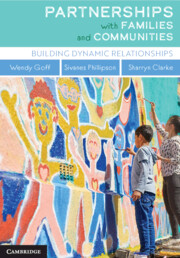
Partnerships with Families and Communities: Building Dynamic Relationships is a comprehensive and accessible resource that provides pre-service teachers with the tools required to build effective, sustainable and proactive partnerships in both early childhood and primary educational settings. This text introduces models of home-school-community partnerships in educational contexts and presents a comprehensive partnerships approach for best practice in applying and leading effective relationships with key stakeholders. It explores essential underpinning policies, legislation and research theories that position strong, positive and proactive partnerships as a systemic solution to children's learning development. Key topics covered include diversity in partnership work, reflective practice and tools for evaluating working partnerships. Each chapter includes focused pedagogy, key terms and definitions, scenarios and review questions, which enable readers to deeply engage with new concepts. 'Proactive Partners' boxes explore real-world scenarios and encourage readers to link theory with practice.
Achieving Sustainable Development Goal 4 is underpinned by the provision of quality inclusive education for all young persons, including persons with disabilities. The universal design for learning (UDL) framework provides the basis for establishing an inclusive pedagogical learning environment in classrooms. However, implementing such an inclusive pedagogical framework continues to be profoundly challenging across all countries, including Australia. Teacher attitude is the most important construct in efforts to create inclusive educational contexts. The aim of this study was to examine secondary school teachers’ attitudes towards the UDL framework in Australia. One hundred and twenty mainstream secondary classroom teachers in Sydney completed an online survey. The mean values and standard deviations of a self-designed UDL framework were calculated to examine teacher attitudes. Correlations and multiple regressions were conducted to verify the relationship between teachers’ attitudes and their background variables. The main results indicated that Australian secondary school teacher attitudes towards the UDL framework were generally positive, although they still had some practical concerns, such as having inflexible ideas about how to provide instructions. The findings provide useful insights for developing professional teacher training to promote inclusive education, where the UDL framework is a lens for interpreting inclusive education.
Preparing teachers to work with and for diversity in their classrooms and beyond is an objective that seems to be globally accepted in pre-service and in-service teacher education. However, what diversity means, what it entails and how to engage with diverse individuals in educational contexts can take on multiple shapes in different parts of the world. This Element suggests that the multifaceted and polysemic notion of interculturality could be useful to unthink and rethink (ad infinitum) working with diverse people in education. The Element surveys the different meanings and ideologies attached to the notion, using a multilingual perspective to do so. Recent research published internationally on the topic and its companions such as multicultural is also reviewed. The main addition to the field is a critical and reflexive perspective which is proposed for teacher educators, (students) teachers and researchers. The proposal draws from Dervin's most up-to-date theoretical and pedagogical work.
This chapter introduces the rationale and conceptual ideas for partnership work in education settings in the early years and primary setting. It provides arguments for building dynamic relationships as the basis of partnerships with families and community. You will learn about the benefits of partnerships and how these benefits can impact positively on children, families, professionals and communities as a whole.You will also explore key underpinning policies, legislations and research theories that positions strong, positive and proactive partnerships as a systemic solution to children’s learning development.At the same time, you will be able to appreciate the need to form partnerships for the good of children’s development as well meet the standards of practice that teachers and professionals in general should aspire to achieve.This chapter sets the stage for the rest of book, which aims at enabling and empowering you to build authentic and sustainable partnerships with families, external professionals and community representatives.
In this chapter, we begin by looking at ways that you can plan and implement partnership work. Together, we will learn about a range of different approaches that we can use when planning on building relationships. We will examine strategies to determine the appropriate approach and come to an understanding on the importance of co-design in partnerships. This chapter will show you how to draw on the second premise of the TWINE Model of Partnership – to plan – so that you can prepare yourself to start implementating partnership work.
In this chapter, your thinking around leading partnerships will be challenged. Throughout this chapter, you will be supported to develop a critical understanding of how leadership can impact partnerships, both positively and negatively.In the chapters so far, you have explored conceptual and practical components of partnerships and the key aspects that lead to successful partnership work.We have explored how diversity can challenge us as well as enrich our understanding of family and ways of being. We have also delved deeply into developing approaches, actions, strategies and tools to implement effective partnerships whereby we can measure their success.Of critical importance is how we lead all these processes.The aim of this chapter is for you to identify when leadership approaches need to change in response to the positioning of partnership work and ensure a way forward for all parties.
In this chapter, we build on the legislative requirements, conceptual ideas and theories that underpin the way we see and understand partnership work in education settings. As you engage with the chapter, you will be introduced to theoretical modelling and ideas that can inform your work with families, professionals and community. The ideas presented in this chapter will also support you to understand the various practices and communication strategies that are introduced in the succeeding chapters in this book.
In this chapter, we discuss and illustrate the tools of evaluating partnership work as part of a continuous improvement that you will need to make when building partnerships. As you engage with the chapter, you will learn what evaluation is and how to use evaluation to ensure that partnerships work for the benefit of children and their families. Throughout the chapter, we will explore different methods for collecting data and analysis, including various strategies that will inform the improvement and change necessary for good work in partnership-building.