To save content items to your account,
please confirm that you agree to abide by our usage policies.
If this is the first time you use this feature, you will be asked to authorise Cambridge Core to connect with your account.
Find out more about saving content to .
To save content items to your Kindle, first ensure no-reply@cambridge.org
is added to your Approved Personal Document E-mail List under your Personal Document Settings
on the Manage Your Content and Devices page of your Amazon account. Then enter the ‘name’ part
of your Kindle email address below.
Find out more about saving to your Kindle.
Note you can select to save to either the @free.kindle.com or @kindle.com variations.
‘@free.kindle.com’ emails are free but can only be saved to your device when it is connected to wi-fi.
‘@kindle.com’ emails can be delivered even when you are not connected to wi-fi, but note that service fees apply.
In Chapter 8, we reprise the economic concepts examined in the preceding chapters and introduce four emerging dogonomic topics. We showed how neoclassic economics is central to understanding both supply and demand for dogs, and behavioral economics also helps understand demand. We also posit four important emerging topics. First, we consider the evolution of the property rights of dogs and of property rights with respect to dogs. Second, we explain how we expect these property rights changes to affect policies relevant to the welfare of dogs. Third, we discuss the emergence of interest group politics around dogs. Fourth, we review the emergence of canine genetic sequencing and of phenotypic behavior to lead to further boutique selection, a step beyond artificial selection, and the likely impact of cloning.
In Chapter 3, we analyze the demand side of the market for dogs. We first consider some implications of the tension between treating dogs as property and their commonly perceived status as family members. We report on the increasing prevalence of dogs in U.S. households and review the survey evidence that shows that a large majority of households now consider dogs to be family members. We describe some of the factors and reasons that affect the demand for dogs in general, and the differences across socio-demographic groups. We consider whether pets are (economic) substitutes or complements for children. We address particularly economic explanations for potential inefficiencies (market failures) in the demand for dogs. We then consider demand for specific types or breeds of pet dogs, which can be explained partly by the theory of fads. Finally, we consider dog ownership in two circumstances: first, dog ownership by the homeless; second, the (perhaps temporary) increase in dog ownership during the COVID pandemic. We use microeconomic analysis of markets to help understand the surge in dog ownership induced by COVID and predict its long-term impacts.
In Chapter 7, we expand on the working roles of dogs and classify current canine occupations. We introduce the theory of comparative advantage and note its important role in evolutionary science. We classify canine occupations in terms of two dimensions: the type of dog advantage (comparative, absolute, or unique) and whether the occupation requires a higher or lower level of training. These occupations include service (guide, hearing, disabled, and psychiatric assistance), emotional support, therapy, hunting, herding, racing, search & rescue, substance detection, police work, diabetic alerting, cancer detection, and seizure alerting. We explain the trade-offs between selection and training across occupations, both in terms of breeds and juvenile dogs within breeds. We examine two studies that employ cost-benefit analysis. First, we present an analysis of the social benefits of guide dogs. Second, we discuss the controversy surrounding the treatment of emotional support animals in air travel and the cost-benefit analysis the Department of Transportation used to support its rule that allowed airlines to treat emotional support animals as pets rather than as service animals.
In Chapter 6, we confront the reality that many dog owners must eventually face decisions about their dogs’ end-of-life, potentially including hard decisions about euthanasia or costly medical interventions. We frame these decisions about ending life in terms of the owners’ fiduciary responsibilities and what they imply across different property rights regimes. We show how framing the relationship between dogs and humans in terms of principal-agent theory may offer some novel insights about responsibilities. We explore the appropriateness of euthanasia and how individual preferences and societal perspectives on its appropriateness have changed over time. We then examine the growth in pet health insurance and pre-paid veterinary plans and how this growth affects the economics of the choice between various treatments and euthanasia. We conclude by considering how individual and societal attitudes toward the use of dogs in medical research have changed over time. Nonetheless, although the number of dogs used in research has declined in recent years, many dogs still suffer and experience premature death.
In Chapter 5, we explain how a stated preference method, contingent valuation, is used to estimate the value of statistical dog life (VSDL). This shadow price is useful in cost-benefit analyses, included in regulatory impact analyses of rules that affect canine mortality risk. We explain how economists estimate the value of statistical life (VSL) and how to interpret it. We motivate the value of the VSDL with the melamine pet food disaster, which killed many dogs and cats and resulted in the Food and Drug Administration being given more authority to regulate pet food. The VSDL was estimated using a survey experiment presented to dog owners in a national survey. Respondents were asked about their willingness to pay for a reduction in the mortality risk that their dogs face from canine influenza. We describe the construction of the survey instrument and the experimental design, and then demonstrate how the statistical analyses of the resulting data can reduce behavioral biases that might reduce the validity of the results. We conclude by considering how the VSDL may be extended beyond regulatory analysis to tort and divorce law and public policy more generally.
In Chapter 4, we examine the supply of dogs to the U.S. market. We first explain two potential sources of social inefficiency in the market: information asymmetry and negative externality. We then explore the heterogeneous nature of the sources of supply. Based on organizational form, we distinguish between commercial and so-called backyard breeders. Based on the ethics of practice, we distinguish between ethical breeders who provide high-quality care and unethical breeders who do not. We relate our six resulting categories of supply, including puppy mills and shelters, to the information asymmetry, negative externality, and a third potential market failure, the public good nature of the problem of protecting dogs from cruelty. Finally, we argue that serious market failures provide justification for government intervention to increase efficiency. However, the current patchwork of regulations and lack of resources invested in enforcement allow puppy mills and black-market breeders to impose costs on others and harm dogs.
In Chapter 1, we set out the big question that this book seeks to answer: How does economics help us understand the various relationships between human beings and dogs? We label our effort to answer this big question and the many related economic questions and issues as “dogonomics.” To frame the question, we introduce two somewhat differing economic perspectives: neoclassical economics, which assumes individual rationality, and behavioral economics, which argues that people act irrationally in predictable ways. We make the case that, although many dogs are bought and sold in markets, they are unlike other commodities and most other animals. Dog exceptionalism is real. Indeed, they often have a dual nature as both commodity and family member.
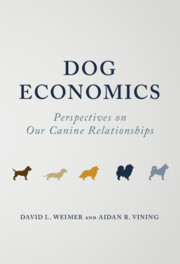
Archaeologists, anthropologists, and evolutionary biologists study the origins of our relationship with dogs and how it has evolved over time. Sociologists and legal scholars study the roles of dogs in the modern family. Veterinarian researchers address the relationship in the context of professional practice, yet economists have produced scant scholarship on the relationship between humans and dogs. Dog Economics applies economic concepts to relationships between people and dogs to inform our understanding of their domestication. It interprets their contemporary role as both property and family members and explores factors that affect the demand for dogs as well as market failures of the American puppy market. Offering economic perspectives on our varied relationships with dogs, this book assesses mortality risks and addresses end-of-life issues that commonly arise. It develops a framework for classifying canine occupations, considers the impact of pet insurance on euthanasia, and assesses the social value of guide dogs.
The branch of psychology that studies how physical objects are perceived by subjects is known as psychophysics. A feature of the experimental design is that the experimenter presents objectively measurable objects that are imperfectly perceived by subjects. The responses are stochastic in that a subject might respond differently in otherwise identical situations. These stochastic choices can be compared to the objectively measurable properties. This Element offers a brief introduction to the topic, explains how psychophysics insights are already present in economics, and describes experimental techniques with the goal that they are useful in the design of economics experiments. Noise is a ubiquitous feature of experimental economics and there is a large strand of economics literature that carefully considers the noise. However, the authors view the psychophysics experimental techniques as uniquely suited to helping experimental economists uncover what is hiding in the noise.
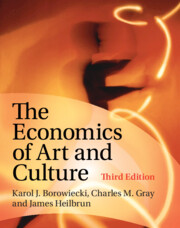
Spanning the economics of the fine arts, performing arts, and public policy, this updated classic is the go-to resource for navigating today's creative industries. Building on real-world data, engaging case studies, and cutting-edge research, it prepares students for careers in the cultural, creative, and public sectors. By avoiding mathematical treatments and explaining theories with examples, this book develops theoretical concepts from scratch, making it accessible to readers with no background in economics. While most of the theory remains timeless, this new edition covers changes in the world's economic landscapes. Updates include new sections on gender representation, cultural districts and tourism, digital broadcasting and streaming, how technology impacts the arts, and arts management and strategy. The authors demonstrate data-driven decision-making using examples and cases from various databases. Students learn to assess academic results and apply the learned material using the discussion questions and problem sets.
Chapter 5 illustrates how demand responds to changes in the forces on which it depends. Using the theory of consumer behavior, we start out by explaining the concepts of price, income, and cross-price elasticity of demand, as well as how to derive these elasticities. We will also cover empirical evidence on the actual value of the price and income elasticities of demand for the live performing arts in several countries over several different time periods.
This chapter provides insights into how the arts labor market works. We seek to understand what motivates artists to pursue their chosen professions and discuss whether the concept of the “starving artist” is valid. Using an artist survey, we explore the stated opinions of an artist to describe who can be classified as a professional artist. We shed light on the labor market of artists by investigating the role of unions, the “superstar” phenomenon, and the decision problem of an artist using the human capital model. Finally, we discuss gender representation in the labor market as well as the gig labor market.