Refine search
Actions for selected content:
173654 results in Earth and Environmental Sciences
Future design: futurability, presentability, and pastability
-
- Journal:
- Global Sustainability / Volume 8 / 2025
- Published online by Cambridge University Press:
- 06 November 2025, e47
-
- Article
-
- You have access
- Open access
- HTML
- Export citation
Tracing the 14C bomb peak in Pierre Soulages’ artworks to improve radiocarbon dating of 20th century paintings
-
- Journal:
- Radiocarbon , First View
- Published online by Cambridge University Press:
- 06 November 2025, pp. 1-11
-
- Article
-
- You have access
- Open access
- HTML
- Export citation
Index
-
- Book:
- Impact of Urban Floods on Water Quality
- Published online:
- 23 October 2025
- Print publication:
- 06 November 2025, pp 144-147
-
- Chapter
- Export citation
Disappeared ice, vanishing life: The end of the largest glacier of the Bergamo Alps (Italy) and the consequences for its endemic biodiversity
- Part of
-
- Journal:
- Annals of Glaciology / Volume 66 / 2025
- Published online by Cambridge University Press:
- 06 November 2025, e34
-
- Article
-
- You have access
- Open access
- HTML
- Export citation

Transport and mixing in control volumes through the lens of probability
- Part of
-
- Journal:
- Journal of Fluid Mechanics / Volume 1020 / 10 October 2025
- Published online by Cambridge University Press:
- 06 November 2025, A26
-
- Article
-
- You have access
- Open access
- HTML
- Export citation

The influence of an insoluble surfactant on capillary oscillations of a bubble in a liquid
-
- Journal:
- Journal of Fluid Mechanics / Volume 1022 / 10 November 2025
- Published online by Cambridge University Press:
- 06 November 2025, A45
-
- Article
- Export citation
Contents
-
- Book:
- Impact of Urban Floods on Water Quality
- Published online:
- 23 October 2025
- Print publication:
- 06 November 2025, pp v-vii
-
- Chapter
- Export citation
10 - “The Sponge City” Initiative in China
-
-
- Book:
- Impact of Urban Floods on Water Quality
- Published online:
- 23 October 2025
- Print publication:
- 06 November 2025, pp 128-138
-
- Chapter
- Export citation
7 - Coping with Water Supply and Water Quality Problems during Floods and Their Management
-
-
- Book:
- Impact of Urban Floods on Water Quality
- Published online:
- 23 October 2025
- Print publication:
- 06 November 2025, pp 95-102
-
- Chapter
- Export citation
Uncovering an eruptive history using new tephra data from Argentine lacustrine cores linked to Chilean volcanoes in the southern segment of the Southern Volcanic Zone
-
- Journal:
- Quaternary Research , First View
- Published online by Cambridge University Press:
- 06 November 2025, pp. 1-21
-
- Article
- Export citation
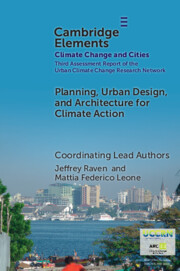
Planning, Urban Design, and Architecture for Climate Action
-
- Published online:
- 05 November 2025
- Print publication:
- 11 December 2025
-
- Element
-
- You have access
- Open access
- HTML
- Export citation
Investigation of the High-pressure Behaviour of Clinochlore by X-ray Diffraction and Infrared Spectroscopy
-
- Journal:
- Mineralogical Magazine / Accepted manuscript
- Published online by Cambridge University Press:
- 05 November 2025, pp. 1-18
-
- Article
-
- You have access
- Export citation

Large aspect ratio Rayleigh–Bénard convection perturbed by a floating immersed body
-
- Journal:
- Journal of Fluid Mechanics / Volume 1022 / 10 November 2025
- Published online by Cambridge University Press:
- 05 November 2025, A41
-
- Article
- Export citation
-
Turbulent Rayleigh–Bénard convection in an extended layer of square cross-section with moderate aspect ratio $L/H=8.6$ ( $L$ is the length of the cell, $H$ is its height) is studied numerically for Rayleigh numbers in the range ${\textit{Ra}}= 10^6{-}10^8$. We focus on the influence of different types of boundary conditions, including asymmetrical ones, on the characteristics of Rayleigh–Bénard convection with and without an immersed freely floating body. Convection without a floating body is characterised by the formation of stable thermal superstructures with preferred location. The crucial role of the symmetry of the boundary conditions is revealed. In the case of thermal boundary conditions of different types at the upper and lower boundaries, the flow pattern in Rayleigh–Bénard convection has a regular shape. The immersed body makes random wanderings and actively mixes the fluid, preventing the formation of superstructures. The mean flow structure with an immersed body is similar for all combinations of boundary conditions except for the case of a fixed heat flux at both boundaries. The floating disk does not change the tendency of turbulent convection to form a circulation of the maximal available scale under symmetric Neumann-type conditions. The type of boundary conditions has a weak influence on the Nusselt and Reynolds number values, significantly changing the ratio of the mean and fluctuating components of the heat flux. As the Rayleigh number increases, the motions of the body become more intensive and intermittent. The increase of $Ra$ also changes the structure of the mean flow without the body but the additional mixing provided by the floating body preserves the flow structure.


Controls on sediment supply to the Holocene Thar Desert: Sr and Nd isotopes with bulk-sediment geochemical constraints
-
- Journal:
- Geological Magazine / Volume 162 / 2025
- Published online by Cambridge University Press:
- 05 November 2025, e46
-
- Article
-
- You have access
- Open access
- HTML
- Export citation

Gravity drives the flow within the Stewartson layer in centrifugal convection
-
- Journal:
- Journal of Fluid Mechanics / Volume 1022 / 10 November 2025
- Published online by Cambridge University Press:
- 05 November 2025, A43
-
- Article
- Export citation
-
We conduct three-dimensional numerical simulations on centrifugal convection (CC) in a closed annular container, incorporating gravity and no-slip top and bottom boundaries, to systematically investigate rotation-induced secondary flow. The Stewartson layer, identified by an elongated circulation in mean vertical velocity plots, emerges near the inner and outer cylinders only beyond a critical gravitational forcing. Quantitative analyses confirm that the layer thickness scales as $\delta _{\,\!\textit{st}}\sim {\textit{Ek}}^{1/3}$ due to rotational effects, consistent with results from rotating Rayleigh–Bénard convection, where $Ek$ represents the Ekman number. The internal circulation strength, however, is determined by both gravitational buoyancy and rotational effects. We propose that gravitational buoyancy drives the internal flow, which balances against viscous forces to establish a terminal velocity. Through theoretical analysis, the vertical velocity amplitude follows $W_{\,\!\textit{st}}\sim {\textit{Ek}}^{5/3}\,Ro^{-1}\,{\textit{Ra}}_g\,Pr^{-1}$, showing good agreement with simulation results across a wide parameter range. Here, $Ro^{-1}$ represents the inverse Rossby number, ${\textit{Ra}}_g$ is the gravitational Rayleigh number, and ${\textit{Pr}}$ is the Prandtl number. The theoretical predictions match simulations well, demonstrating that the Stewartson layer is gravity-induced and rotationally constrained through geostrophic balance in the CC system. These findings yield fundamental insights into turbulent flow structures and heat transfer mechanisms in the CC system, offering both theoretical advances and practical engineering applications.


The future of mineralogical crystallography: Expanding horizons in the 21st century: 150 years of the Mineralogical Society: Past Discoveries and Future Frontiers
-
- Journal:
- Mineralogical Magazine , FirstView
- Published online by Cambridge University Press:
- 05 November 2025, pp. 1-8
-
- Article
-
- You have access
- Open access
- HTML
- Export citation

Uncovering flow and deformation regimes in the coupled fluid–solid vestibular system
-
- Journal:
- Journal of Fluid Mechanics / Volume 1022 / 10 November 2025
- Published online by Cambridge University Press:
- 05 November 2025, A40
-
- Article
-
- You have access
- Open access
- HTML
- Export citation
Treaty Time, Penikett Tony, (2025), Amazon, 292 p. ISBN 979-8280908789.
-
- Journal:
- Polar Record / Volume 61 / 2025
- Published online by Cambridge University Press:
- 05 November 2025, e29
-
- Article
-
- You have access
- HTML
- Export citation

Natural convection in a vertical channel. Part 3. Bifurcations of many (additional) unstable periodic orbits and their dynamical relevance
-
- Journal:
- Journal of Fluid Mechanics / Volume 1022 / 10 November 2025
- Published online by Cambridge University Press:
- 05 November 2025, A42
-
- Article
-
- You have access
- Open access
- HTML
- Export citation
Middle Bronze Age fortification systems’ evolution in Kakucs-Turján in the light of geoarchaeological studies
-
- Journal:
- Radiocarbon , First View
- Published online by Cambridge University Press:
- 05 November 2025, pp. 1-17
-
- Article
-
- You have access
- Open access
- HTML
- Export citation
