To save content items to your account,
please confirm that you agree to abide by our usage policies.
If this is the first time you use this feature, you will be asked to authorise Cambridge Core to connect with your account.
Find out more about saving content to .
To save content items to your Kindle, first ensure no-reply@cambridge.org
is added to your Approved Personal Document E-mail List under your Personal Document Settings
on the Manage Your Content and Devices page of your Amazon account. Then enter the ‘name’ part
of your Kindle email address below.
Find out more about saving to your Kindle.
Note you can select to save to either the @free.kindle.com or @kindle.com variations.
‘@free.kindle.com’ emails are free but can only be saved to your device when it is connected to wi-fi.
‘@kindle.com’ emails can be delivered even when you are not connected to wi-fi, but note that service fees apply.
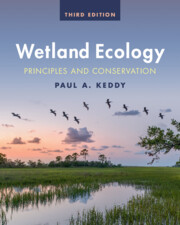
Richly illustrated in full colour and packed with examples from every major continent and wetland type, this third edition has been completely rewritten to provide undergraduates with a thoroughly accessible introduction to the basic principles. It divides the world’s wetlands into six principal types and presents six major causal environmental factors, arranged by importance and illustrated with clear examples, making it easy for instructors to plan tailored lectures and field trips and avoid overwhelming students with unnecessary detail. It retains its rigour for more advanced students, with sections on research methods and experiments, and over a thousand classic and contemporary references. Each chapter ends with questions that review the content covered and encourage further investigation. With expanded sections on topical issues such as sea level rise, eutrophication, facilitation and the latest approaches to restoration and conservation, the new edition of this prize-winning textbook is a vital resource for wetland ecology courses.
Richly illustrated in colour and packed with examples from every major continent and wetland type, this third edition has been completely rewritten to provide undergraduates with a thoroughly accessible introduction to the basic principles. It divides the world's wetlands into six principal types and presents six major causal environmental factors, arranged by importance and illustrated with clear examples, making it easy for instructors to plan tailored lectures and field trips and avoid overwhelming students with unnecessary detail. It retains its rigor for more advanced students with sections on research methods and experiments, and over a thousand classic and contemporary references. Each chapter ends with questions that review the content covered and encourage further investigation. With expanded sections on topical issues such as sea level rise, eutrophication, facilitation and the latest approaches to restoration and conservation, the new edition of this prize-winning textbook is a vital resource for wetland ecology courses.
In 1866, Charles F. Hall recorded testimony from a Pelly Bay native named Sŭ-pung-er who reported that together with his uncle, they had visited the Northwest coast of King William Island 4 years prior in search of materials abandoned by the Franklin Expedition. Sŭ-pung-er told Hall that he had identified a site which Hall believed was a “vault” which might contain documents and speculated that it could have been a burial site for a high-ranking officer. Sŭ-pung-er’s testimony also included the description of a wooden “pillar, stick or post” which marked the spot of the vault. The location of this site and the pillar have never been found. Yet they remain sought-after for both their significance and the potential bonanza of information about the expedition. Any clue or artefact, which could provide clarity for this site, is therefore of great value. This paper describes a model of the pillar seen on King Williams Island, replicated by Sŭ-pung-er, which Hall brought back from the Arctic and included in his list of Franklin relics. The model, now housed in the Smithsonian Museum of American History, was first featured in a drawing of relics appearing in 1869 in Harper’s Weekly magazine. The fact that this artefact has been in plain sight for so long, but unrecognised for what it is, is significant. The pillar model both provides clarity and continues the mystery surrounding the Franklin Expedition.
The tragic Andrée balloon expedition of 1897 serves as a haunting reminder of the dangers posed by ice drift during polar exploration. This paper examines Andrée’s initial decision after his balloon flight to march towards Cape Flora in Franz Josef Land, despite its much greater distance compared to the Sjuøyane archipelago. The rationale behind this choice remains unclear, but potential factors include stored supplies, the demonstrated winter survival in Franz Josef Land and the scientific interest in unexplored regions. By analysing historical accounts and employing scenario analyses, this study contributes to a better understanding of Andrée’s perception of ice drift and its impact on their ill-fated journey. The paper explores major forces affecting ice drift, reviews the historical development of understanding ice drift in the area, and presents an analysis of Andrée’s understanding and decision-making. The overall conclusion is that Andrée probably was unaware of the substantial deflection to the right of the direction of the wind that ice drift in the Arctic on average is characterised of due to the Earth’s rotation (the Coriolis effect). Without this deflection, the decision to march towards Cape Flora would have made sense under the assumption of continued northerly winds.
The frigid geographical environment in the Arctic has shaped the exploration attribute of the polar cruise shipping network. In this study, the typical characteristics and special structure of the Arctic adventure cruise shipping network are investigated by using the network analysis method based on the data of 172 adventure cruise itineraries in the Arctic. It is found that the Arctic adventure cruise itineraries are dominated by 8–17 days of medium itineraries, and the ratio of one-way itineraries to round-trip itineraries is about 1:1. There are differences in the centrality of different ports, forming two core ports Reykjavík and Longyearbyen and a sub-core port Kangerlussuaq. The overall contact strength of the Arctic adventure cruise shipping network is low. Under the joint influence of such factors as centrality and contact strength, the Arctic constitutes the dual-core clusters of Iceland and Svalbard Islands and a sub-core cluster of Greenland.