To save content items to your account,
please confirm that you agree to abide by our usage policies.
If this is the first time you use this feature, you will be asked to authorise Cambridge Core to connect with your account.
Find out more about saving content to .
To save content items to your Kindle, first ensure no-reply@cambridge.org
is added to your Approved Personal Document E-mail List under your Personal Document Settings
on the Manage Your Content and Devices page of your Amazon account. Then enter the ‘name’ part
of your Kindle email address below.
Find out more about saving to your Kindle.
Note you can select to save to either the @free.kindle.com or @kindle.com variations.
‘@free.kindle.com’ emails are free but can only be saved to your device when it is connected to wi-fi.
‘@kindle.com’ emails can be delivered even when you are not connected to wi-fi, but note that service fees apply.
The first section of this introduction sets the scene for the volume as a whole by briefly considering the history of intertextuality within modern classical scholarship, both Latin and Greek, and then highlighting the special methodological and historical challenges that attend on comparative approaches to early Greek literature. As scholars increasingly agree on the need to read early Greek literature in a comparative way, it is argued, this only makes more urgent the question of how best to do so. The second section of the introduction highlights some of the core methodological, historical, and literary preoccupations of this book by exploring in chronological order two contrastive and complementary case studies from early elegy, one from Tyrtaeus and one from Simonides. Rather than providing a set of definitive answers about how these texts relate to epic tradition and/or particular epics, this section aims to give a sense of the sort of questions at stake in the following chapters. The introduction then concludes by summarising each of those chapters and highlighting interconnections between them.
This chapter examines Lucian’s manipulation of images of geographical authority in his True Histories, with particular reference to his representation of human and other bodies immersed in their environments. It look first at the tension between detached geographical observation and images of bodily immersion or entanglement with particular landscapes both in imperial Greek literature more broadly, and also in Lucian’s work, where that theme has a particular prominence. That point is illustrated first through discussion of Lucian’s On the Syrian Goddess, which returns repeatedly to images that challenge the idea of a clear dividing line between bodies and their environments, and also between observer and participant status. The second half of the chapter then traces the contrast between detached observation and corporeal immersion through the True Histories, especially in the scenes in the stomach of the whale, from 1.30–2.20, arguing that Lucian in this text undercuts notions of detached geographical authority in ways that are closely related to his comical undermining of various other kinds of intellectual and social pretension in his other works.
This chapter investigates Archilochus’ relationship to the tradition of wisdom literature, using the poet as a case study for how we can think about inter-generic and intertextual relationships so early in the Greek literary tradition. Having established that Archilochus is familiar with (and expects his audience also to know) the conventions of didactic moralising, the chapter discusses the case for a stronger proposition: that his poetry demonstrates a specific relationship with the poems of Hesiod. The chapter examines some fragments which demonstrate the best case for an intertextual relationship (frr. 196a, 195, 177) and discusses how reading these through a Hesiodic lens enhances our understanding of what the poems aim to do and how they fit into Archilochus’ broader rhetorical strategy.
Lucian’s In Praise of the Fly offers a delightfully wry encomium of the humble house fly. While the speech engages wittily with sophistic traditions by praising this troublesome insect, it also raises important questions about social marginality and the workings of power, and about the mechanisms through which value is conventionally assessed and reinforced. This chapter examines scale, social status, and literary self-consciousness in Lucian’s representation of the fly as a creature of immense cultural importance. The encomium, it is argued, plays with conventional associations between size and value, revelling in comic juxtapositions of scale, and in the mismatch between ambition and achievement. It also exploits traditional modes of discourse that present animals as models for the socially disenfranchised, and draws on the vocabulary of literary criticism and composition in order to evoke and challenge the symbolism traditionally attributed to other insects and to represent the fly provocatively as the new emblem of a refined literary and cultural aesthetic.
Lucian is a master of ekphrasis – the art of rhetorical description and notably the vivid verbal evocation of works of art. One particular aspect of Lucian’s art historical enterprise is a comparative aesthetic. This extends beyond the comparison of artworks with other things or people (in texts whose titles signal such comparison) to some of the forms in which Lucian chose to write, notably dialogic media (whether dramatic of reported). This comparative game knowingly plays with the inevitable competition of art and text that inheres in the verbal description of the visual. Beyond this, Lucian takes synkrisis or comparison – a central trope in the rhetorical handbooks – and exploits it so as to give voice to the marginal, to elevate the alien and to emphasise questions of multiplicity and diversity within empire. This ideological exploitation of description is what in part has made Lucian so attractive and controversial since the era of Renaissance Humanism. The apparently unproblematic arena of visual aesthetics is brilliantly seized – not only by Lucian but also many of his modern readers – as a site within which to reveal the place, voice, and importance of cultural, ethnic and subaltern identities not always in simple harmony with the hegemonic status quo of the Roman empire.
This chapter examines Lucian’s Erotes to explore qustions of authorship and agency. It explores how questions about authorship operate differently for erotic and non-erotic works and the ways in which erotic discourse is more amenable to anonymous or masked authors. The chapter shows how according Lucianic authorship to this text enriches our understanding of other texts by Lucian. It examines how the Erotes functions to critique normative sexual discourse and suggest that in the comparison between men and women as love objects the text underlines the tiredness and conventionality of this debate and the rhetorical tropes that are employed in it. By contrast, this reading of the Erotes seeks to locate the critical frisson of the text (its ‘kink’) in its discussion of the magnitude of male appetite and the way the text correlates sex and the divine.
As scholars look increasingly for the traces of intertextuality and allusion in early Greek poetry, Homer remains the prime focus of interest, and the relationship between the Iliad and Odyssey especially so. This chapter suggests that, though direct allusion between texts should not be ruled out a priori, an intertextual dynamic which stems from the traditionality of the texts is a more reliable and rewarding first interpretative step. The discussion reviews two examples which have served as important planks in the case that the Odyssey explicitly refers to the Iliad, and finds wanting the allusive arguments normally used to make that case, before suggesting a more methodologically and historically sound form of interaction. Interpretation, meaning, and appreciation all remain possible, and are indeed much richer in their appreciation of the poetry.
This chapter focuses on Sappho’s engagement with epic, by focusing on the appeal and significance of her songs for audiences beyond Lesbos. The argument is in three parts. First, it demonstrates that Lesbos was famous for its women and its songs also independently of Sappho: her songs helped to increase the reputation of her native island by revealing exactly what went into the making of its glamorous women. In fragments 98, 44, and several others, we see lovely women and precious goods crossing the sea and causing great delight on arrival – or disappointment when they fail to materialise. Likewise, Sappho’s own songs must have travelled overseas causing pleasure and, simultaneously, increasing the value of Lesbian exports, including women (whether they travelled overseas as brides or upmarket courtesans). Second, this chapter observes that, in both Sappho and Alcaeus, heroic characters drawn from the Trojan saga are always involved in travelling and getting married. Finally it makes the point that, in Sappho’s extant fragments, intertextual engagements with epic work primarily by superimposing the itineraries of people dear to her onto the routes traced by heroes and heroines in their own journeys of homecoming and homemaking.
The seventh chapter focuses on Latin love elegy, tracing its history from several Greek roots and in Roman comedy, and concentrating on the genre as a whole. It also looks at other poetic treatments of love, Catullan, Lucretian, and Horatian, in order to show what was so distinctive about elegy. At the end, it observes that the genre lasted only a short while, and explores some of the reasons why. Treatments of Propertius, Tibullus, and Ovid, with brief exploration of Gallus
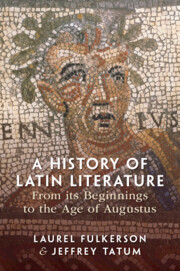
Latin literature exploded onto the scene from relatively humble beginnings in the third century BCE. In an astonishingly short time the Romans adopted and adapted nearly all the genres of literature known to them and not only were they well aware of their large-scale appropriation but even, curiously, boasted of it. This readable new history of Latin literature covers the full span of the Roman republic, concluding with the age of Augustus, whose great poets engaged with the enormous political and cultural changes of their time and laid the foundations for the literature of the Imperial period. All the major writers are covered but attention is also paid to more fragmentary but still key authors such as Ennius, Cato, Lucilius, and Varro. Readers are given the essential historical, cultural, and literary background as well as close readings of specific passages, which reveal the charm and complexity which animate Latin literature.
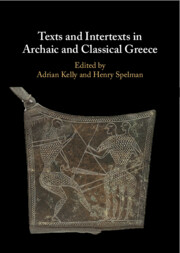
Encompassing the period from the earliest archaic epics down through classical Athenian drama, this is the first concerted, step-by-step examination of the development of allusive poetics in the early Greek world. Recent decades have seen a marked rise in intertextual approaches to early Greek literature; as scholars increasingly agree on the need to read these texts in a comparative way, this only makes all the more urgent the question of how best to do so. This volume brings together divergent scholarly voices to explore the state of the field and to point the way forward. All twelve chapters address themselves to a core set of fundamental questions: how do texts generate meaning by referring to other texts and how do the poetics of allusivity change over time and differ across genres? The result is a holistic study of a key dimension of literary experience.
Plato's Republic is a central text in the Western philosophical tradition and also a specimen of its author's exceptional literary and dramatic skill. The first book introduces, and conspicuously fails to answer, the question: What is justice? It also introduces the sophist Thrasymachus, who is quite certain that he knows what justice is, namely that it is nothing other than what the dominant power in the state considers to be in its own interest. The contentious confrontation between Thrasymachus and Socrates sets the stage for Plato's controversial construction of an ideal state in which the true nature of justice will be revealed. The Commentary draws attention to the way Plato anticipates developments in later books, thus serving as an introduction to Republic as a whole. Particular attention is paid to Plato's language and style, so that students of Greek literature as well as philosophy are well served.
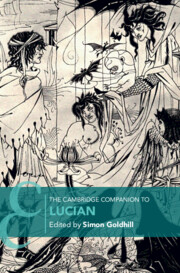
Lucian is one of the most prolific and wide-ranging writers from antiquity and one of the most influential and controversial. His work is deeply embedded in the cultural and religious politics of the Greek world in the Roman Empire, but also played an important role in later periods, particularly during the Renaissance, and was considered a crucial example of the inherited wisdom of classical antiquity. Lucian's prose is limpid and elegant as well as sharply funny and full of great stories, dramatic dialogues, and brilliant satire. This Companion, written by world-leading scholars, introduces the major themes of his corpus and provides more detailed studies of individual works. Readers will be able to appreciate his major contributions to the history of satire, comic dialogues, religion, art, and erotics as well as being given a snapshot of the most important episodes in his work's reception in the West.