To save content items to your account,
please confirm that you agree to abide by our usage policies.
If this is the first time you use this feature, you will be asked to authorise Cambridge Core to connect with your account.
Find out more about saving content to .
To save content items to your Kindle, first ensure no-reply@cambridge.org
is added to your Approved Personal Document E-mail List under your Personal Document Settings
on the Manage Your Content and Devices page of your Amazon account. Then enter the ‘name’ part
of your Kindle email address below.
Find out more about saving to your Kindle.
Note you can select to save to either the @free.kindle.com or @kindle.com variations.
‘@free.kindle.com’ emails are free but can only be saved to your device when it is connected to wi-fi.
‘@kindle.com’ emails can be delivered even when you are not connected to wi-fi, but note that service fees apply.
Aristotle maintains that defining "intelligence" (nous) requires first defining its activity, “understanding” or “insight” (noēsis) which requires first having considered its objects, intelligible beings (noēta). This chapter is about the nature of these objects: what about them makes them intelligible? My principal proposals are that what makes them intelligible is that they are "separate" and "unmixed," and that because, insofar as they are intelligible, they are, in their essence, "activity."’ I am aware this makes it sound as though Aristotle takes intelligibility to consist in some kind of intelligence. But in fact this is a result he is committed to, by the doctrines that intelligence is intelligible and that there is something that intelligible objects "all are in common"; for the alternative, as he himself says, is to suppose that intelligence "will have something mixed-in, which makes it intelligible just like the rest." The challenge, then, is not to steer clear of this result, but to make sense of it. My proposal is that the key to this lies in realizing that and why Aristotle thinks of intelligibility as a creature of intelligence.
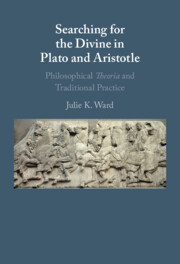
To scholars of ancient philosophy, theoria denotes abstract thinking, with both Plato and Aristotle employing the term to signify philosophical contemplation. Yet it is surprising for some to find an earlier, traditional meaning referring to travel to festivals and shrines. In an attempt to dissolve the problem of equivocal reference, Julie Ward's book seeks to illuminate the nature of traditional theoria as ancient festival-attendance as well as the philosophical account developed in Plato and Aristotle. First, she examines the traditional use referring to periodic festivals, including their complex social and political arrangements, then she considers the subsequent use by Plato and Aristotle. Broadly speaking, she discerns a common thread running throughout both uses: namely, the notion of having a visual experience of the sacred or divine. Thus her book aims to illuminate the nature of philosophical theoria described by Plato and Aristotle in light of traditional, festival theoria.
Xenophon of Athens (c. 430–354 BCE) has long been considered an uncritical admirer of Sparta who hero-worships the Spartan King Agesilaus and eulogises Spartan practices in his Lacedaimoniôn Politeia. By examining his own self-descriptions - especially where he portrays himself as conversing with Socrates and falling short in his appreciation of Socrates' advice - this book finds in Xenophon's overall writing project a Socratic response to his exile and situates his writings about Sparta within this framework. It presents a detailed reading of the Lacedaimoniôn Politeia as a critical and philosophical examination of Spartan socio-cultural practices. Evidence from his own Hellenica, Anabasis and Agesilaus is shown to confirm Xenophon's analysis of the weaknesses in the Spartan system, and that he is not enamoured of Agesilaus. Finally, a comparison with contemporary Athenian responses to Sparta, shows remarkable points of convergence with his fellow Socratic Plato, as well as connections with Isocrates too.
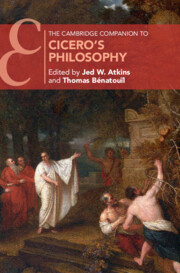
Cicero is one of the most important and influential thinkers within the history of Western philosophy. For the last thirty years, his reputation as a philosopher has once again been on the rise after close to a century of very low esteem. This Companion introduces readers to 'Cicero the philosopher' and to his philosophical writings. It provides a handy port-of-call for those interested in Cicero's original contributions to a wide variety of topics such as epistemology, the emotions, determinism and responsibility, cosmopolitanism, republicanism, philosophical translation, dialogue, aging, friendship, and more. The international, interdisciplinary team of scholars represented in this volume highlights the historical significance and contemporary relevance of Cicero's writings, and suggests pathways for future scholarship on Cicero's philosophy as we move through the twenty-first century.
Sextus Empiricus' Against the Physicists examines numerous topics central to ancient Greek inquiries into the nature of the physical world, covering subjects such as god, cause and effect, whole and part, bodies, place, motion, time, number, coming into being and perishing and is the most extensive surviving treatment of these topics by an ancient Greek sceptic. Sextus scrutinizes the theories of non-sceptical thinkers and generates suspension of judgement through the assembly of equally powerful opposing arguments. Richard Bett's edition provides crucial background information about the text and elucidation of difficult passages. His accurate and readable translation is supported by substantial interpretative aids, including a glossary and a list of parallel passages relating Against the Physicists to other works by Sextus. This is an indispensable edition for advanced students and scholars studying this important work by an influential philosopher.
This chapter explores assumptions about what things are made of (physicality) as revealed by ethnography and the study of antiquity. The history of Greek speculations on the problem reveals a striking diversity, where Aristotle’s ontology based on the primacy of substances was certainly not universally accepted by other theorists. A very different view on the question is common among ancient Chinese writers, who usually focussed not on stable substances but on interacting processes. This allows us to qualify some of the conclusions proposed by the anthropologist Descola in his account of the contrast between naturalism and animism.
This chapter challenges the binary contrast between ’myth’ and rational account (logos), reviewing the negative impact of the application of that dichotomy when used to draw contrasts between properly scientific modes of discourse and those to be dismissed as irrational. Ethnographic reports show that there is often no equivalent to our term ’myth’ in indigenous vocabularies, at least not one that carries similar pejorative undertones. The arguments of Lévi-Strauss that systems of myth may convey ’concrete science’ have the merit of taking those systems seriously, but still imply a pejorative binary judgement.
Opening his City of God is a heartfelt dedication from Augustine to his “dearest son” (fili carissime) Marcellinus, a Roman tribune and the imperial commissioner who was dispatched by Emperor Honorius to preside over the Council of Carthage in June of AD 411. Best known for his assistance to the Bishop of Hippo in bringing the Donatist Schism to an end, Marcellinus was not shy in asking Augustine questions by exchanging rich letters (epp. 128, 129, and 133) during this time. Furthermore, Augustine’s On the Merits and Forgiveness of Sins and on Infant Baptism (pecc. mer.) and The Spirit and the Letter (spir. et litt.), both dated AD 412, are also dedicated to Marcellinus in response to some answers this theologically cultured aristocrat first posed to the great bishop. Overseeing the debates between Catholics and Donatists in AD 411 would eventually cost Marcellinus his life, yet win him the hallowed crown of martyrdom. The well-connected Donatists were able to convince Marinus, comes rei militaris of both Italy and Africa, that Marcellinus and his brother Apringius (cf. ep. 134), African proconsul in AD 411, were secretly plotting with the comes Africae Heraclinus to usurp imperial power. Despite Augustine’s and other African bishops’ intervention, Marinus ordered the brothers’ beheading in mid-September of AD 413 on charges of high treason. However, a year later the imperial court realized that these charges had been fabricated. Emperor Honorius exonerated both brothers, produced evidence that Marinus had acted out of selfishness, and thereby referred to Marcellinus and Apringius with great honor, and had both celebrated as Catholic martyrs of the Donatist rebellion.
This chapter examines current assumptions about the agenda of the history of science where the dominant narrative concentrates on the Greek legacy and then on the transformations that took place in the scientific revolution of the seventeenth century. A Great Divide is often postulated between the workings of the Savage Mind and those of Western scientific modernity. When Greek ideas concerning nature, magic and metaphor are critically examined the way is open to expand the remit of the history of science to make room for a fuller appreciation of the work of other ancient societies and modern indigenous groups.
“The whole Church of the true God holds, confesses and professes that Christ is going to come from heaven to judge the living and the dead” (ciu. Dei 20.1; Babcock 2.390), as Augustine shows throughout ciu. Dei 20. As simple as this affirmative statement may sound, its emphatic nature masks the complexity of thought about God’s final judgment that had already come to challenge the Christian community by the early 5th century AD, and which Book 20 was designed, in part, to address. True enough, all known early creeds encapsulated the promise of a future judgment requiring Christians to affirm their belief that Christ, with the Father, would judge the living and the dead. But this still left many questions unanswered. When would this judgment occur? How would the events of the last day unfold? How would divine justice be done, and be seen to be done? How did the ordinary experience of human death relate to the events outlined in the Book of Revelation? And what kind of community would result?