To save content items to your account,
please confirm that you agree to abide by our usage policies.
If this is the first time you use this feature, you will be asked to authorise Cambridge Core to connect with your account.
Find out more about saving content to .
To save content items to your Kindle, first ensure no-reply@cambridge.org
is added to your Approved Personal Document E-mail List under your Personal Document Settings
on the Manage Your Content and Devices page of your Amazon account. Then enter the ‘name’ part
of your Kindle email address below.
Find out more about saving to your Kindle.
Note you can select to save to either the @free.kindle.com or @kindle.com variations.
‘@free.kindle.com’ emails are free but can only be saved to your device when it is connected to wi-fi.
‘@kindle.com’ emails can be delivered even when you are not connected to wi-fi, but note that service fees apply.
This chapter examines the composition of the World Soul, which partakes of a lower soul that is the principle of life and of a higher, purely noetic soul. Its role is not merely cognitive, but it also has an important providential function.
This chapter examines the principles of Calcidius’ commentary (and to a lesser extent of the translation); he adopts a sequential reading of the Timaeus itself, in contrast to the mode preferred by the Neo-Platonists, and reads the Timaeus as a sequel to Plato’s Republic and a prequel to the Parmenides.
The conclusion argues for an earlier date (first half of the fourth century CE) than the editor of the text Waszink assumed, and locates Calcidius in the strand of the tradition called Middle Platonism.It also states that Calcidius' commentary does not present a Christian worldview, though he makes a few concessions to a Christian audience, addressed in the second person.
This chapter examines Calcidius' explicit treatment of Numenius, and the role of the views attributed to the latter in the commentary as a whole; it argues that Numenius is an important influence, but that Calcidius asserts his independence also from his views.
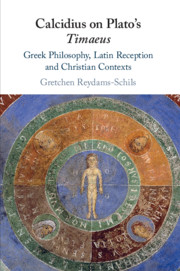
This is the first study to assess in its entirety the fourth-century Latin commentary on Plato's Timaeus by the otherwise unknown Calcidius, also addressing features of his Latin translation. The first part examines the authorial voice of the commentator and the overall purpose of the work; the second part provides an overview of the key themes; and the third part reassesses the commentary's relation to Stoicism, Aristotle, potential sources, and the Christian tradition. This commentary was one of the main channels through which the legacy of Plato and Greek philosophy was passed on to the Christian Latin West. The text, which also establishes a connection between Plato's cosmology and Genesis, thus represents a distinctive cultural encounter between the Greek and the Roman philosophical traditions, and between non-Christian and Christian currents of thought.
A relative change occurs when some item changes a relation. This Element examines how Plato, Aristotle, Stoics and Sextus Empiricus approached relative change. Relative change is puzzling because the following three propositions each seem true but cannot be true together: (1) No relative changes are intrinsic changes; (2) Only intrinsic changes are proper changes; (3) Some relative changes are proper changes. Plato's Theaetetus and Phaedo property relative change. I argue that these dialogues assume relative changes to be intrinsic changes, so denying (1). Aristotle responds differently, by denying (3) that relative change is proper change. The Stoics claimed that some non-intrinsic changes are changes (denying (2)). Finally, I discuss Sextus' argument that relative change shows that there are no relatives at all.
In Wittgenstein and the Social Sciences, Robert Vinten takes a fresh look at the relationship between Wittgenstein's philosophy and the social sciences. He argues that although social sciences are quite different to the natural sciences, they are nonetheless properly called 'sciences'. The book looks in detail at whether Wittgenstein can be claimed by conservatives, liberals, or socialists as their own. Wittgenstein's philosophical remarks and remarks about politics and culture are taken into account in deciding where to locate Wittgenstein in relation to various ideologies. In the final part of the book, Vinten considers how Wittgenstein's philosophy can be of use in resolving or dissolving problems in the social sciences. Along the way, he critically assesses work from Perry Anderson, Terry Eagleton, Richard Rorty, and Chantal Mouffe in the light of Wittgenstein's philosophical oeuvre. The book makes a compelling examination of how Wittgenstein's work remains as relevant as ever to thinking about our cultural and political situation.
The question of whether Wittgenstein was a conservative philosopher has generated a large literature. Given the enormous scope of the literature there will not be space here to consider all of the various arguments in favour of deeming Wittgenstein a conservative. In particular many have focused in on Wittgenstein's claim in §124 of the Philosophical Investigations that philosophy ‘leaves everything as it is’. That remark alone is deserving of a long discussion (I discuss it in Chapters 5 and 6 of this book) and if controversies surrounding Wittgenstein's remarks about rule- following, rationality, and relativism were taken into consideration a sizable book could be written on the topic of Wittgenstein's relationship to conservatism. I will restrict myself, in this chapter, to the arguments found in J. C. Nyiri's paper ‘Wittgenstein 1929– 31: The Turning Back’.
The evidence brought by each side of the debate about whether Wittgenstein was conservative can be roughly divided into evidence concerning Wittgenstein's occasional remarks directly concerning political matters and evidence from among Wittgenstein's philosophical remarks. The reason I say ‘roughly’ divided is that there is some controversy about the extent to which this division can be made. Within Wittgenstein's typescripts each kind of remark would not be clearly separated; a remark about politics might be followed by a remark about philosophy, and philosophers might think that there is no clear division between the two kinds of remark (or that there aren’t two kinds of remark at all). In this chapter I will treat the political remarks and philosophical remarks separately and I hope that by the end of the chapter it will become clearer how a separation can be made. I will argue that philosophical remarks that have been construed as having political implications do not in fact have the implications that some commentators have suggested.
If we can separate out the two kinds of remark then there are really two questions to answer. First, we can ask whether Wittgenstein was conservative in his political views and second, we can ask whether Wittgenstein's philosophical remarks have conservative political implications. To the first question my answer will be that Wittgenstein certainly held some political views that can be deemed conservative (although he also held some views that could be characterized as left- wing and as expressing a deep dissatisfaction with the way things were).
Karl Marx is rightly regarded as one of the most important philosophers of the nineteenth century. His work encouraged the growth of socialist and communist parties and inspired revolutions in the twentieth century. Marx and Engels's Communist Manifesto has sold more copies than 50 Shades of Grey. In fact, the only book to have sold more copies is the Bible. With capitalism having recently been in a deep economic crisis around the world, trust in mainstream economists is dwindling and a new generation is turning to Marx for answers. David Harvey's lectures on Marx's Capital are being viewed by hundreds of thousands of people via the internet and sales of the book itself are up. Since Syriza's victory in the Greek election of January 2015 the ‘erratic Marxist’, and finance minister, Yanis Varoufakis, has become a regular feature on the news. Historians, political theorists, and philosophers who are opposed to Marx's thought cannot afford to ignore it.
Similarly, Wittgenstein is regarded by many as the greatest philosopher of the twentieth century. Bertrand Russell, writing in 1959, said that ‘during the period since 1914 three philosophies have successively dominated the British philosophical world, first that of Wittgenstein's Tractatus, second that of the Logical Positivists, and third that of Wittgenstein's Philosophical Investigations’. Peter Hacker, commenting on this assessment, suggests that ‘Wittgenstein bestrides fifty years of twentieth century analytic philosophy somewhat as Picasso bestrides fifty years of twentieth century painting’. His work has influenced the course of psychology, sociology, and cultural theory as well as philosophy and it has inspired poetry, novels, and films.
However, given the enormous influence of these two thinkers it is surprising that little has been written about the commonalities in their thought or about the possibility that the two philosophies might be mutually enriching.6 It is not that commonalities do not exist. Gavin Kitching, in his introduction to a collection of essays about Marx and Wittgenstein, claims that both Wittgenstein and Marx reject the idea that language ‘pictures’ reality, oppose the idea that in studying society we study something essentially non- linguistic, and reject the dualisms of observer- observed and subject- object. Others have pointed out that Marx and Wittgenstein both evoke natural history, that they both think that philosophers need to entirely reconceive their task, and that both philosophers are particularly sensitive to social context.
This chapter divides into two main parts. The first part will examine Wittgenstein’s relevance to problems concerning justice insofar as his philosophy involves getting clear about concepts. Wittgenstein's philosophical remarks could help us to get to grips with philosophical problems about justice by helping us to get clear about the concept of justice and thereby aiding our understanding. The second part of the chapter moves beyond concerns with getting clear about the concept of justice and asks whether Wittgensteinians have reason to criticize particular conceptions or theories of justice that are currently in circulation and whether Wittgensteinians should favour particular conceptions or theories of justice, before finally discussing some ways in which tools from Wittgenstein's later work might help us to understand and overcome injustices.
Getting Clear about the Concept of Justice
It is possible that the texts of past philosophers might help us to resolve conceptual problems about justice. However, there are various problems with this. One problem is that some past philosophers wrote in languages other than our own and the translations that we have of their work might obscure the fact that they employed different concepts to us. For example, Hanna Pitkin points out that the ancient Greeks used the word dike and had no equivalent to our word ‘justice’. Dike ‘came to mean “justice” and to measure the rightness of human action’ but it ‘originally meant simply “the way”: a descriptive account of how things in fact were, or were done’.
It was dike or dikaiosyne that Plato wrote about in The Republic. The words are usually translated as ‘justice’ in English translations of Plato's work but according to the translator Ernest Barker that is not a very good translation. The Greek word dike, according to Barker, ‘includes the ethical notions (or some of the ethical notions) which belong to our word “righteousness” ‘ and Pitkin thinks that if we get a better sense of what the Greek expression means then some of Plato's claims become more plausible. For example, whereas it strikes us as odd to say that justice is the ‘master virtue’, encompassing all other virtues, we can at least see where someone like Plato is coming from if they say that righteousness is the ‘master virtue’, containing all others.
This book aims at exploring the implications of Wittgenstein's philosophy for social philosophy and the social sciences. I should make clear at the outset that I will be particularly concerned with Wittgenstein's later philosophical work – his work from the 1930s until his death in 1951. When I talk about ‘Wittgenstein's philosophy’ I will primarily be talking about the mature philosophy of the Philosophical Investigations and On Certainty rather than his earlier work in the Tractatus Logico- Philosophicus, that he criticized in the later work. However, I will occasionally refer to his earlier work and note certain elements of continuity in Wittgenstein's work.
According to Wittgenstein (throughout his career) philosophy is a discipline that is not based on observation and experiment. It is not an empirical discipline and, more particularly, philosophy is not a science. This book defends the later Wittgenstein's take on philosophy and attempts to show its usefulness for social philosophy and social science. So, this book is not a work of social science and it will not rely on empirical data about our current or past social and political circumstances. I will not be attempting to formulate prescriptions for, say, politicians, social workers, or political activists based on evidence drawn from observations, questionnaires, medical records, interviews, or crime statistics. The aim is not to provide advice about policy or information that might help social scientists to solve particular concrete problems that concern them. Rather, this is a book that is primarily concerned, as Wittgenstein was, with conceptual matters. The focus will be on examining conceptual matters in social philosophy and the social sciences with an eye to showing that Wittgenstein's philosophy can be helpful in overcoming confusions.
However, although this work is primarily focused on conceptual matters and is not a work in social science, I take it that it is of relevance to social science and that social scientists have something to learn from Wittgenstein. We cannot make a neat separation between the conceptual cartography engaged in by philosophers and the practices of social scientists. In order to produce good work in social science we must achieve some clarity about the concepts we are using. To say something true about social phenomena we must make sense. The kinds of confusions that Wittgenstein was so skilled in identifying in his philosophical work are confusions that are still rife among social scientists.
It might seem that Wittgenstein's philosophical remarks could be useful in getting to grips with traditional problems in epistemology and metaphysics but that they have little bearing on social and political philosophy. However, that would be to draw a conclusion too quickly. Philosophers from the tradition that Wittgenstein distanced himself from concerned themselves with social and political issues going at least as far back as Socrates and Plato. In the Republic, for example, Plato presents a philosophy of mind and epistemology that parallels and complements his political philosophy. Traditional philosophers such as Plato saw their political philosophy as something intertwined with their reflections upon knowledge, mind, and reality and there are still plenty of social philosophers today who see their social- philosophical concerns as being entwined with their philosophy of mind and epistemology. So, one way in which Wittgenstein's remarks might have a bearing on political philosophy is that his remarks might undermine political philosophies that are entwined with confused thoughts about language, metaphysics, and epistemology.
Having discussed the nature of philosophy and political ideologies in previous chapters, the focus of this chapter will be on the issue of freedom of the will. This is a traditional philosophical problem (or set of problems) and also one that appears to have implications for social and political philosophy. Conceptions of freedom, and of decision- making, are implicated in discussions of democracy, of legal responsibility, and of morality. If determinism is correct then it would seem to have very profound implications for our understandings of these issues. The role of Wittgensteinian philosophy in discussing these issues, I suggest, is to help us to get clear about the relevant concepts and ultimately to give us the understanding that will make the problems dissolve – to make latent nonsense patent nonsense and to show that the formulation of the problems involves some conceptual confusion.
As hinted at above, there is not one single problem of freedom of the will. Various problems have arisen in the history of philosophy: some relating freedom to goodness and evil, some concerning the role of God in the universe and its compatibility with human freedom, and others concerning causation or mental causation.
The philosophers have only to dissolve their language into the ordinary language, from which it is abstracted, in order to recognize it as the distorted language of the actual world and to realize that neither thoughts nor language in themselves form a realm of their own, that they are only manifestations of actual life.
Karl Marx, The German Ideology
Introduction
Wittgenstein's philosophy is, more often than not, simply ignored by Marxist philosophers. However, on the rare occasions that Marxist philosophers have tried to give an account of Wittgenstein's philosophy they have often, mistakenly, supposed that Wittgenstein's philosophy stands in opposition to Marxist philosophy. Marx tried to give a scientific account of human society and culture, whereas Wittgenstein was notoriously opposed to theorizing in philosophy. Marx famously said that ‘the philosophers have only interpreted the world, in various ways; the point is to change it’, while Wittgenstein was concerned with conceptual considerations and had very little to say about workers’ struggles. Early, critical, responses to Wittgenstein from figures on the left proved to be influential, including Ernest Gellner's Words and Things and Herbert Marcuse's One- Dimensional Man. However, more recent accounts of Wittgenstein's thought from Marxists in both the continental and analytic traditions have been more sympathetic and have overcome the weaknesses of some of the earlier analyses.
My argument in this chapter will be that the apparent differences between Marxist and Wittgensteinian thought dissolve once one understands the different ways in which Marx and Wittgenstein thought about the nature of philosophy. I will start by looking at some of the mistakes made by Perry Anderson in his attempts to get to grips with Wittgenstein. I will then go on to see how those mistakes have been compounded by Alex Callinicos before finally saying something about what Marxists stand to gain from a better understanding of Wittgenstein's philosophy.
The reasons for focusing on the work of Anderson and Callinicos are, first, that in both cases they have audiences that go beyond academia: Anderson was, for a long time, editor of the New Left Review and regularly writes for other publications, including the London Review of Books. Alex Callinicos is an active socialist, editor of the International Socialism Journal, and he regularly writes for Socialist Worker.
Ludwig Wittgenstein has been accused of being a relativist by various philosophers. In this chapter I will focus particularly on accusations of cognitive relativism levelled at Wittgenstein by Roger Trigg. Accusations of relativism, of various sorts, have been thought to undermine Wittgenstein's philosophical approach. However, there are some philosophers, such as Robert Arrington, Natalie Alana Ashton, Gordon Baker, Hans- Johann Glock, Peter Hacker, and Martin Kusch, who have found relativism in Wittgenstein's work and thought that it is a benign or even a positive feature of his philosophy. Still others argue that Wittgenstein is not a relativist at all. In this chapter I will start by looking at the various forms of relativism and then go on to consider whether Wittgenstein can be placed in one or another of the relativistic camps and throughout the chapter I will look at the credibility of various forms of relativism.
There are, I think, good reasons for thinking that Wittgenstein was a certain kind of relativist, although he certainly did not think that ‘anything goes’ in the moral, religious, epistemic, or conceptual spheres or that all positions staked out in these spheres were of equal value. What kind of reasons are there for thinking that Wittgenstein was a relativist? For one thing it is clear that Wittgenstein rejected certain kinds of realist positions within philosophy. Realists who set themselves up in opposition to idealism in philosophy are subject to the same kinds of confusions as idealists, according to Wittgenstein. So, for example, in the Blue Book Wittgenstein says that ‘the trouble with the realist is always that he does not solve but skip the difficulties which his adversaries see, though they too don't succeed in solving them’, and in On Certainty Wittgenstein argues that the ‘claim’ that ‘there are physical objects’ is nonsense.Wittgenstein rejected the idea that our concepts are somehow imposed on us by reality and he acknowledges the possibility that our concepts might be very different if the world were different in certain ways. It seems clear that Wittgenstein rejects the idea that there is a single best way to divide up the world with concepts and the idea that a certain conceptual scheme might be absolutely correct.