To save content items to your account,
please confirm that you agree to abide by our usage policies.
If this is the first time you use this feature, you will be asked to authorise Cambridge Core to connect with your account.
Find out more about saving content to .
To save content items to your Kindle, first ensure no-reply@cambridge.org
is added to your Approved Personal Document E-mail List under your Personal Document Settings
on the Manage Your Content and Devices page of your Amazon account. Then enter the ‘name’ part
of your Kindle email address below.
Find out more about saving to your Kindle.
Note you can select to save to either the @free.kindle.com or @kindle.com variations.
‘@free.kindle.com’ emails are free but can only be saved to your device when it is connected to wi-fi.
‘@kindle.com’ emails can be delivered even when you are not connected to wi-fi, but note that service fees apply.
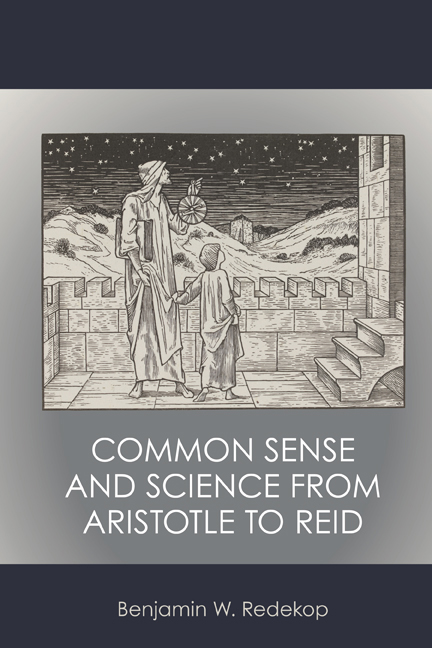
Common Sense and Science from Aristotle to Reid reveals that thinkers have pondered the nature of common sense and its relationship to science and scientific thinking for a very long time. It demonstrates how a diverse array of neglected early modern thinkers turn out to have been on the right track for understanding how the mind makes sense of the world and how basic features of the human mind and cognition are related to scientific theory and practice. Drawing on a wealth of primary sources and scholarship from the history of ideas, cognitive science, and the history and philosophy of science, this book helps readers understand the fundamental historical and philosophical relationship between common sense and science.
Thomas Reid's philosophy of common sense exercised a significant influence on Western thought and continues to be relevant today. It appeared on the world stage as a scientific philosophy amenable to Christian beliefs, the rise of a modern public sphere and democratic politics. Exercising its most profound impact in postrevolutionary France and America, it promised to combine progress and stability, establishing links between common-sense experience and philosophical and scientific thought in an era of rapid sociopolitical, religious, and scientific change. It had a significant impact on the development of higher education in both countries and was an important undercurrent in the broad expanse of nineteenth-century intellectual culture, a current which fed and mingled with other streams of thought.
Although an identifiable school of “common-sense philosophy” began to wane around the middle of the nineteenth century, Reid's philosophy proved to be a multivalent and fertile influence on subsequent philosophical developments in Britain, France, and America. Reid's impact in Germanspeaking lands was slight but worth considering. And today his thinking remains pertinent not only to philosophers but also to psychologists, cognitive scientists, and philosophers of science. In what follows, I first provide an analytical overview of Reid's historical influence and impact in Britain, France, Germany, and America, before concluding with some observations on the relevance of his thought to the findings of contemporary research into the nature and structure of the human mind and to the ongoing scholarly discussion about the relationship between common sense and scientific inquiry.
Reid's thought gained an immediate following upon publication of his Inquiry in 1764. James Oswald (1703–1793) was a Scottish minister who published An Appeal to Common Sense in Behalf of Religion in two volumes (1766/ 1772). Although he cited Reid sparingly, Oswald seized upon Reid's ideas to defend the faith from “the assertions of sceptics and infidels,”1 opposing the common-sense principles that ordinary people take for granted to the labored and drawn-out reasonings of the learned, the latter threatening to confound the instinctive moral and religious impulses possessed by all human beings.
The French Jesuit scholar Claude Buffier (1661–1737) was the first modern thinker to develop a fully fledged philosophical doctrine of common sense (sens comun). In his philosophical writings, Buffier sought to shore up connections between the human mind and the external world that had been left tenuous by Descartes and Locke. The inherent skepticism and idealism of modern philosophy did not square with the rough and ready perceptions of the average person, and Buffier sought to ground higher thought in common-sense experience.
Like most common-sense philosophers who followed after him, Buffier was an educator, and consequently he was very responsive to the growth in literacy and the rise of a modern public sphere of enlightened discourse that was in principle open to everyone. As a young man he taught courses in the humanities, and after joining the Jesuit order in 1695 he became a full-time man of letters who published popular works of history, philosophy, religion, geography, ethics, grammar, and logic, culminating in his 1732 Cours de sciences, a complete course of studies for youth. He was a sociable figure who moved in aristocratic circles and attended fashionable salons, yet he remained at heart a popularizer who aimed to make higher learning accessible to the average person. Buffier spearheaded the trend in Jesuit education toward studying history and geography as independent subjects, and his widely adopted textbook on French grammar helped to focus more attention on the vernacular. Buffier, who frequented the salon of the feminist Marquise de Lambert, was also a supporter of female education, arguing that women are as intelligent as men. He has thus been seen as “a radical and reforming element within the structure of Jesuit education.”
Buffier was a scriptor (scholar/ writer) at the intellectually vibrant Collége Louis-le-Grand in Paris from 1701 until his death in 1737, and he was a founding editor of the Mémoires de Trévoux, a cosmopolitan journal that featured articles and reviews on a variety of learned topics, written mainly by Jesuits but also by other members of the European Republic of Letters, including Leibniz.
The thought of Thomas Reid (1710–1796) presents a fitting climax and culmination of the story we have been following about the relationship between common sense and science dating back to the ancient Greeks. As we have seen, by the turn of the eighteenth century the New Science had challenged the intellectual primacy of common-sense experience in favor of recondite, expert, and even counterintuitive knowledge increasingly mediated by specialized instruments. Meanwhile modern philosophical thinking that emerged in tandem with the New Science, including skeptical and materialist currents of thought, had problematized the perceptions of everyday sense experience and accepted understandings of the self, morality, religion, and society. Everything was “up for grabs,” intellectually, and thinkers from across the intellectual spectrum and throughout Europe felt compelled to revisit the grounds of our most basic beliefs and forms of knowledge.
In the case of Reid's contemporary David Hume (1711–1776), reexamination of the fundamental bases of human knowledge led to skeptical scrutiny of, among other things, our perception of causal relations in nature, a fundamental precondition of scientific endeavor. In this chapter I argue that in responding to this “problem of induction” as advanced by Hume, Reid completed the long-term philosophical process, outlined in previous chapters, of reconnecting everyday understanding and experience with the findings and methods of modern natural science. An educator and mathematician selfconsciously working within the framework of the New Science, Reid articulated a philosophical foundation for natural knowledge anchored in the human constitution and in processes of adjudication in an emerging modern public sphere of enlightened discourse. Reid thereby completed the ongoing intellectual transformation of one of the bases of Aristotelian science—common experience—into a philosophically and socially justified notion of “common sense.” This fact, along with the fact that his perspective—and that of the common-sense/ moral sense philosophical tradition generally—was supportive of orthodox Christian theology and moral precepts, helps to explain why Reid's thought was so influential in nineteenth-century Europe and America (discussed at length in the Epilogue).
Previous chapters have shown how a variety of European thinkers—including Herbert of Cherbury, René Descartes, Henry Lee, G. W. Leibniz, and Henry More, among others—were beginning to explore and develop the idea that human beings intuitively perceive certain notions, ideas, truths, or principles that condition our experience and make moral, scientific, and religious knowledge possible. We have seen how Claude Buffier was developing a philosophy of sens comun in eighteenth-century France and how the seeds of a philosophy of common sense were being planted in the British Isles by moral philosophers like Francis Hutcheson in Ireland and Scotland, and the Third Earl of Shaftesbury and Bishop Butler in England, where the figure of “common sense” as a term of popular culture was emerging in its own right.
Now we turn our attention to Enlightenment Scotland, where a fullyfledged philosophy of common sense, with strong links to modern science and the scientific method, began to emerge: first in the works of George Turnbull and Henry Home, Lord Kames, before coming to full fruition in the work of Thomas Reid. Although previous European thinkers had been making similar arguments and observations, it was in Scotland that a coherent and developed “school” of common-sense philosophy grew and matured, extending deep into the nineteenth century and far beyond the shores of Scotland.
Hutcheson, Turnbull, Kames, and Reid were a subset of thinkers within the larger Scottish Enlightenment, which has come to assume a place in modern intellectual history that rivals the French Enlightenment. According to Donald Withrington, “The really distinctive mark of the Enlightenment in Scotland is that its ideas and ideals were very widely diffused, in all areas and among a very wide span of social groups, in what was for the time a remarkably well-educated and highly-literate population.” Alexander Broadie argues that the Scottish Enlightenment had roots stretching back to the fifteenth century and notes that its proponents were highly literate, sociable, and engaged in various intellectual clubs and societies, and as such “lived in each other's intellectual pockets.”
Modern science was founded in part on a distrust of ordinary sense experience and “appearances” in favor of corpuscular, idealized, and mathematical truths. The world of everyday experience needed to be reexamined, tested, transcended, put on the rack, and reduced (at least in theory) to invisible forces and minute particles in order to be understood. The writings of early-modern philosophers like Descartes, Hobbes, Locke, and Hume, who were deeply influenced by the discoveries and methodologies of modern science, exhibited this perspective, and the long-term effect was to place into doubt much that seemed to be self-evidently true and spontaneously known.
The first major event in this story was the advent of Copernicanism. There was no more significant and far-reaching challenge to the common-sense underpinnings of scientific thought and practice than the idea that the earth moves in a double motion around the sun—an idea which labored under the burden of contradicting Scripture as well. The challenge to Scripture, and with it the medieval Christian worldview and power structure, often receives the most attention in discussions of the travails of Copernicanism. But as both Calvin and Galileo recognized, if there was a discrepancy between science and Scripture on astronomical questions, that was because the Scriptural writers had been addressing the common folk, on their own terms, about salvation and were not trying to teach them astronomy. Thus although religious concerns and controversies were clearly central to the way in which Copernicanism and the new physics that went with it were received, there can be little doubt that Copernicanism exemplified the challenges posed by modern science to common-sense experience, even as sense experience itself began to assume an authority that it had not held since Aristotle.
Copernicus himself realized the absurdity of his proposal, noting that it was “in opposition to the general opinion of mathematicians and almost in opposition to common sense [communem sensum] [that] I should dare to imagine some movement of the earth.” Here, Copernicus employs the term “common sense” to signify basic sense perceptions shared by everyone, as opposed to more abstruse mathematical knowledge. Copernicus's early Polish defender Barholomew Keckermann (d. 1609) argued that “ ‘Everything indicates that the movement of the Earth as assumed by the greatly famed Copernicus must not be regarded as a realistic term but as an astronomical working term.’ “
The traditional narrative of modern philosophy emphasizes the triumph, over the course of the eighteenth century, of Lockean empiricism over various forms of rationalism. But thinking in terms of a dichotomy between “rationalism” and “empiricism” obscures more than it clarifies. While it is true that thinkers following in the wake of Locke's Essay were forced to take the role of sense experience much more seriously than before, a salient feature of eighteenth-century philosophy was its exploration of just how the mind is able to gain understanding from experience. And this exploration often led philosophers to sharpen and refine innatist arguments, rather than reject them entirely, as Locke had done. Locke's attack on innatism thus helped to stimulate the emergence of a mature philosophy of common sense.
Although the term “common sense” had occasionally appeared in seventeenth-century philosophical discourse, it tended to be invoked in a rhetorical manner, as when Robert Ferguson stated that the first heretics of the Christian Church “overthrew common sense, and did violence to the Universal Uniform and perpetual Light of Mankind” or when John Ray said that the common sense of mankind tells them that animals suffer. But already in such appeals, the term functioned as a synonym for practical reason or commonly held principles or truths. During the eighteenth century, as “common sense” began to be widely used in the service of a growing egalitarian and democratic mindset, thinkers started to accord it more philosophical weight and substance. It was becoming increasingly important to reconcile elite knowledge with common understanding, particularly as middling classes assumed ever greater prominence in cultural and political life, and thus it should come as no surprise that the term assumed a new role in the vocabulary of philosophers during the eighteenth century.
Locke's Essay received many critical responses after its publication in 1689, and his rejection of innate principles was a central point of contention. As Yolton states, many people “found Locke's rejection of innate ideas, his treatment of conscience, and his dissociation of the law of nature from the inward principles commonly supposed to be inherent in man dangerously challenging to the established morality and to revealed religion.”
The previous chapter focused on the ways in which early-modern science, and the philosophy that developed in its wake, came into conflict with commonsense experience and understandings. However, it would be a mistake to think that the modern philosophy of common sense was simply a reaction to the New Science; in fact, modern science was both a stimulus and a methodological resource for thinking about “principles” of common sense. And there were other intellectual currents in the early-modern period—including the rise of modern skepticism—that led a variety of thinkers who predated Reid to argue that human beings intuitively perceive certain notions, ideas, truths, or principles that condition our experience and make moral, scientific, and religious knowledge possible. This tradition of thought stretched from Herbert of Cherbury and René Descartes through the Cambridge Platonists and other English innatists to Henry Lee, G. W. Leibniz, the Third Earl of Shaftesbury, Claude Buffier, Frances Hutcheson, Joseph Butler, George Turnbull (Thomas Reid’s teacher), and Henry Home (Lord Kames), Reid’s friend and interlocutor.
While lines of influence between such thinkers are not always evident, and they did not all employ the term “common sense,” they were responding to many of the same currents in modern thought, and in similar ways. Viewed against the background of such thinkers, the thought of Reid and his followers in the late eighteenth and early nineteenth centuries was a continuation and development of an existing, albeit loosely affiliated, tradition of modern thought. Reid was thus mistaken when he wrote in 1764 that the notion of “natural suggestions”— natural principles of mind like causality that are suggested by experience—had “entirely […] escaped the notice of philosophers.” Like most philosophers, Reid was trying to establish himself as someone with something new to say, and he mainly had in mind those post-Lockean philosophers who subscribed to the notion that the main constituents of thought are “ideas” produced by experience and reflection.
Thinkers have been pondering the nature of common sense, and its relationship to science and scientific thinking, for a very long time. In the ancient world, “scientific” knowledge (epistêmê in Greek, scientia in Latin) emerged as a counterpoint to everyday understanding and common opinion, until Aristotle produced a reconciliation of the two that set the course for scientific thought for the next two millennia. It was not until the early-modern period, when the New Science of Copernicus, Galileo, and Newton emerged triumphant, that common sense and its relationship to science again became problematic, remaining so to this day. This book is about this fraught relationship and about the early-modern thinkers who sought to address it, culminating in the thought of the philosopher Thomas Reid (1710–1796), the preeminent figure in the Scottish school of common-sense philosophy. It is a story full of fascinating twists and turns but is ultimately about the perennial quest to understand how the human mind is able to gain credible and reliable knowledge about the self, nature, other human beings, and God.
It is my contention that if we can understand the historical interplay between common sense and science, and the emergence of “common sense” as a contested term in scientific and philosophical discourse, we will have a better grasp of some of the fundamental and enduring problems besetting the relationship between science and society, that is, the problem of the public understanding of science. In some parts of the world, including particularly the United States, questions that have been long settled in the scientific community—for example, global warming, evolution by natural selection, the value of vaccines—remain controversial in the larger public arena. A disconcerting gap persists between everyday knowledge and understandings, and well-established scientific theories and facts. While there are many factors—economic, religious, political—contributing to this state of affairs, it builds upon a mismatch between our everyday, commonsensical judgments and intuitions, and the discoveries and methods of modern science. This book helps readers to better understand the fundamental contours of this relationship and why common sense and science may not be at odds after all.
Historians of philosophy suggest that philosophic reasoning arose in opposition to the common sense of the multitude. The earliest Greek philosophers—lovers of wisdom and seekers of the truth that lay behind appearances—often cast themselves as those who went against popular opinions and everyday prejudices. The mysterious teachings of Heraclitus (540–480 BCE) and Parmenides (515–450 BCE) seemed to contradict what was known to everyone. Heraclitus suggested that very few would ever understand the logos or underlying order of the world, while Parmenides advanced cryptic arguments to the effect that change was only apparent, not real. Democritus (460–370 BCE) posited a world made up of tiny atoms that was quite different from the world as we experience it. In doing so, Democritus made a distinction between what would come to be known as “primary” and “secondary” qualities. The former are qualities inherent in matter itself, while the latter are the qualities of things as they appear to us. Such teachings, historians of philosophy suggest, “set philosophers against common sense in a most dramatic way.”
Plato (428–348 BCE) did much, in his writings, to distance philosophers from the common people and to differentiate true scientific knowledge (epistêmê) from the misguided and murky opinion (doxa) of the rabble. At the same time, however, he advanced the notion that knowledge of absolute truths is in some sense innate, requiring dialectical reasoning to be brought to light. Experience of the sensible world is misleading and cannot by itself provide us with scientific knowledge; there is an intuitive dimension to knowing. A variation of this idea (albeit with much more faith in sense perception) would form one of the core concepts of the modern philosophy of common sense.
According to Plato, Socrates held that the body, with its inaccurate and misleading senses, hinders knowledge.3 Sight, touch, hearing, and taste provide only confused, relative measures of things, not their essence. True knowledge is abstract, universal, absolute, rational, and divorced from sense experience. The most that the multiplicity of sense experience can do is arouse perplexity and provoke thought, causing the mind to seek the essential unities that underlie the flux of experience.4 It is the task of the philosopher to lead men on this upward journey out of the realm of sense experience to higher levels of wisdom.
There are a variety of ways in which one can view the thought of Thomas Hobbes (1588–1679), but for our purposes he was important because he advanced a thoroughly mechanistic and materialistic view of human nature, informed by the ideas of Descartes, Galileo, and others, that left little room for ineffable “spiritual” entities, free will, and innate first principles of mind that provide us with unmediated knowledge of an independent reality. Hobbes saw “man” as a purely material being driven by his passions and the need to survive (and hence as essentially solitary and selfish), and the world at large as being entirely constituted by matter in constant motion.
For Hobbes, “There is no conception in a man's mind, which hath not at first, totally, or by parts, been begotten upon the organs of Sense.” Sense is a “seeming” or “fancy” caused by an external motion or pressure on one of our organs, which gets communicated via nerves “and other strings” to the brain and heart and then produces a resistance or counterpressure that is directed outward to the original cause. In step with the emerging scientific distinction between primary and secondary qualities, Hobbes asserts that colors and sounds and other such qualities are not in the bodies that produce them but rather in us; their external cause is only matter in motion. The mind itself contains little, however, before experience. “There is no other act of man's mind, that I can remember, naturally planted in him, so, as to need no other thing, to the exercise of it, but to be born a man, and live with the use of his five Senses.” All other faculties that seem proper to man “are acquired, and encreased by study and industry; and of most men learned by instruction, and discipline […] For besides Sense, and Thoughts, and the Trayne of Thoughts, the mind of man has no other motion.”
Belief and knowledge are hence based on our physical experience of the world. Science consists in our ability to order our sense experiences through the proper use of language: scientific knowledge is at root “knowledge of all the Consequences of names appertaining to the subject at hand.”
This is the first systematic analysis of Aristotle's concept of lexis. Ana Kotarcic argues that it should be approached on three interconnected levels: the first dealing with language as a system, the second with actual language usage, into which sociolinguistic factors come into play, and the third with prescriptions for the kind of language to be used in poetic and rhetorical compositions. She introduces ideas and concepts from classics and modern linguistics into the analysis alongside the philosophical approaches which have prevailed until now. The results reveal that Aristotle's ideas on lexis are complex, well-developed and intimately connected to many other fundamental concepts in his works, such as aretē, energeia, ēthos, logos, mimēsis, pathos, phantasia and technē. A major component of his thought is therefore illuminated comprehensively for the first time.
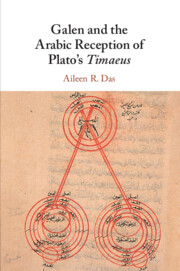
This first full-length study of the Arabic reception of Plato's Timaeus considers the role of Galen of Pergamum (129–c. 216 CE) in shaping medieval perceptions of the text as transgressing disciplinary norms. It argues that Galen appealed to the entangled cosmological scheme of the dialogue, where different relations connect the body, soul, and cosmos, to expand the boundaries of medicine in his pursuit for epistemic authority – the right to define and explain natural reality. Aileen Das situates Galen's work on disciplinary boundaries in the context of medicine's ancient rivalry with philosophy, whose professionals were long seen as superior knowers of the cosmos vis-à-vis doctors. Her case studies show how Galen and four of the most important Christian, Muslim, and Jewish thinkers in the Arabic Middle Ages creatively interpreted key doctrines from the Timaeus to reimagine medicine and philosophy as well as their own intellectual identities.
The main objective of this Element is to reconstruct Aristotle's view on the nature of ontological priority in the Categories. Over the last three decades, investigations into ontological dependence and priority have become a major concern in contemporary metaphysics. Many see Aristotle as the originator of these discussions and, as a consequence, there is considerable interest in his own account of ontological dependence. In light of the renewed interest in Aristotelian metaphysics, it will be worthwhile - both historically and systematically - to return to Aristotle himself and to see how he himself conceived of ontological priority (what he calls 'priority in substance' [proteron kata ousian] or 'priority in nature' [proteron tēi phusei]), which is to be understood as a form of asymmetric ontological dependence.
This chapter gives an overview of the problems raised by the concept of motion in the period investigated – specifically, its apparent integration of Being and non-Being, and its combination of Time and Space. It then discusses the central notions employed in the present project: the criteria or standards established for philosophical inquiry (the principles of non-contradiction and of sufficient reason, and a criterion termed “rational admissibility”) and the roles of logic and mathematics in establishing natural philosophy. This chapter lays out broad outlines, systematic and historical, of the issues to be discussed in detail in the ensuing chapters, each of which will deal with one thinker or one school. Thus this opening chapter will serve as a first orientation for the project as well as a reservoir for consultation if questions concerning the basic concepts employed arise during the reading of the whole book.