To save content items to your account,
please confirm that you agree to abide by our usage policies.
If this is the first time you use this feature, you will be asked to authorise Cambridge Core to connect with your account.
Find out more about saving content to .
To save content items to your Kindle, first ensure no-reply@cambridge.org
is added to your Approved Personal Document E-mail List under your Personal Document Settings
on the Manage Your Content and Devices page of your Amazon account. Then enter the ‘name’ part
of your Kindle email address below.
Find out more about saving to your Kindle.
Note you can select to save to either the @free.kindle.com or @kindle.com variations.
‘@free.kindle.com’ emails are free but can only be saved to your device when it is connected to wi-fi.
‘@kindle.com’ emails can be delivered even when you are not connected to wi-fi, but note that service fees apply.
What is hidden from mortals we should try to find out from the gods by divination for to him that is in their grace the gods grant a sign. (Xenophon, Memorabilia 1.1.9)
Throughout his letters, Paul claims to convey the words and will of his God, and of that God’s Messiah, Jesus. This observation is painfully obvious, but has not generally received the attention it deserves in Pauline scholarship. For those studying his letters from a confessional perspective such an observation may be taken for granted or treated at the level of the general inspiration of scripture. For many lay readers of Paul the passages that need more explanation are those in which he claims not to be speaking directly for God (such as 1 Cor 7:12). For critical scholarship, the truth value of such claims is appropriately bracketed, and attention instead focuses on the development of his ideas within his cultural and religious milieu. Within this cultural and religious milieu, though, we may still ask the question: if Paul claims to convey the words and will of a deity, how does he believe he has received such knowledge? His letters suggest a variety of means through which he discerns the divine will: he has visions and revelations of the risen Jesus, he receives prophetic words and wisdom transmitted by holy pneuma, he interprets Jewish sacred texts and, more generally, he reads signs of divine activity in the human and natural world around him.
The aim of this study is twofold: to provide a category through which these various methods of hearing from the divine can be conceptualised in Paul’s first-century context and, second, to provide a reading of Paul’s letters that attends to how these various methods function in relation to each other in Paul’s broader worldview. Many of these aspects of Paul’s letters have been extensively studied in their own right, but Pauline scholarship has so far lacked an adequate analytical category through which to account for all of these methods of divine communication in Paul’s historical context. The most common categories that might accomplish such a task are “revelation” or “prophecy,” but both of these are limited in the evidence they allow for consideration and in the way they relate Paul to his historical and philosophical context.
I began this study by showing how previous scholarly categories have not been able to present a full picture of Paul’s access to divine knowledge which situates him convincingly in his historical context. While Paul’s letters evince diverse means of access to divine communication, categories such as “prophecy” or “revelation” account for only portions of the evidence, and neither of those categories has been able to situate Paul’s full range of divinatory methods in the first-century culture of a Jew living in the Hellenistic Roman Empire. Under the rubric of “divination” I have analysed Paul’s various means of divine communication under the subheadings of “visions,” “speech,” “texts,” and “signs,” elucidating their role in Paul’s letters with reference to the contemporary divinatory practices of the Graeco-Roman world. I have also considered how Paul presents the mechanics of divination in conversation with contemporary philosophical reflections on the same topic.
Rather than summarise each chapter in turn, I organise my conclusions below thematically and synthetically, drawing together various strands that have emerged from the cumulative analysis of this study. Part one functions as something of a summary of Chapters 2 to 5 and focuses on the different types of knowledge each divinatory method provides. Part two considers the implications of this for how to situate the question of “revelation” in Paul’s historical context. Parts three and four take up again the question of the mechanics of divination from Chapter 1, presenting some more nuanced conclusions about divination in relation to Paul’s anthropology, cosmology, and theology that the ensuing chapters have made possible.
Methods of Divination in Paul
As ancient people turned to the gods for advice and information on a broad range of matters, so, too, Paul’s methods of divination uncover a large range of information: from smaller scale signs and revelations that direct various aspects of everyday life, to expansive insights about cosmology and eschatology. Within this range certain methods and certain types of signs lend themselves most readily to certain types of information.
Non-verbal signs are perhaps the most limited in scope as they generally only convey divine approval or disapproval.
By the early Old Kingdom, steep social hierarchies had developed in Egypt. A small group of individuals at the top seemed to hold the fate of the country in their hands, as only the ‛ruling classes’, to use Marxist-inspired terminology, commanded the resources to express their ideas and practices. In durable materials and at places favourable for preservation, the texts, inscriptions, paintings, sculpture, and monumental architecture commissioned by the elite shaped modern perceptions of ancient Egypt. Other types of evidence, such as the workmen’s huts, simple graves, and local community shrines discussed in this book seem merely to fill the gaps and are hardly ever used to develop alternative approaches to the traditional narrative.
The basic unit of divination is the sign, “something that represents something else,” which is then “taken as the basis for a process of inference.”This is most obvious for so-called artificial means of divination, in which the flight of a bird or the shape of a liver represents success in battle or something similar, but it also applies to inspired visions and prophecy. Anne Marie Kitz breaks down the process of divination in general into three defining characteristics: first, the divine manipulation of earthly material (ranging from stones used for lot-casting to animals to human mediums), second, the sign (the way the lots fall, the particular flight of the birds, the vision seen or the words uttered in prophecy), and third, the interpretation of the sign.This is a useful model with which to see the structural similarities across different methods of divination and highlights how, in all methods, there remains a sign that needs to be interpreted. This is no less true for visions or prophecy than it is for the interpretation of texts.
In each of the preceding chapters, I have shown how these various forms of divination either interact with signs in the external world, or can themselves function as signs that need interpreting. In this chapter, I turn more focused attention to signs and omens in Paul’s letters, those things in the world from which he draws inferences about divine activity and disposition. The first half of the chapter will survey the various ways signs could be interpreted in the ancient world and how Paul’s appeals to signs and omens fit within this context. The second half will be devoted to analysing the role of divine signs in Rom 1–3. These opening chapters of Romans show a sustained engagement with the question of how certain things have been revealed, and also contain what many scholars have taken to be Paul’s central and defining comments on the topic of “revelation.”
Interpreting Signs and Omens
Varieties of Signs and Interpretations
A great variety of things could be read as signs, and different signs could be interpreted with various levels of sophistication. On the one hand, certain objects acquired, through convention, specific semiotic value, such as the flight of birds, or the liver or entrails of an animal.
The ancient Egyptians were part of a continuous web of people living on the African, Asian, and European continents and the islands between them (Figure 6.1). Lifestyles and habitats varied greatly across this region, but cities and palaces emerged in many areas during the third and early second millennia bc that functioned as regional collecting points and hubs of interregional exchange. Objects connected people over long distances. The circulation of foreign products and styles contributed to an awareness of identity and otherness. In a hymn of the New Kingdom, the god Aten is praised for having created all human beings in Syria, Nubia, and Egypt, distinguishing them by their spoken languages, skins, and characters. Egyptian visual display expressed ethnic differences explicitly by emphasising features of the body, such as hairstyles, skin colour, tattoos, and clothing, though how people behaved towards stereotypes is difficult to gauge. The integration of material remains in the analysis and a refined interpretation of written and visual sources show that practices of contact were multilayered.
The pyramid age began after a centralised polity formed along the Lower Nile in the late fourth and early third millennia bc and ended before Egypt rose to empire in the second half of the second millennium. It saw the unfolding of the Egyptian state, which affected the lives of people across north-east Africa. Archaeologists equate the pyramid age with the Early and Middle Bronze Ages, so these terms are frequently found in discussions of synchronisms across the Mediterranean and the Near East, but they are uncommon in Egyptology when describing internal developments in Egypt and interactions with societies in north-east Africa. From the later nineteenth century ad, the pyramid age was subdivided into the Old and Middle Kingdoms. The term First Intermediate Period, a period portrayed retrospectively in ancient Egyptian texts as a time of chaos, only became widely used after the First World War, possibly in response to contemporary experiences following the breakdown of the European concert of powers.1
There have been significant advances in settlement archaeology in north-east Africa over the past fifty years.1 The number of excavated settlements has increased substantially, and new fieldwork methods have brought to light settlement remains previously hidden from the eyes of archaeologists (Figure 4.1). Most ancient Egyptians probably lived in villages and rural estates that have long been archaeologically elusive. Larger settlements are gradually appearing on maps of ancient Egypt, but towns represent just one – and not the most pertinent – type of settlement in the archaeological record of the pyramid age. Settlements built for the purpose of the state have left a rather clear footprint on the ground.
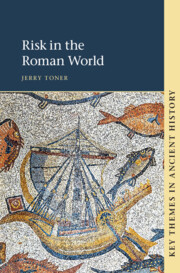
Modern theorists have seen the development of the concept of risk as reflecting a profound shift away from a belief in the divine determination of human fate. Modernity, it is also argued, has seen the introduction of new mega-risks, which are far larger than those before. The chapter challenges these views and argues both that the Romans were not simply fatalistic about the future, and also that it is impossible to quantify whether the ancients faced less risk.
Modern risk studies have viewed the inhabitants of the ancient world as being both dominated by fate and exposed to fewer risks, but this very readable and groundbreaking new book challenges these views. It shows that the Romans inhabited a world full of danger and also that they not only understood uncertainty but employed a variety of ways to help to affect future outcomes. The first section focuses on the range of cultural attitudes and traditional practices that served to help control risk, particularly among the non-elite population. The book also examines the increasingly sophisticated areas of expertise, such as the law, logistics and maritime loans, which served to limit uncertainty in a systematic manner. Religious expertise in the form of dream interpretation and oracles also developed new ways of dealing with the future and the implicit biases of these sources can reveal much about ancient attitudes to risk.
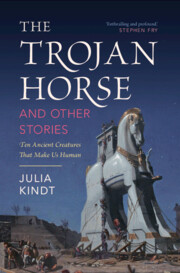
What makes us human? What, if anything, sets us apart from all other creatures? Ever since Charles Darwin's theory of evolution, the answer to these questions has pointed to our own intrinsic animal nature. Yet the idea that, in one way or another, our humanity is entangled with the non-human has a much longer and more venerable history. In the West, it goes all the way back to classical antiquity. This grippingly written and provocative book boldly reveals how the ancient world mobilised concepts of 'the animal' and 'animality' to conceive of the human in a variety of illuminating ways. Through ten stories about marvelous mythical beings – from the Trojan Horse to the Cyclops, and from Androcles' lion to the Minotaur – Julia Kindt unlocks fresh ways of thinking about humanity that extend from antiquity to the present and that ultimately challenge our understanding of who we really are.
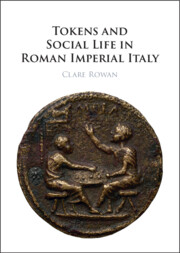
Tokens are underutilised artefacts from the ancient world, but as everyday objects they were key in mediating human interactions. This book provides an accessible introduction to tokens from Roman Italy. It explores their role in the creation of imperial imagery, as well as what they can reveal about the numerous identities that existed in different communities within Rome and Ostia. It is clear that tokens carried imagery that was connected to the emotions and experiences of different festivals, and that they were designed to act upon their users to provoke particular reactions. Tokens bear many similarities to ancient Roman currency, but also possess important differences. The tokens of Roman Italy were objects used by a wide variety of groups for particular events or moments in time; their designs reveal experiences and individuals otherwise lost to history. This title is also available as Open Access on Cambridge Core.