To save content items to your account,
please confirm that you agree to abide by our usage policies.
If this is the first time you use this feature, you will be asked to authorise Cambridge Core to connect with your account.
Find out more about saving content to .
To save content items to your Kindle, first ensure no-reply@cambridge.org
is added to your Approved Personal Document E-mail List under your Personal Document Settings
on the Manage Your Content and Devices page of your Amazon account. Then enter the ‘name’ part
of your Kindle email address below.
Find out more about saving to your Kindle.
Note you can select to save to either the @free.kindle.com or @kindle.com variations.
‘@free.kindle.com’ emails are free but can only be saved to your device when it is connected to wi-fi.
‘@kindle.com’ emails can be delivered even when you are not connected to wi-fi, but note that service fees apply.
Chapter 8 considers how the consolidation of royal authority impacted the agricultural and economic landscapes of southeastern Sicily, paying particular attention to the ways in which the tithe administration may have fostered trade and economic prosperity for the cities of the kingdom.
Chapter 6 takes as its focus the remains of two aboveground granaries that once stood in the agora of Morgantina, one of the cities that recognized Hieron’s authority as king. After a brief discussion of the buildings’ architectural form and function, the chapter explores where the Morgantina granaries fit within the corpus of known Hellenistic granary buildings and goes on to argue they played a central role in the projection of Hieron’s royal authority at the western edges of his kingdom.
Alarming decreases in cotton production have been reported over the last three decades due to neoliberal agrarian policies, agribusiness and shrinking areas of cultivatable land, among other factors. These changes underline the importance of creating an archive of knowledge about the production of cotton. Its history, the role of the state and the forms of hierarchical and exploitative divisions of labour need to be reconstructed and recalled as an exercise in nurturing the collective memory, for they are currently suffering a pervasive process of memory erasure by the powers that be. This short chapter is, in a way, an appendix to my book The Cotton Plantation Remembered (2013). It focuses on some ten documents derived from account books of the Fuuda family’s ‘izba located in Balamun in the Nile Delta, which accumulated wealth by acquiring massive tracts of agricultural land during the second half of the nineteenth century. This chapter is an attempt at attesting and reviving the significance of these account books for an alternative historical reading of such estates, as well as for rethinking what constitutes an archive.
Chapter 4 focuses on an institution central to the administration of the Hieronian state: the agricultural tithe collected annually from the cities subject to Hieron’s authority.
Cartography can help us understand how European knowledge of the topography and toponymy of the Delta has evolved over the centuries; however, we must be aware of the intellectual, social, religious and economic conditions under which maps were produced. Their content is far from exclusively geographic and the same map could show many levels of miscellaneous knowledge. Often, no European traveller had ever seen the cities drawn on the map. Consequently, before the nineteenth century, maps of Egypt and the Delta were unstable and contradictory – different maps expressed different Deltas, different representations of the world. The maps discussed in this chapter will paint a picture – a necessarily uncertain, shifting and composite picture – of knowledge acquired on the north of Egypt. This chapter will hopefully be a useful tool for understanding the evolution of European knowledge of the Delta and the research conducted in different places. By providing a list of the main documents, both cartographic and textual, relevant to the evolution of the cartography of the Delta, I hope to make place-specific research possible for those who wish it. It will also allow us to better understand what a thirteenth- or eighteenth-century map can say and not say.
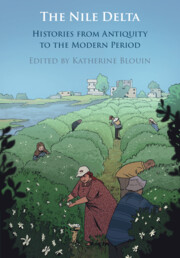
This is the first volume on the history of the Nile Delta to cover the c.7000 years from the Predynastic period to the twentieth century. It offers a multidisciplinary approach engaging with varied aspects of the region's long, complex, yet still underappreciated history. Readers will learn of the history of settlement, agriculture and the management of water resources at different periods and in different places, as well as the naming and mapping of the Delta and the roles played by tourism and archaeology. The wide range of backgrounds of the contributors and the broad panoply of methodological and conceptual practices deployed enable new spaces to be opened up for conversations and cross-fertilization across disciplinary and chronological boundaries. The result is a potent tribute to the historical significance of this region and the instrumental role it has played in the shaping of past, present and future Afro-Eurasian worlds.
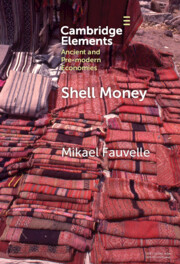
Where, when, and under what circumstances did money first emerge? This Element examines this question through a comparative study of the use of shells to facilitate trade and exchange in ancient societies around the world. It argues that shell money was a form of social technology that expanded political-economic capacities by enabling long-distance trade across boundaries and between strangers. The Element examines several cases in which shells and shell beads permeated throughout daily life and became central to the economic functioning of the societies that used them. In several of these cases, it argues that shells were used in ways that meet all the standard definitions of modern money. By examining the wide range of uses of shell money in ancient economic systems around the world, this Element explores the diversity of forms that money has taken throughout human history. This title is also available as Open Access on Cambridge Core.
Chapter 2 considers how Cicero responded to the model of the body politic proposed by Catiline. Rejecting the head of state metaphor, his oratory describes a civic healer capable of diagnosing and curing the ills of the Republic. This idea drew upon a well-established moralizing tradition that identified vice as a contagion that had infected the res publica. Whereas Varro, Sallust, and Lucretius employed such imagery to indict Rome’s governing class for its ambitio and avaritia, Cicero used it to justify the extralegal execution of the Catilinarian conspirators. Although he sought to protect a constitution under threat, his medically inspired language helped legitimize violence as a tool of political engagement. Identifying Clodius and his allies as new malignancies in need of amputation, he contributed to a corrosive cycle of civic conflict that culminated in Pompey’s sole consulship and Caesar’s dictatorship, two constitutional innovations justified as curative remedies. In the end, his rhetoric proved susceptible to appropriation by those less invested in collegial governance than he.
The Conclusion uses the downfall of Nero to consider the legacy of the body politic metaphor in Roman political thought. Julio-Claudian writers relied on the duality of head and body to express fears about the recurrence of civil war. Without a head to command Rome’s warring limbs, they argued, Rome would return to its ancestral cycle of self-destruction. The Year of the Four Emperors confirmed the prescience of their warnings. Plutarch and Tacitus relied on symbolism of a headless body politic to describe the conflict, confirming their perception of sole rule as necessary if not ideal. This contest for power therefore did not weaken the Principate so much as confirm its viability as an institution independent of its Augustan origins. With the rise of the Flavians came the formalization of both sole rule and the Imperial model of the body politic for centuries to come.
The Introduction presents the main questions and aims of the book. I argue that Roman thinkers used the metaphor of the body politic to articulate competing visions of the res publica between the Catilinarian Conspiracy and Year of the Four Emperors. I frame my discussion in relation to the Cambridge School of intellectual history, which has catalyzed the revival of interest in classical republicanism. In contrast to its focus on questions of liberty and popular sovereignty, my book turns towards problems of statesmanship and constitutional transformation. It asks how a foundational metaphor of civic organization evolved in response to the establishment of autocracy. It foregrounds the importance of metaphor as an avenue of political thought.
Chapter 3 explores how the models of the healer and head of state converged around the figure of the princeps. Although each proved useful in validating the Principate, their distinctive Republican histories invested them with divergent imperial trajectories. Because Cicero had already integrated the figure of the healer into Republican discourse, Augustan writers could soon locate the princeps in this role as well. The regal resonance of the caput, in contrast, made it unavailable as a descriptor of the “first citizen.” It is therefore absent in the works of Vergil, Horace, and Propertius. Yet for a society steeped in organic comparisons and confronted with constitutional change, the utility of the metaphor was obvious. Livy responded to this quandary in his first pentad, which depicts three stages in the life cycle of the Roman body politic: a regal polity topped by a caput, a Republic structured around the Fable of the Belly, and a fusion of these two forms under Camillus. Livy’s narrative thereby helped make the head of state metaphor available for contemporary usage. As Augustus’ rule came to an end, Ovid finally began identifying him as the caput orbis.
Chapter 5 locates the Younger Seneca and Lucan in a shared conversation about the long-term ramifications of sole rule. It opens with a reading of Seneca’s De Clementia, which is the first text to theorize the metaphors of the healer and head of state. Using both to construct a persuasive ideal of imperial interdependence, Seneca described a body politic whose health vacillates in proportion to the virtue of its princeps. The sick heads and overzealous surgeons that crop up in his other works, however, confirm the risks of such an arrangement. Lucan took this idea as his point of departure in the Bellum Civile, which responds to the imagistic framework of De Clementia through the characters of Sulla and Pompey. Portraying the former as a surgeon who makes excessive use of the scalpel and the latter as a head who suffers the mutiny of his limbs, he portrayed a body politic that was harmed but yet unable to survive without its rulers. He thereby conveyed the futility of politics in a society doomed to civil war.