To save content items to your account,
please confirm that you agree to abide by our usage policies.
If this is the first time you use this feature, you will be asked to authorise Cambridge Core to connect with your account.
Find out more about saving content to .
To save content items to your Kindle, first ensure no-reply@cambridge.org
is added to your Approved Personal Document E-mail List under your Personal Document Settings
on the Manage Your Content and Devices page of your Amazon account. Then enter the ‘name’ part
of your Kindle email address below.
Find out more about saving to your Kindle.
Note you can select to save to either the @free.kindle.com or @kindle.com variations.
‘@free.kindle.com’ emails are free but can only be saved to your device when it is connected to wi-fi.
‘@kindle.com’ emails can be delivered even when you are not connected to wi-fi, but note that service fees apply.
A Greek hymn is selected among other examples in the corpus of Greek ‘magical’ papyri written in Egypt during the Roman Imperial time. Addressed to the Moon goddess in a plurality of forms and names, it draws a complex portrait of a powerful divinity for love affairs. The incantation weaves innovative denominations together with a poetic and ritual tradition in order to enact power. The poet realised a technical ‘tour de main’ to picture a many-faced goddess, tying heavenly and shining traits to the gloomiest and the deadliest, and entangling anthropomorphic characteristics to a patchwork of animal features. The poetic mastery over names and figures offers tools for the making of the divine inside the ritual performance, with the effect of rendering a vivid perception of the Moon goddess encompassing all her aspects.
Having wandered through the gallery of portraits of ancient deities, with our noses in the air, our eyes and ears wide open to hear their names and the stories they tell, passing from Zeus to Yahweh, from Hecate to Isis, from Melqart to Bel, one may wonder whether we have lost our bearings? Like Brobdingnagians, those giants visited by Gulliver, we have spanned centuries and millennia, leapt from one shore of the Mediterranean to the other, and climbed to the heights of Olympus to scrutinise the gods, eye to eye. However, we have not been satisfied with looking, observing details, admiring colours, noting contrasts and underlining the nuances; our sound and light portraits resonated with 1,001 names. We have invited you to a concert of divine music: like Lilliputians, this time, sitting in a huge cave filled with many and varied sounds, we have listened to what might seem to be an incredible cacophony of names, a heterogeneous symphony of onomastic sequences, a labyrinth of sounds to make your head spin. Would naming the gods be a virtuoso game? Scholarly entertainment? Or a deluge, a random proliferation or chaos?
This chapter copes with the challenge of portraying a divinity which is supposed to be nameless and imageless, and evoked by ‘abstract’ notions such as the ‘God’, the ‘Lord’, the ‘Name’ or even the ‘Place’. The bans on pronouncing his name and depicting his image are two faces of the same coin: to explore in a new and unpredictable way his identity. Starting from the role played by names in ancient Near Eastern traditions and in the Hebrew Bible, this chapter explores the onomastic puzzle of the biblical god, who holds many names, but whose name YHWH is the only one regarded as a proper name and revealed by himself to Moses. Such a central and enigmatic name is interpreted as a promise of presence and assistance to the people god chose on earth (Israel). The onomastic connection between YHWH and the Jews never ceased to strike external observers and produced many misunderstandings, and even mystifications, in the history of the research of the biblical divine names.
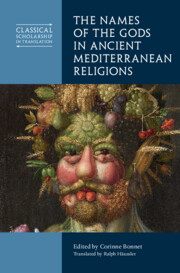
Giuseppe Arcimboldo was born in Milan around 1527 and after 1562–1563, having completed his training in Lombardy, he became a court artist in the service of the Habsburgs, successively under the emperors Ferdinand I, Maximilian II and Rudolf II, probably in Prague and then in Vienna. As the royal family’s portraitist, he assured his remuneration by producing completely classical canvases in the conventional style that reflected an official art form. At the same time, Arcimboldo produced some rather surprising works: composite heads and hybrid metamorphoses of the human face in which deception and illusion triumphed. With Arcimboldo blurring human perceptual reference points, his contemporaries referred to his canvases as scherzi, grilli and capricci, ‘jokes’, ‘caprices’ and ‘grotesques’, a marvellous and confusing mixture of genres. Still fascinated by these paradoxical, neither beautiful nor ugly, virtuoso and unusual portraits, our contemporaries call it ‘Mannerism’.
Let’s go and meet Melqart, the protector of Tyre, so attached to his rock and yet a tireless traveller. He travelled all the shores of the Mediterranean region with the Phoenicians from rock to rock. We will see why he adorned himself with the attributes of Heracles and what he shares with his Greek companion. We will also discuss his association with other deities in the Western Mediterranean. Finally, we will see why, long after the Phoenician expansion, he remains a reference point of the Phoenician world and of Tyre, the rock par excellence.
As early as the Hellenistic period but more widely in the imperial age throughout the Roman Empire, we observe consecrations and dedications both to deities known by other theonyms and to a power in its own right, named Panthe(i)os in Greek and Pantheus in Latin. Faced with this formulation, scholars have emphasised the ‘quantitative’ force of the Greek pas, pasa, pan (translated as ‘total, universal’), interpreting this god as reflecting a process of gradual translation from the multitude of gods of Greco-Roman paganism to a ‘total’ and thus ‘universal’ god, which would thereby pave the way for Christian monotheism. The analysis of this term and its contextual applications shows that Panthe(i)os/Pantheus does not portray an abstractly ‘total’ and therefore ‘unique’ god, but a ‘super-god’ with exceptional powers called upon for the sake of pragmatic efficiency, on a religious horizon still fully perceived as plural. By choosing this name, the worshippers thus displayed their privileged relationship with the deity from whom they expected protection in a particularly effective manner.
This paper deals with the Palmyrene divine title MR ‘LM’ which can be translated as Master of the World, of the Universe or of the Eternity. As a point of departure, it takes the theory of relativity and the sense of the time and space in the reference to the divine competences. Does the god called by this particular name have unlimited power, when he is the ruler of the entire universe and time? This paper shows the equal relevance of the title to the two Palmyrene gods: Bel and Baalshamin, remembering the transdivine character of the epithets
Starting from the respective onomastic landscapes of Dionysos and Poseidon, this chapter draws portraits of each god before comparing them. Indeed, as far as divine onomastics, and especially cult epithets, are concerned, points of convergence can be investigated, such as fishing or plant-growing. On the other hand, oppositions are even more representative of the situation of each god in structuring axes of ancient Greek Weltanschauung: Poseidon seems to be very ‘male’ while Dionysos is definitely more mobile between genders; and while the former is deeply rooted in stability and ‘holding together’, the latter makes waves and ‘loosens’. As other deities in a polytheistic system, what distinguishes these two gods is not so much a space (the sea, for example or a domain (such as that of vegetation) as the way in which they invest it. In other words, gods and goddesses of ancient polytheisms can be better understood when looking at their relations with and situations vis-à-vis each other.
The first occurrences of the onomastic formula ‘Zeus Helios great Sarapis’ belongs to the reign of Trajan. Appearing in the military and economic context of the quarries of the Egyptian eastern desert, this divine name associates, in a single henotheistic entity, the great gods of Egypt (Amon-Ra-Helios), the Greco-Roman world (Zeus-Iuppiter) and Alexandria (Sarapis), giving pre-eminence to the latter. The iconographic translation of this theological evolution can be found in the provincial coinage of Alexandria during the Antonine period.
The divine beings of the ancient Near East were complex entities, endowed with numerous prerogatives. In light of their multiplicity, this chapter investigates the narrative and symbolic strategies used by the inhabitants of ancient Mesopotamia to describe and conceptualise the divine. Firstly, it focuses on how the polysemy and polyphony typical of cuneiform writing were skillfully used to express the multiple features of gods and goddesses. Subsequently, the text focuses on some of the oldest cuneiform sources ever known: the god lists, in which the many names and onomastic attributes of the divinities were listed, following a specific conceptual order. Finally, the importance of the name for the definition of a deity is investigated by examining the case of Marduk and Aššur, two gods who established their supremacy precisely through the accumulation of theonyms.
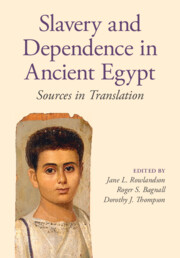
Ancient Egypt offers rich sources of documentary evidence for the study of the experiences of dependent people, particularly enslaved persons, and how they changed over almost four millennia from the Old Kingdom to the early Islamic period. This volume, the work of a team of scholars spanning the full range of disciplines and languages involved, provides nearly three hundred primary sources in translation, arranged both chronologically and thematically, and is aimed principally at students, instructors and general readers. The documents reveal how people became slaves and ceased to be slaves and how they were traded and exchanged in different periods. They also detail the various kinds of work slaves undertook, whether in the household, in agriculture or in mines and quarries. Introductions explain and contextualise the sources, and particularly address the problems of varying terminology in several different languages. The book shows Egypt's place in the world history of slavery.
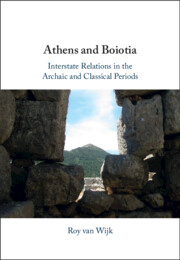
Were Athenians and Boiotians natural enemies in the Archaic and Classical period? The scholarly consensus is yes. Roy van Wijk, however, re-evaluates this commonly held assumption and shows that, far from perpetually hostile, their relationship was distinctive and complex. Moving between diplomatic normative behaviour, commemorative practice and the lived experience in the borderlands, he offers a close analysis of literary sources, combined with recent archaeological and epigraphic material, to reveal an aspect to neighbourly relations that has hitherto escaped attention. He argues that case studies such as the Mazi plain and Oropos show that territorial disputes were not a mainstay in diplomatic interactions and that commemorative practices in Panhellenic and local sanctuaries do not reflect an innate desire to castigate the neighbour. The book breaks new ground by reconstructing a more positive and polyvalent appreciation of neighbourly relations based on the local lived experience. This title is available as Open Access on Cambridge Core.
From Greece to Palmyra, Tyre or Babylon, the names of the gods, like 'Thundering Zeus', 'Three-faced Moon', 'Baal of the Force' or the enigmatic YHWH, reveal their history, family ties, fields of competence and capacity for action. Shared or specific, these names bring to light networks of gods: the Saviour gods, the Ancestral gods, the gods of a city or a family. Names tell stories about the relationship between men and gods, gods and places, places and cultures and so on. They show how gods travel and spread, how they appear and disappear, how they participate in the political, social, intellectual history of each community. Through the study of divine names, the twelve chapters of this book unfold a gallery of portraits that reveal the changing aspects of the divine throughout the ancient Mediterranean.
In the 4th century BCE, the Mareotis region developed as a crucial connection between Egypt and the Mediterranean, supplying Alexandria with all sorts of agricultural or artisanal goods; it was renowned above all for its wine. Yet despite ideal geologic conditions for growing grapes, a remarkable concentration of Roman and Byzantine wineries in the area, and ample evidence for widespread wine cultivation by ancient Egyptians, up until now no Pharaonic installation of wine-making had been discovered in the region. However, for the first time, concrete examples of vine-growing remains, from the New Kingdom to the Ptolemaic period, have been uncovered at the site of Plinthine/Kom el-Nugus. Relying on our archaeological and geomorphological research, this chapter concentrates on the early development of wine-making in Mareotis, showing how it developed alongside the growing interest of the state in these western margins. It shows how wine-making evolved from the New Kingdom to the Late Period, and assesses what kind of impact (if any) the coming of the Greeks had on local viticulture. It confirms that viticulture did not take off after the Macedonian conquest; rather, there exists strong continuity irrespective of political changes.