To save content items to your account,
please confirm that you agree to abide by our usage policies.
If this is the first time you use this feature, you will be asked to authorise Cambridge Core to connect with your account.
Find out more about saving content to .
To save content items to your Kindle, first ensure no-reply@cambridge.org
is added to your Approved Personal Document E-mail List under your Personal Document Settings
on the Manage Your Content and Devices page of your Amazon account. Then enter the ‘name’ part
of your Kindle email address below.
Find out more about saving to your Kindle.
Note you can select to save to either the @free.kindle.com or @kindle.com variations.
‘@free.kindle.com’ emails are free but can only be saved to your device when it is connected to wi-fi.
‘@kindle.com’ emails can be delivered even when you are not connected to wi-fi, but note that service fees apply.
In ancient Greece and Rome, veiling practices were ordinary (part of daily life) and extraordinary (part of special ritual occasions). Women’s veils were versatile objects that were involved in the performance of status, piety, modesty, and beauty. Some men veiled in the act of sacrifice or to hide strong emotions of sorrow and anger.
Visual and textual evidence from the Mediterranean region indicates the continued significance, complexity, opacity, and versatility of veiling practices among the late ancients. For women of this era (including Christians and Jews), veiling was entwined with performances of social status, honor, shame, deference, and obligations to others and the gods. Veiling was part and parcel of the formation of religious and liturgical subjects in the late ancient imaginary.
The trope that nature is a woman who hides or reveals herself has been around at least since the time of the presocratic philosopher, Heraclitus, who remarked: “Nature loves to hide.” This chapter introduces the allegorical representation of nature and truth as a veiled woman in diverse texts from Platonic philosophy and late ancient biblical interpretation to medieval literature and post-Enlightenment visual arts. This introduction also includes an examination of twenty-first century political contexts of veiling, and it presents an outline of the plan of the book.
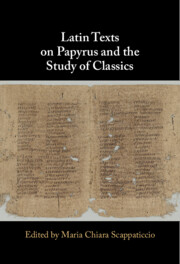
This volume gathers 25 chapters focused on Latin texts on papyrus, exploring them from multi- and cross-disciplinary perspectives. It serves as a companion to the texts published in The Corpus of Latin Texts on Papyrus (Cambridge, forthcoming). The chapters provide in-depth analyses of the chosen texts from literary, philological, linguistic, and historical perspectives, or offer methodological reflections on Latin texts on papyrus, promoting innovative approaches. They cover topics ranging from palaeography and philology to Latin literature and from ancient law to ancient and medieval history, and brilliantly demonstrate the potential of Latin texts on papyrus to inspire and illuminate the field of Classics.
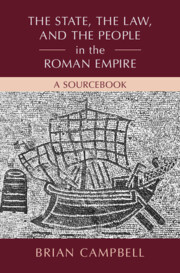
This volume makes more widely available to students and teachers the treasure trove of evidence for the administrative, social, and economic history of Rome contained in the Digest and Codex of Justinian. What happened when people encountered the government exercising legal jurisdiction through governors, magistrates, and officials within the legal framework and laws sponsored by the state? How were the urban environment of Rome and Italy, the state's assets, and human relations managed? How did the mechanisms of control in the provinces affect local life and legal processes? How were contracts devised and enforced? How did banks operate? What was the experience of going to court like, and how did you deal with assault or insult or recover loss? How did you rent a farm or an apartment and protect ownership? The emperor loomed over everything, being the last resort in moderating relations between state and subject.
Chapter 7: Crucial to any legal system is the plaintiff’s ability to get the defendant into court, and the supervision of the process in civil suits. In Rome the praetor decided if there was a case to answer, and presented a formula to the judge outlining the main issues. The formulary system was gradually superseded in the first century ad by cognitio, in which there was only one stage, before a magistrate, who heard the case himself and reached a judgement. Criminal cases were heard in public jury courts, and the charge was brought by a private individual (delator). Roman society was litigious, and it is useful to examine the experience of appearing in court, the place of the litigant, the availability and role of advocates, and the extent to which the state could ensure fairness in a system weighted in favour of the wealthy and the socially advantaged. State and citizen came in contact through the legal process and the courts.
Chapter 6 considers how the legal system dealt with theft, damage to property, personal insult, and violence, and how citizens obtained redress. The law of obligations is important since, for example, theft, the most common action that modern law defines under criminal law, was under Roman law a delict, prosecuted through action taken by the injured party on the basis of an obligation on the wrongdoer to make restitution. Therefore, the Romans distinguished between a delict and a crimen, which was punished by public penalty after formal trial. In the legal definition of unlawful killing, injury, outrage, and loss, concepts of negligence, deceit, and causation emerged in assessing responsibility. We then consider the definition of theft and robbery, the remedies available for plaintiffs, and the main criminal offences tried in the public jury courts. Those who did not conform with the religious establishment and social conventions, for example, magicians, Jews, and Christians, faced pursuit and prosecution.
Scholarship on ancient Greek prayer has almost always focused on its public instantiations: in sacrifice, oratory, sanctuary contexts, etc. This chapter explores the evidence for ancient Greek prayer in the liminal space where public and private clash, coalesce, and collapse. I argue that the prayers of ancient polytheists, though rarely – if ever – strictly private, routinely operated across and between different spheres such as the public and the private, the polis and the oikos, the intimate and the communal. I approach the study of ancient prayer afresh, not as a site of opposition between the individual and the polis, nor as a space in which the distinctions between these realms of praxis are erased or effaced. Rather, prayer here features as an occasion to reflect on the spectrum of possible intersections between personal piety (individual feelings towards and actions in service of the divine) and the wider superstructures of religion, politics, society, and culture within which its practitioners were imbricated and to which they sought to respond.
Herodotus’ Historiesare filled with instances of personal engagement with the supernatural. If we consider that phenomenon in the specific terms of ‘personal religion’, new patterns and questions emerge. This chapter demonstrates not only that personal religion in Herodotus tends to resolve itself in the political, but that this reinforces the point that there was no strict boundary between personal and polis religion. Most of the people whose experiences Herodotus relates remain ‘public figures’, and Herodotus’ historical narrative, by its nature, devotes significant attention to political affairs. Many episodes from the Histories involve atypical individuals. But their experiences with the divine nevertheless fit into common categories, and the concerns which lead these individuals to approach the divine are mostly nothing out of the ordinary. Herodotus’ stories reveal elements of personal religious practice which might otherwise be difficult to find in surviving sources. By considering both personal and civic aspects of Greek religious thought and practice in Herodotus’ work, we see the continuous presence of the gods in the lived experience of individuals.
Chapter 5 considers the legal definition of ownership and possession and how they were acquired and protected. Possession was important in that someone who had physical control of something, for example, a farm, could use the land and enjoy its fruits even though the property was formally owned by another. Having possession of an object brought significant benefits since it was an important step to proving and acquiring ownership by usucapio (that is, having it in your possession for at least two years in the case of immovables, one year for movables). The acquisition and distribution of land was part of the history of the republic, and the management of land, the designation of boundaries, the establishment of jurisdiction, and the resolution of disputes through the legal process remained important. We then consider the role of law in arranging farm tenancy and negotiating leases, and the position of urban landlords and tenants.
This chapter investigates instances of personal divination in the ancient Greek world. This includes the use of oracles, omens, forms of technical divination and the occurrence of prophetic dreams in personal matters that do not articulate the concerns of the polis. The chapter explores what personal issues warranted a consultation of the gods, as well as the scope and limits for individuals to use the divinatory system to their advantage. The chapter shows that consultation with the gods about questions of personal concern (about health, travel and questions of everyday life) was not merely available to the upper classes and those in power, but conducted by everyday people, including women, metics and slaves. Throughout, the chapter carefully distinguishes between what we know about actual personal oracle consultations on the one hand, and their representation in works of literature on the other. At the same time, the chapter presents several themes that run through different kinds of evidence and explores what they reveal about the use and abuse of divine knowledge (and the actions it is made to sanction) in the ancient Greek world.
Old Comedy was performed at polis festivals by a citizen chorus but depicted non-elite individuals pursuing their personal goals by personal means, including their personal interactions with the divine. Since its characters are individual community members, comedy is uniquely suited to reflecting and exploring the relationship between polis and personal religion. Although many of the personal religious practices in comedy can be interpreted as comically incongruous, this is part of the genre’s characteristic transformation of lofty to low and civic to personal. The chapter shows that comedy does not merely depict but enacts personal religion. It glances briefly at oikos religion, philosophical religion, and foreign/non-established cults before focusing on personal divination, sacrifice, prayer, and religious practices relating to love and sex. A final section examines how comedy sometimes elevates personal religion to a polis level and sometimes reduces polis religion to a personal level. In all cases, a complex interrelationship of polis and personal religion becomes evident, but never one in which the latter is merely a subset of the former.