To save content items to your account,
please confirm that you agree to abide by our usage policies.
If this is the first time you use this feature, you will be asked to authorise Cambridge Core to connect with your account.
Find out more about saving content to .
To save content items to your Kindle, first ensure no-reply@cambridge.org
is added to your Approved Personal Document E-mail List under your Personal Document Settings
on the Manage Your Content and Devices page of your Amazon account. Then enter the ‘name’ part
of your Kindle email address below.
Find out more about saving to your Kindle.
Note you can select to save to either the @free.kindle.com or @kindle.com variations.
‘@free.kindle.com’ emails are free but can only be saved to your device when it is connected to wi-fi.
‘@kindle.com’ emails can be delivered even when you are not connected to wi-fi, but note that service fees apply.
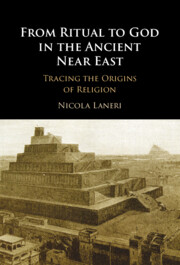
Human belief systems and practices can be traced to ca. 10,000 BCE in the Ancient Near East, where the earliest evidence of ritual structures and objects can be found. Religious architecture, the relics of human skeletons, animal symbolism, statues, and icons all contributed to a complex network into which the spiritual essence of the divine was materially present. In this book, Nicola Laneri traces the transformation of the belief systems that shaped life in ancient Near Eastern communities, from prehistoric times until the advent of religious monotheism in the Levant during the first millennium BCE. Considering a range of evidence, from stone ceremonial enclosures, such as as Göbleki Tepe, to the construction of the first temples and icons of Mesopotamian polytheistic beliefs, to the Temple of Jerusalem, the iconic center of Israelite monotheism, Laneri offers new insights into the symbolic value embodied in the religious materiality produced in the ancient Near East.
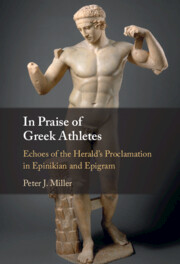
In ancient Greece both epinikian songs and inscribed epigrams were regularly composed to celebrate victory at athletic festivals. For the first time this book offers an integrated approach to both genres. It focuses on the ultimate source of information about athletic victory, the angelia or herald's proclamation. By examining the ways in which the proclamation was modified and elaborated in epinikian song and inscribed epigram, Peter Miller demonstrates the shared features of both genres and their differences. Through a comprehensive analysis of the metaphor of the herald across the corpus, he argues that it persists across form, medium, and genre from the Archaic to the Hellenistic period, and also provides a rich array of close readings that illuminate key parts of the praise of athletes. This title is part of the Flip it Open Programme and may also be available Open Access. Check our website Cambridge Core for details.
We have referred elsewhere to Aristotle’s pronouncement in his Poetics on the role of the chorus in tragedy: ‘the chorus must be regarded as one of the actors; being part of the whole, it should take part in the action (sunagonízesthai), not as in Euripides, but as in Sophocles’. In the wake of this famous normative statement it is often said that the chorus of Euripides’ tragedies no longer played the central role it had played in those of Sophocles. According to Aristotle the tragic poet Agathon had been the first to turn the chorus’ interventions into mere musical intermezzos or embólima, and many have ascribed the same tendency to Euripides. If there is one play of Euripides that does not justify this belief it is his second Hippolytus. This play shows the master tragedian at the apex of his poetic career.
If there is a Greek tragedy that is not often associated with choral song this must surely be Sophocles’ Oedipus Tyrannus. The play has become synonymous with the story about the young Oedipus’ fate made famous by Sigmund Freud, and as such it has been canonized as the founding myth of psychoanalysis. As Freud first put it, in the fourth of his Five Lectures on Psychoanalysis: ‘The child takes both of its parents, and more particularly one of them, as the object of its erotic wishes … the child reacts to this by wishing, if he is a son, to take his father’s place, and, if she is a daughter, her mother’s … The myth of King Oedipus, who killed his father and took his mother to wife, reveals, with little modification, the infantile wish, which is later opposed and repudiated by the barrier against incest.’
At the turn of the twenty-first century the chorus captured the attention of readers of Greek tragedy, especially anglophone scholars. In the field of cultural anthropology, the indirect influence of Victor Turner’s work on ‘theatrical performance’ was particularly significant. Inspired by Wilhelm Dilthey’s notion of experience as Erlebnis, and on the basis of ethnological field research on the initiation rites of male and female adolescents in the Ndembu tribe of present-day Zambia, Turner formulated a view of culture as a collection of individual experiences made available to society by means of expression (both verbal and physical). Theatrical performance is thus a ‘structured unit of experience’, a processual accomplishment or ritualized staging of the social drama.
Is tragedy choral? Let us return finally to the question of origins, but let us do so while keeping strictly to the poetical, narrative and ritual dimensions. We will now be able to draw some conclusions regarding the pragmatics of the tragic choral voice – both masculine and feminine – as it is orchestrated by the poets who stage, in the service of the city, an action belonging to its heroic past.
Though he was both friend and collaborator of Johann Wolfgang Goethe in Weimar, Schiller was not significantly influenced by his fellow playwright. We find no allusion in his quasi-Aristotelian definition of ‘Tragedy’ to the famous triad canonized some thirty years later by the master of Weimar: Epos, Lyrik, Drama – the ‘three natural and authentic forms of poetry’. Admittedly, Goethe was at pains to nuance his thesis precisely in relation to ‘das ältere griechische Trauerspiel’, ‘the ancient Greek tragedy’. He explained that in a first phase of development of the genre the three natural forms of poetry merged into one, inasmuch as the main character was still the chorus and the lyric mode was predominant. Later, the three forms tended to diverge and to organize themselves in sequence within individual tragedies. Goethe therefore found within the genre of tragedy the clarity of narrative epic, the exaltation of lyric emotion and the personal action of drama.
To get to the root of the grave misunderstanding underlying modern notions of the lyric mode we must revisit this chapter in the history of tragic criticism.
Let us begin by looking at a tragedy that is largely choral. Aeschylus’ Persians was staged at the Great Dionysia in 472, only one year after the Battle of Salamis, where the Athenian fleet had defeated Xerxes’ armada. The Great King had invaded continental Greece, and on reaching Athens had set fire to the Acropolis and destroyed the temple of its tutelary deity Athena, the Old Parthenon. Aeschylus’ choregos was none other than Pericles. Here we follow the dramatic – and choral – unfolding of this tragedy whose action takes place in Susa, the capital of Persia.
In the wake of German Romantic aesthetic thought, Greek tragedy was appropriated by idealist philosophy as a basis for theories of the Tragic. This resulted on the one hand in a positive ontology that led, by way of tragic reversal, to man’s absolute conscience and freedom, and on the other hand in a negative ontology in which human nature’s fundamental indeterminateness eludes language. In this perspective, Greek drama acts as a salutary reminder that human reality eludes Enlightenment reason. A historicized version of these idealist theories of the Tragic, greatly influenced by Christian theology around divine Incarnation and Redemption, finds expression in recent work by various scholars; by staging divine men who suffer and gods who are all too human, Attic tragedy as a genre is held to refer to a ‘minimal theology’ based on the effects of time and animated by a ‘theoretical need’ that is instrumental rather than final; it presents on stage a series of paradoxical individualities. By relying on a template, it enables singular dramatic situations to ‘make sense’.