To save content items to your account,
please confirm that you agree to abide by our usage policies.
If this is the first time you use this feature, you will be asked to authorise Cambridge Core to connect with your account.
Find out more about saving content to .
To save content items to your Kindle, first ensure no-reply@cambridge.org
is added to your Approved Personal Document E-mail List under your Personal Document Settings
on the Manage Your Content and Devices page of your Amazon account. Then enter the ‘name’ part
of your Kindle email address below.
Find out more about saving to your Kindle.
Note you can select to save to either the @free.kindle.com or @kindle.com variations.
‘@free.kindle.com’ emails are free but can only be saved to your device when it is connected to wi-fi.
‘@kindle.com’ emails can be delivered even when you are not connected to wi-fi, but note that service fees apply.
The use of i-longa is very different from that of apices in the tablets of the Sulpicii and the tablets from Herculaneum. For one thing, i-longas are far more common than apices. In the TPSulp. tablets I count 799 instances of i-longa (compared to 76 apices), which appear in all but 16 of the 127 documents. In the TH tablets they appear in 26 documents out of 40, and I count 243 instances in total. They also differ in the range of phonemes which they represent. Adams (2013: 104–8) discusses the use of <ì> in the tablets of the Sulpicii at some length, although without a rigorous collection of examples. He observes that it is found for long /iː/ (as might be expected on the basis of the grammatical tradition), for short /i/, and for /j/, both word-initially and word-medially between vowels. The large numbers of i-longa in the tablets of the Sulpicii make a full investigation difficult, but 163 cases are used to write a synchronic short vowel (with 19 of these being vowels which were originally long), which equates to 20% of the total.
The writers on language were aware that <c> had previously been used for /g/ (e.g. Terentianus Maurus 210–211, 894–901 = GL 6.331.210–211, .351.894–.352.891). Instances of <c> for <g> are occasionally found in my corpora, but it is hard to take them seriously as examples of old-fashioned spelling. In the curse tablets there are scores, if not hundreds, of instances of <g> in the corpus as a whole, and in most cases the few apparent cases of <c> are probably to be put down to the difficulty of distinguishing <c> from <g>, either in the writing or reading of small letters on a thin piece of soft metal which is generally then subject to folding and unfolding, abrasion, water and other types of damage etc. – cf. Väänänen’s (1966: 53) comment that instances of <c> for <g> at Pompeii are ‘simple writing errors’ (‘simples erreurs d’écriture’). For similar reasons, the few instances of <c> for <g> in the graffiti from the Palatine are not to be taken seriously.
A number of different changes took place to reduce original geminate consonants in Latin. In addition, there was another rule (or rules) which produced geminates out of original single consonants. Since these changes did not take place at the same time, and were not necessarily reflected in spelling at the same rate, I will discuss them here separately.
Adams (1995: 97–8, 2003: 531–2) collected most examples of apices in the Vindolanda tablets in Tab. Vindol. II and III. Including some doubtful cases, he counts 92 instances. We can add a further 7 found in the more recently published tablets, and 6 which he omitted. With the new cases we have a total of 105 instances of apices (Table 35), of which 82 = 78% are on long vowels, and 19 = 18% are on short vowels, with a further 2 = 2% on vowels which were short but used to be long, and 2 = 2% on vowels of uncertain length (Table 36).
In the course of the second century BC, /ɔ/ became /ɛ/ after /w/ and before a coronal, other than a single /r/ (Weiss 2020: 152), for example uoster > uester ‘your’, uoto > ueto ‘I forbid’, aduorsom > aduersum ‘against’. The earliest inscriptional example comes in the Lex repetundarum of 123–122 BC (CIL 12.583), where we find a single example of auersum beside five cases of the spelling <uo>. I have found 6 instances of the <uo> spelling dated to the first century BC, beside 52 examples of <ue>.
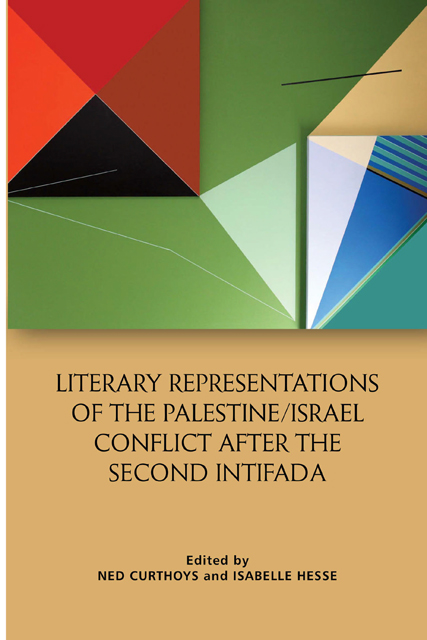
This edited collection brings together discussions of literary works from Israel, the Occupied Palestinian Territories, the Palestinian and Jewish Diasporas, as well as from authors and creators not directly involved with the conflict who are seeking to unpack its complexities for a wider audience. It offers new perspectives into how the Palestine/Israel conflict is, and can be, represented after the Second Palestinian Intifada, an epochal event for both Israelis and Palestinians. This collection foregrounds the thematic concerns that link literary engagements with Palestine/Israel across the globe but also examines the role that aesthetic representation plays in framing the conflict and its power dynamics. It addresses how emergent forms of writing and representation illuminate but also redescribe conflict in the context of Israel and Palestine and how, as in the case of the investigative graphic novel for example, depicting this conflict has had reverberations for representing conflict and conflict zones more widely.
Petrie reappraises Scottish politics in the decades after 1945, augmenting existing accounts of this period by foregrounding the importance of ideology and language. Founded upon original archival research, the book recovers the central role played within modern Scottish politics by an individualist, anti-bureaucratic critique of central government. Deployed initially by those on the political right to attack the programme of nationalisation implemented by the post-war Labour government, by the 1960s this rhetoric was being exploited by advocates of constitutional change. As liberty came to be framed in constitutional rather than economic terms, understandings of political representation also changed: crucially, the arrival of the referendum in British politics granted credibility to the belief that there existed a distinctive Scottish tradition of popular sovereignty. Focused upon Scotland, this study nevertheless engages with broader debates and will appeal to historians of modern Britain as well as political and legal scholars.
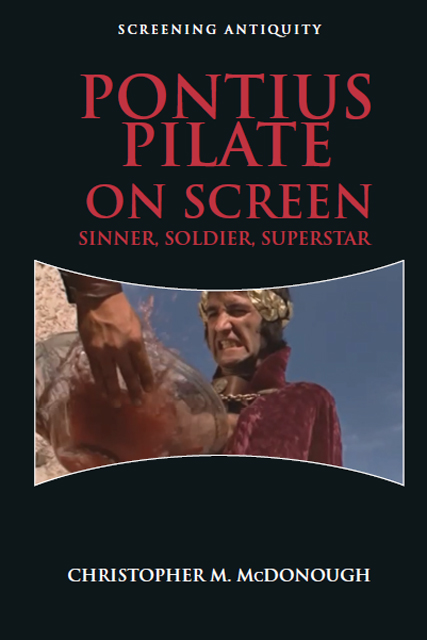
Pontius Pilate On Screen deals with one of history's most controversial characters. From Monty Python's 'Life of Brian' to Mel Gibson's 'Passion of the Christ', Pontius Pilate is a figure of evidently endless fascination to filmmakers. The Roman prefect is depicted at times as the hapless victim of machinations beyond his control and at other times as the heartless villain of the piece. If in films about the Passion Jesus represents eternal truth, Pilate symbolises the values of the present - whether it is the lingering trauma of the Holocaust, the ongoing struggle over Civil Rights or the polarised politics of the current day - as filmmakers endeavour again and again to portray in Pontius Pilate a compelling counter-figure to Jesus himself.
This book considers portrayals of Pontius Pilate in film from the silent era to the twenty-first century. It discusses over 25 films in detail, including Cecil B. DeMille's 'King of Kings' (1927), Norman Jewison's 'Jesus Christ Superstar' (1973), Martin Scorsese's 'Last Temptation of Christ' (1988), Mel Gibson's 'The Passion of the Christ' (2004) and Sony's 'Risen' (2016). Based on extensive archival research and original interviews with actors, screenwriters and producers, it offers an extended discussion of the history, tradition and reception of Pontius Pilate.
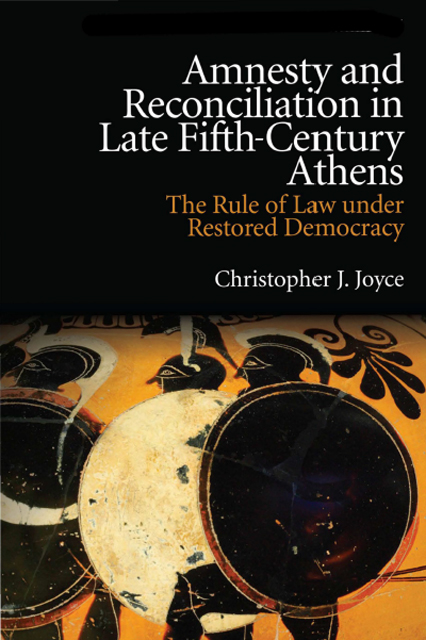
The Athenian Reconciliation of 403 BCE was the pinnacle of amnesty agreements in Greek antiquity. It guaranteed lasting peace in a political community torn apart by civil conflict, because it recognised that for society to cohere, vindictive action over crimes which predated the exchange of oaths was legally inadmissible. This study analyses the historical circumstances which led to the fall of democracy at Athens in 404, the civil conflict which followed under the Thirty Tyrants and the restoration of democracy and the rule of law in 403. It analyses afresh the Reconciliation Agreement in the light of New Institutionalist perspectives, showing that the resurrection of democracy was guaranteed by the rule of law and by the strict application of the agreement in the democratic law courts. It offers fresh readings of the clauses of the Agreement and the legal trials which followed in its wake and shows that the Athenian example was the paradigm not only for amnesties in the ancient world but for those since the seventeenth-century.
In the ancient Mediterranean world, individuals routinely looked for divine aid to cure physical afflictions. Contested Cures argues that the inevitability of sickness and injury made people willing to experiment with seemingly beneficial techniques, even if they originated in a foreign cultural or religious tradition. With circumstances of close cultural contacts, such as prevailed in Palestine, the setting was ripe for neighbouring Jews, Samaritans, Christians, Greeks and Romans to borrow rituals perceived to be efficacious and to alter them to fit their own religious framework. As a result, they employed related means of seeking miraculous cures. The similarities of these rituals, despite changes in the identity of the divine healers that they invoked, made them the subject of polemical discourse among elite authors trying to police collective borders. Contested Cures investigates the resulting intersection of ritual healing and communal identity.
This innovative study synthesises evidence for the full range of healing rituals that were practised in the ancient Mediterranean world. Examining both literary and archaeological evidence, it considers ritual healing as a component of identity formation and deconstructs the artificial boundary between 'magic' and 'religion' in relation to ritual cures.
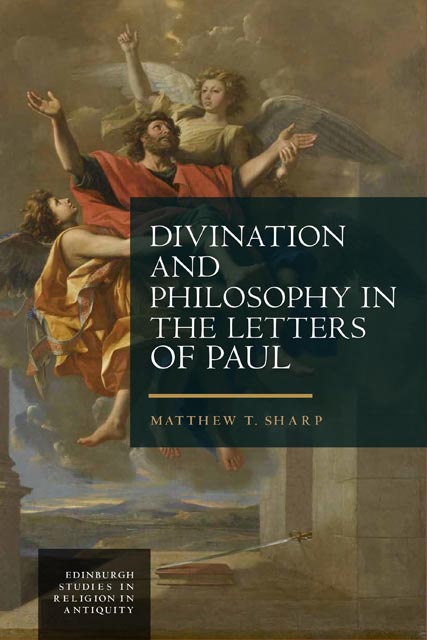
This book analyses the apostle Paul's claims to receive and interpret knowledge from divine sources within the context of divination in the Graeco-Roman world. Each chapter studies a particular aspect of divination in Paul's letters in comparison with similar phenomena in the Graeco-Roman world, dealing in turn with the underlying logic of divination (in the context of ancient philosophical conversations), visionary experience, prophecy and divine speech, the divinatory use of texts and the interpretation of signs. As such, the book forms an in-depth study of divine communication in Paul's letters, integrating this theme with the broader topics of cosmology, anthropology, eschatology and theology. While New Testament texts and early Christian figures have traditionally been studied from the vantage point of theological categories (such as 'revelation') that isolate early Christianity from its historical context in the Graeco-Roman world, this book re-reads Paul's thought and practice concerning divine communication within, not against, the Graeco-Roman thought and practice of divination. In doing so it illuminates the coherence and connections both between Paul and his historical context and between diverse topics of Paul's letters that have usually been studied in isolation from each other.
Chapter 4 concludes the analysis of Julian’s reckoning with Constantine’s propaganda. It focuses on Julian’s strategy to disavow the public persona of the first emperor who had promoted the association between Christian sovereignty and ideals of philosophical leadership. The first section considers the efforts of Constantine’s propaganda to use the events of his (Constantine’s) life to prove that Roman history was guided by Christian providence. The engagement with autobiography in Julian’s final writings appears in this light as the culmination of his response to Christianity’s claims of intellectual dominance over Greco-Roman culture. The second section reconstructs Julian’s joint attempts to project his life as the token of his superior understanding of providential history (Against Heraclius) and to mobilise past Roman history as a source of counter-exempla disproving Constantine’s claims (The Caesars). In the process, Julian repurposed a fundamental element of Constantine’s propaganda – imperial iconography – to his advantage (Caesars; Misopogon).