To save content items to your account,
please confirm that you agree to abide by our usage policies.
If this is the first time you use this feature, you will be asked to authorise Cambridge Core to connect with your account.
Find out more about saving content to .
To save content items to your Kindle, first ensure no-reply@cambridge.org
is added to your Approved Personal Document E-mail List under your Personal Document Settings
on the Manage Your Content and Devices page of your Amazon account. Then enter the ‘name’ part
of your Kindle email address below.
Find out more about saving to your Kindle.
Note you can select to save to either the @free.kindle.com or @kindle.com variations.
‘@free.kindle.com’ emails are free but can only be saved to your device when it is connected to wi-fi.
‘@kindle.com’ emails can be delivered even when you are not connected to wi-fi, but note that service fees apply.
Following the overarching theme of associations’ regulations, the chapters of this book have provided the reader with different insights into a large variety of ancient associations that were embedded in as many local realities, in an attempt on the one hand to highlight similar patterns but on the other hand also to stress the vivacity and diversity of the fenomeno associativo, ‘associational phenomenon’: although common traits certainly emerge, one should in no way expect uniformity. The world of associations was in fact a complex one: this book has mainly explored associations active in the Greek-speaking world, but even in this ‘common cultural sphere’ one sees a great variety of different options at play, which mirror the character of their various societies. The ways in which associations operated were a result of the strategies adopted by them on the basis of the different challenges they encountered and the way in which they appear to us is also linked to the contingent production and preservation of the sources, which varied depending on location and time. It is therefore not surprising that the picture we have gained from late Hellenistic and early Roman Athens is a different one from that of contemporary Mantinea, for instance: in Athens, as we have seen in the discussion by Arnaoutoglou in Chapter 6, associations made full use of the polis’ general directions, trends and mechanisms in the regulation of members’ behaviour so as to enhance their profile and foster their autonomy, room of action or survival, by providing an image that matched the expectations of the public administration.
Despite the considerable number of private associations attested in the Peloponnese, epigraphic sources from this region only rarely allow us an insight into norms of the associations’ internal organisation. Beyond a regulation for the use of an hestiatorion, ‘banquet-hall’, and a chalkion (in this context the term probably refers to ‘bronze cooking utensils’ or the place where they were stored) on a metal tablet from Sicyon (sixth/fifth century BC), which is followed by a list of seventy-three male names,1 and an extremely fragmentary inscription from Mantinea,2 which refers to a nomos and to imposition of fines, texts of this type are not preserved. Some indirect light on private associations’ rules and regulations is further shed by a small number of honorific decrees originating in Peloponnesian towns. This chapter will focus on this category of texts from Mantinea.
The self-perpetuity of Greek private associations and the continuous performance of their collective activities presupposed the ability both to admit new members and to draw regular contributions (that is to say, material support) from the existing ones. The diffuse evidence on the rules that regulated these essential aspects of the associations’ internal functions has been thoroughly examined both in the pioneering works of the late nineteenth and early twentieth centuries and in more recent studies.
This volume in the LACTOR Sourcebooks in Ancient History series offers generous selections from Cassius Dio's account of the Julio Claudians, with accompanying maps, appendices and a thorough, contextualising Introduction. It provides for the needs of students at schools and universities who are studying ancient history in English translation and has been written and reviewed by experienced teachers.
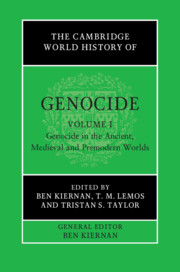
Volume I offers an introductory survey of the phenomenon of genocide. The first five chapters examine its major recurring themes, while the further nineteen are specific case studies. The combination of thematic and empirical approaches illuminates the origins and long history of genocide, its causes, consistent characteristics, and the connections linking various cases from earliest times to the early modern era. The themes examined include the roles of racism, the state, religion, gender prejudice, famine, and climate crises, as well as the role of human decision-making in the causation of genocide. The case studies cover events on four continents, ranging from prehistoric Europe and the Andes to ancient Israel, Mesopotamia, the early Greek world, Rome, Carthage, and the Mediterranean. It continues with the Norman Conquest of England's North, the Crusades, the Mongol Conquests, medieval India and Viet Nam, and a panoramic study of pre-modern China, as well as the Spanish conquests of the Canary Islands, the Caribbean, and Mexico.
This volume in the LACTOR Sourcebooks in Ancient History series offers a generous selection of primary texts on Athenian democracy, which flourished in the fifth and fourth centuries BC, with an accompanying glossary and introductory notes. It provides for the needs of students at schools and universities who are studying ancient history in English translation and has been written and reviewed by experienced teachers. The texts selected include extracts from the important literary sources as well as some key inscriptions, some of which were previously difficult for students to access.
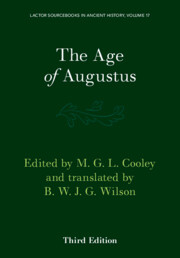
This volume in the LACTOR Sourcebooks in Ancient History series features primary texts on the Age of Augustus (31 BC-AD 14), with accompanying maps, illustrations, glossary and introductory notes. It provides for the needs of students at schools and universities who are studying ancient history in English translation and has been written and reviewed by experienced teachers. The texts selected include extracts from the important literary sources but also numerous inscriptions, coin legends and extracts from legal texts, some of which were previously difficult for students to access.
This volume in the LACTOR Sourcebooks in Ancient History series features primary texts relating to Cicero's campaign for the consulship of 63 BC, with an accompanying glossary and timeline. It provides for the needs of students at schools and universities who are studying ancient history in English translation and has been written and reviewed by experienced teachers. The texts selected include two letters to Atticus, extracts from two speeches and Asconius' commentary on Cicero's speech as a candidate, and 'A Short Guide to Electioneering' attributed to Quintus Cicero.
This volume in the LACTOR Sourcebooks in Ancient History series offers a generous selection of primary texts on Sparta, with accompanying maps, illustrations, glossary, chronology and explanatory notes. It provides for the needs of students at schools and universities who are studying ancient history in English translation and has been written and reviewed by experienced teachers. The texts selected include extracts from the important literary sources but also numerous inscriptions, many of these being otherwise difficult for students to access.
Apart from after /u/, /w/ and /kw/, where the raising of /ɔ/ was retarded until the first century BC, which is discussed below (Chapter 8), there are few cases of <o> for <u> arising from these contexts in the corpora. Even where we do find <o>, a confounding factor in identifying old-fashioned spelling of /u/ of these types is the lowering of /u/ to [o] which eventually led in most Romance varieties to the merger of /u/ and /ɔː/. According to Adams (2013: 63–70), this can be dated to between the third and fifth centuries AD, and did not take place at all in Africa. This requires him to identify a number of forms which show <o> for /u/ as containing old-fashioned spelling (or having other explanations) in the Claudius Tiberianus letters (Adams 1977: 9–11, 52–3; 2013: 63–4).
The Latin alphabet inherited from its Etruscan model a superfluity of signs to represent the phoneme /k/: <c>, <k> and <q>. It also inherited, to some extent, the convention in early Etruscan inscriptions whereby <k> was used in front of <a>, <q> before, and <c> before <e> and, although consistent usage of this pattern is found rarely even in the oldest Latin inscriptions (Hartmann 2005: 424–5; Wallace 2011: 11; Sarullo 2021). Over time, <c> was preferred for /k/ in all positions, while the digraph <qu> was used to represent the phoneme /kw/. Nonetheless, both <k> before <a> and <q> before (with the value /k/) lived on as optional spellings into the imperial period.
Single *i̯ between vowels was lost very early in Latin (possibly at the Proto-Italic stage). Consequently, the sound represented by consonantal between vowels was actually geminate /jj/ from various sources (Weiss 2020: 67–8). I have not been able to find any epigraphical examples of <ii> prior to the first century BC, and Weiss’ (2020: 68 fn. 64) statement that ‘[g]eminate spelling … is frequently encountered on inscriptions’ seems exaggerated. A search for ‘cuiius’, one of his two examples, on the whole of the EDCS, finds 13 examples, as opposed to 793 for ‘cuius’. The other is maiiorem (CIL 2.1964.3.10): a search for ‘maiior’ finds 12 examples, including derived names, beside 948 for ‘maior’.
The reduplicated perfect of spondeō ‘I swear’ was originally spepondī, a spelling still used by Valerius Antias, Cicero and Caesar in the first century BC, according to the second century AD author Aulus Gellius (Noctes atticae 6.9.12–15), implying that spopondi was the standard spelling at the time. The inscriptional evidence outside the corpora is not very numerous; to some extent it supports this interpretation. There are only 4 instances of spepondi (AE 1987.198, AD 256; AE 1987.199, AD 254–256, both from Ostia; CIL 6.10241, around the age of Hadrian; CIL 6.18937). By comparison, there are 8 of spopondi, of which 2 are dated to the first century AD: CIL 2.5042 = 5406 (AE 2000.66), CIL 6.10239 (EDR177718).
The diphthong /ɔu/ became /oː/ and then /uː/ by the third century BC (see p. 000). On the use of <o> in place of in poplicos > pūblicus and words derived from it, see p. 000. It is possible that iodicauerunt (Kropp 11.1.1/26) in a curse tablet from Carthage, in the second century AD, for iūdicāuē̆runt < *i̯oudik- is an old-fashioned spelling representing the mid-point of the change (at any rate, no other explanation springs to mind). Since we have long /uː/ in the first syllable, this spelling cannot be explained by confusion of /ɔː/ and /u/. At least in legal texts, derivatives of iūs were particularly favoured for this (Decorte 2015: 160–2), although use of <o> for /uː/ rather than <ou> was never common, even in the archaic period.
apices ibi poni debent, ubi isdem litteris alia atque alia res designatur, ut uénit et uenit, áret et aret, légit et legit, ceteraque his similia. super i tamen litteram apex non ponitur: melius enim [i pila] in longum producetur. ceterae uocales, quae eodem ordine positae diuersa significant, apice distinguuntur, ne legens dubitatione impediatur, hoc est ne uno sono eaedem pronuntientur.