To save content items to your account,
please confirm that you agree to abide by our usage policies.
If this is the first time you use this feature, you will be asked to authorise Cambridge Core to connect with your account.
Find out more about saving content to .
To save content items to your Kindle, first ensure no-reply@cambridge.org
is added to your Approved Personal Document E-mail List under your Personal Document Settings
on the Manage Your Content and Devices page of your Amazon account. Then enter the ‘name’ part
of your Kindle email address below.
Find out more about saving to your Kindle.
Note you can select to save to either the @free.kindle.com or @kindle.com variations.
‘@free.kindle.com’ emails are free but can only be saved to your device when it is connected to wi-fi.
‘@kindle.com’ emails can be delivered even when you are not connected to wi-fi, but note that service fees apply.
During his visit to Ethiopia in 1968, the shah spoke to representatives of the Organisation of African Unity about his commitment to combatting colonialism and racial discrimination. It is surprising, therefore, that not long after the shah had returned to Iran, his diplomats began to discuss with South African diplomats the establishment of political relations between the two countries. The chapter explores the origins of this engagement and examines what drove the two sides together in this period. At the United Nations and other international forums, the shah and his diplomats spoke out in harsh terms against discrimination, racism and human rights violations in Southern Africa. But in spite of this public condemnation, the shah developed and maintained strong security and economic ties with apartheid South Africa. The chapter questions to what extent the shah was able to maintain his position as a champion of independence and human dignity, while enjoying such friendly ties with the apartheid regime.
The threat of Nasserism shaped the shah’s regional strategy in the 1950s and 1960s. This chapter explores the development of the shah’s policy of building relations with moderate allies in the Arab world who could help to contain and balance the radicalism of Nasser. The shah found two allies in North Africa: Tunisia under President Habib Bourguiba and Morocco under King Hassan II. Bourguiba and King Hassan were, like the shah, moderate rulers, with strong ties to the West, who shared the same concerns over Egyptian ambitions and the threat that Nasserism posed to regional stability. One of the strategies the shah developed, for which he sought the support of King Hassan in particular, was to challenge Nasser’s claims to leadership in the Islamic world, by attempting to form a separate grouping of Islamic countries. The ultimate manifestation of this was the Islamic Summit Conference, held in Rabat in 1969, in which King Hassan and the shah played leading roles.
Iranian oil revenues saw extraordinary growth in the 1970s, increasing from $1.2 billion in 1970–71 to $5 billion in 1973–74, and reaching $20 billion in 1975–76. These increased revenues gave the shah status as a major player in the Global South. It allowed him to invest in industrial projects in Africa and purchase not only raw materials to satisfy Iran’s construction boom, but also strategic resources such as uranium and phosphates. Surprisingly little has been written in the historiography of late Pahlavi Iran about how and to what effect Iran used its oil wealth to buy influence in the Global South in the 1970s. This chapter addresses this shortcoming, by examining Iranian aid and development in Africa during this period. Using a wide range of archival material and building on the important scholarship of academics such as Shireen T. Hunter, it looks at exactly how much money was distributed, the types of projects Iran supported, what Iran sought to gain from this investment/philanthropy, and how successful it actually was.
This chapter explores the relationship between Iran and Egypt during the 1950s and 1960s, placing it in a regional context. The two countries forged close ties during the 1930s, when the Iranian crown prince, Mohammad Reza Pahlavi, married Egyptian Princess Fawzia Faud. Shared histories of colonial interference shaped the friendship between Egypt and Iran during the oil nationalisation crisis, yet in the years after the 1952 coup in Egypt, which brought down the monarchy and ultimately brought Nasser to power, Egypt and Iran’s paths diverged. At the Bandung Conference in 1955, while Nasser was inspired by the prospects of Afro-Asian solidarity, the shah’s government was concerned with the need for moderation, and to maintain close ties to the West. One year later, after the nationalisation of the Suez Canal, Nasser became the leading voice of pan-Arabism, which the shah viewed as a major threat both to regional security and to his reign. This divergence in perceptions of their places in the Global South ultimately led to a break in relations between Iran and Egypt. This chapter examines in detail the events that led to this fracture, and the ultimate emergence of Nasser as the shah’s main adversary.
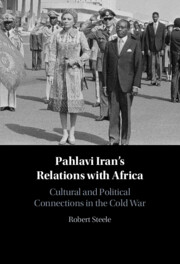
This book presents the first comprehensive study of Iran's complex relationship with Africa during the late Pahlavi era. While many studies of Iran's foreign relations during the Cold War present Iranian policy as fully aligned with the United States, Robert Steele reveals Iran as an independent actor capable of forging its own path, and shows that Africa was central to Iran's economic policy and security strategy during the reign of Shah Mohammad Reza Pahlavi. Africa was where the shah sought allies to balance the radicalism of Nasser, often through Iranian aid, customers for Iranian oil and potential sources of uranium. Bolstered by the British withdrawal from the Persian Gulf in 1971 and the oil price hike of 1973, Steele also shows how the shah saw an opportunity for his Iran to play a leading role in the Indian Ocean, revealing the central place of Africa in Iran's global strategy.
In recent years, constitutional amendments have emerged as a key tool for populist leaders who seek to undermine the rule of law and checks and balances. Abusive constitutionalism is central to democratic and rule of law backsliding, because it allows authoritarian leaders to reshape the legal and institutional framework of the state to entrench their power. By manipulating constitutional rules, these leaders can undermine judicial independence, weaken legislative oversight, and diminish the capacity of political opposition, all while maintaining a veneer of legality. Turkey is an exemplar of such processes. Turkey’s current constitution, introduced in 1982 during military rule, has been amended numerous times, with thirteen significant amendments established during the tenure of the current governing party. These amendments have played a critical role in Turkey’s democratic backsliding, transforming the country from a fragile democracy into a hybrid regime characterized by authoritarian governance.
In the wake of the 2011 Arab Spring and subsequent revolution, Syria found itself in a rapidly changing environment. The fragility of the state and its constitutional contract led to disintegration into a period of civil violence that has yet to fully resolve. The historical process leading to the Syrian constitution of 1973 sheds some light on the legal and political values encompassed within the constitution and the relationship between the national and international politics of law. Although the current constitution of 2012 offered changes and adjustments, it did not pave the way for any change to the former legacy. A full resolution of Syria’s conflict will require not just a new constitutional text but also an inclusive constitutional process. Years after conflict erupted in Syria, the Baʿth Party had not experienced absolute demise, and the new 2012 constitution had not lead to a free election offering a safe transition. Although the constitution did succeed in eradicating explicit mention of the Baʿth Party, this was never reflected in a practical victory. The country remained a conflict-divided state with a constitution that disappointed expectations. This remained the case until 8 December 2024, with the sudden collapse of the regime that Syrians had longed for. This resulted in an interim government that suspended the constitution and ushered in a new era of de facto crisis with an as yet unclear constitutional legacy.
Traditionally, comparative constitutional analysis has been anything but truly comparative—or, rather, the comparisons drawn by scholars were limited to a small number of canonical cases, generally in North America and Europe. Older scholarship focused on structure and text; it began to branch out into adjudication as judicial review of the constitutionality of legislation became a global norm rather than an exception in the second half of the twentieth century.
This paper introduces the term “Open Constitution” as a crucial element for fostering an “Open Society.” It explores the nature and adaptability of constitutions, emphasizing the balance between stability and the necessity for change. Specifically, it examines Iran’s 1906 and 1979 constitutions, highlighting their initial lack of clear amendment procedures and the subsequent modifications aimed at addressing this issue. The 1906 Constitution did not establish a clear amendment process, which was only partially rectified in 1949. Similarly, the 1979 Constitution remained silent on amendments until Article 177 was added during its 1989 revision, outlining a heavily controlled revision process. Both constitutions contain principles deemed unchangeable; however, historical precedents indicate that such provisions are not immune to alteration. The paper concludes that the rigidity of these constitutions, coupled with the absence of practical mechanisms for public or specialized input, poses a risk to political stability and may lead to revolutionary changes. It argues that these constitutions, due to their stringent emphasis on stability and resistance to public demands for change, are inherently self-destructive.
This article explores the challenges of drafting a post-conflict constitution for Yemen, with a focus on balancing the rule of law with emerging political forces, particularly in the context of the country’s ongoing civil war. It highlights the importance of inclusivity, adaptability, and public participation in creating a constitution that promotes peace and stability. Drawing on lessons from Yemen’s recent history and the broader Middle East, the study emphasizes the role of conflict dynamics, particularly those involving the Houthi movement and the Southern Transitional Council, and the implications of separatist aspirations for a unified Yemen. The analysis offers pathways for addressing transitional justice, reconciliation, and the failures of Yemen’s previous constitutional transition, and for laying a foundation for long-term peace and prosperity.
We know plenty of personal names from Cyrenaica and most of them are known to us through inscriptions. Although the bulk of them are Greek, with some local dialectal features, we also find already in the Classical period some Libyan names. Later on, two new influxes become clear in local onomastics: Jewish and Roman names which appear in great number. In 1987 (LGPN 1), these names were collected, with the main emphasis on Greek, and were studied both from a linguistic and a sociohistorical point of view. The publication of digital corpora in 2017 and 2020 and other digital resources now make it possible to update the corpus and to search it much more easily. Some new results are presented here with the stress on Libyan and Jewish names.
This chapter examines Lakhdar Brahimi’s agency as a mediator in Syria, while also clarifying how his strategic perceptions affected his mediation behavior. Adopting a slightly different structure than its predecessor, it consists of two sections. The first assesses the mediator’s agency in determining the main mediation policies and responses from his appointment on August 17, 2012 till his resignation on May 13, 2014. During this period, five policy responses stand out—the Eid al Adha Ceasefire, the May 7 Communiqué, responding to the use of chemical weapons, Geneva II, and the mediator’s resignation. A first-level analysis is applied to clarify the mediator’s input on each. The second section moves to explain the dynamics behind his decision-making. To do so, it focuses on the mediator’s perceptions regarding the four categories outlined in the contingency model—the identity of the mediator, the context of mediation, the parties, and the process of mediation. Such analysis helps shed light on the links between the mediator’s perceptions on these four categories and his decision-making in Syria as well as the formulation of more generalizable principles.