To save content items to your account,
please confirm that you agree to abide by our usage policies.
If this is the first time you use this feature, you will be asked to authorise Cambridge Core to connect with your account.
Find out more about saving content to .
To save content items to your Kindle, first ensure no-reply@cambridge.org
is added to your Approved Personal Document E-mail List under your Personal Document Settings
on the Manage Your Content and Devices page of your Amazon account. Then enter the ‘name’ part
of your Kindle email address below.
Find out more about saving to your Kindle.
Note you can select to save to either the @free.kindle.com or @kindle.com variations.
‘@free.kindle.com’ emails are free but can only be saved to your device when it is connected to wi-fi.
‘@kindle.com’ emails can be delivered even when you are not connected to wi-fi, but note that service fees apply.
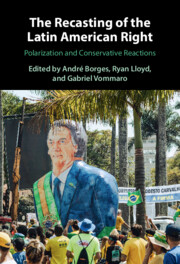
This book analyzes the transformation of the political right in Latin America in response to the strengthening of left-wing parties and movements throughout the region. While Latin America's post-2000 left has been widely studied, little is known about right-wing political formations during and after that time. There is a paucity of research on recent phenomena associated with the reorganization of the Right: the polarization of Latin American electorates and elites; the rebranding of pre-existing conservative parties; the creation of new right-wing parties; and the rise of the radical right. This volume provides a comprehensive account of the strategies used by the political right since 2000. It analyzes both the supply side (parties, movements, and personalist vehicles) and the demand side (voters and public opinion) to provide a description and explanation of how the right has recast itself as a new political force across the entire region of Latin America.
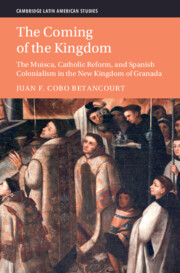
The Coming of the Kingdom explores the experiences of the Indigenous Muisca peoples of the New Kingdom of Granada (Colombia) during the first century of Spanish colonial rule. Focusing on colonialism, religious reform, law, language, and historical writing, Juan F. Cobo Betancourt examines the introduction and development of Christianity among the Muisca, who from the 1530s found themselves at the center of the invaders' efforts to transform them into tribute-paying Catholic subjects of the Spanish crown. The book illustrates how successive generations of missionaries and administrators approached the task of drawing the Muisca peoples to Catholicism at a time when it was undergoing profound changes, and how successive generations of the Muisca interacted with the practices and ideas that the invaders attempted to impose, variously rejecting or adopting them, transforming and translating them, and ultimately making them their own. This title is also available as Open Access on Cambridge Core.
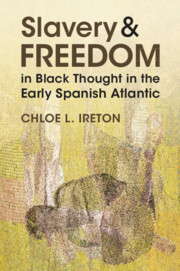
Weaving together thousands of archival fragments, this study explores a shared Black Atlantic world where the meanings of slavery and freedom were fiercely contested and claimed. It recreates the worlds of extraordinary individuals and communities in the long sixteenth century, whilst mapping the development of early modern Black thought about slavery and freedom. From a free Black mother's embarkation license to cross the Atlantic Ocean, to an enslaved Sevillian woman's epistles to her freed husband in New Spain, to an enslaved man's negotiations with prospective buyers on the auction block in Mexico City, to a Black man's petition to reclaim his liberty after his illegitimate enslavement, Chloe L. Ireton explores how Africans and their descendants reckoned with laws and theological discourses that legitimized the enslavement of Black people and the varied meanings of freedom across legal jurisdictions. Their intellectual labor reimagined the epistemic worlds of slavery and freedom in the early modern Atlantic.
This Element analyzes the incorporation of new information and communication technologies (ICTs) by different parties in Latin America to organize volunteers and mobilize supporters during elections. It assesses ICT-related changes in how parties recruit prospective candidates, collect information about citizens' preferences, and mobilize for elections and how these changes have reduced the power of the rank and file within party organizations. Party leaders have an incentive to incorporate new ICTs to increase electoral efficacy and reduce the role of rank-and-file members in performing essential party functions. However, the result of the incorporation of technology depends on leaders' capacity to control the process within the party. Based on case studies of ICT incorporation by various Latin American parties and electoral campaigns, the authors posit that the incorporation of technology will consolidate a power dynamic that predates the adoption of ICTs to fulfill organizational functions.
The incidence of petty corruption in public service delivery varies greatly across citizens and geography. This paper proposes a novel explanation for citizen engagement in collusive forms of petty corruption. It is rooted in the social context in which citizen-public official interactions take place. I argue that social proximity and network centrality provide the two key enforcement mechanisms that sustain favor exchanges among socially connected individuals. Bribery, as a collusive arrangement between a citizen and a public official, relies on the same enforcement mechanisms. Using an original dataset from a household survey conducted in Guatemala, the analysis shows that social proximity and centrality allow citizens to obtain privileges through implicit favor exchanges and illicit payments. These findings are not driven by better access to information about the bribery market. This paper contributes to our understanding of the role of preexisting social relations in sustaining corrupt exchanges.
Estas notas de investigación son el resultado de un proceso etnográfico accidental e involuntario realizado a lo largo de 2023 en el estado de Durango, en el norte de México. Son un análisis preliminar de la información recolectada sobre la evidente presencia del crimen organizado y sus efectos en la vida cotidiana de los ciudadanos. La mayoría de los estudios sobre violencia en México —y América Latina— tienden a tratar situaciones de violencia extrema; o se enfocan en la población pobre y marginada, que sufre distintos tipos de opresión. Estas notas retratan una situación distinta en dos sentidos. Primero, surgen del trabajo de campo realizado en un entorno de aparente tranquilidad: Durango es actualmente uno de los estados más pacíficos del país, si se mide la paz por número de homicidios. Solo un centenar de personas son asesinadas anualmente, lo que es una anomalía en un país cruento, que reporta más de treinta mil muertes violentas cada año. Segundo, las notas emergen, principalmente, del testimonio de las clases medias y altas, segmentos de la población que también sufren las consecuencias de la violencia, pero que han sido largamente ignorados por la literatura. La investigación evidencia que el crimen organizado condiciona significativamente la vida cotidiana de los ciudadanos que viven en paz, pero con miedo. Los grupos criminales perturban el trabajo y el ocio de los ciudadanos, así como su relación con el gobierno. Este estudio también reflexiona sobre cómo el crimen organizado repercute en el funcionamiento normal del Estado y la democracia liberal.
Focusing on the afterlife of the Freedom Edict of April 7, 1800, the chapter moves the story into the nineteenth century, a period of imperial crisis that saw the emergence of liberal trends in the empire as well as new stakeholders in the historical context of the island and, more generally, of the Spanish Atlantic world. Chapter 9 focuses on the problems that the emancipated cobreros faced in actualizing a corporate community model along the lines of colonial Indian law. It further compares El Cobre’s predicament in the new period with that of two other recognized Indian pueblos of El Caney and Jiguani, a situation that resonated elsewhere in the Spanish Atlantic in the postcolonial Latin American republics. Questions about native rights, race, and citizenship, about civil and political rights, about corporate and individual land rights emerged in this new political context, especially with the globalization of El Cobre. This globalization was linked to the arrival of French refugees and the development of a British mining industry in the region. These emerging trends led to the erasure of major aspects of the Freedom Edict of 1800 by the early 1840s.
Chapter 8 focuses on the imperial state level to examine the legal and political logic informing the final adjudication of the case in 1799, a decision that constituted a shift in the decisions the Council of the Indies and colonial tribunals had been taking in the 1780s. The chapter examines the political reasons related to mining utility and security that informed the shift and the juridical basis imperial jurists used to ground the case’s outcome. Ultimately, the Bourbon Crown ruled in favor of the cobreros but attached caveats related to Indian law to their collective freedom. The chapter ventures into the immediate aftermath of the Freedom Edict of 1800 to examine the challenges that emerged in the colony regarding the actualization of the decreed emancipation. It also interrogates the possibility of compensation or reparations to the cobreros for their wrongful enslavement.
Chapter 5 turns to the law in action and the politics of litigation involving adjudication and interpretations of the law. The chapter opens with an examination of the Council of the Indies’ initial judgment in September 1784 on the plaintiffs’ case. Based on a narrow reading of slave law and on pro-slavery policies, the ruling rejected the plaintiffs’ controversial claim to collective freedom and to the criteria of freedom presented by the plaintiffs’ brief but allowed hearings to determine ambiguous cases and stipulated the criteria to be utilized by colonial courts in those cases. The ruling gave way to a cascade of hearings and legal actions in lower-level colonial courts and to a conflict of interpretation over the imperial ruling. Ordinary enslaved and fugitive cobreros dispersed throughout the island became direct participants in the judicial arena at this point as they directly engaged in the politics of litigation for freedom in colonial courts. The chapter shows the way imperial and colonial authorities centralized and controlled judicial outcomes but also the room for maneuvering available in some cases.
This chapter presents a novel electoral strategy by which landowners have successfully influenced policymaking in democratic Brazil: a multiparty congressional caucus known as the Bancada Ruralista. It shows how agrarian elites finance the campaigns, encourage other producers to support, and subsidize the work of like-minded legislators independently of their partisan affiliation, as well as how legislators of agrarian origin collaborate across partisan lines. The chapter argues that Brazil’s Agrarian Caucus is the product of agrarian elites’ collective efforts to build a channel of electoral representation to protect their interests under democracy in a context of high political fragmentation. The threat of radical land reform during the democratic transition prompted landowners to engage in electoral politics. However, high political fragmentation among the agrarian elite rendered party-building unfeasible. The chapter discusses the advantages of an electoral, candidate-centered, multipartisan strategy over other strategies available to economic elites in democracies such as lobbying or party-building, and illustrates these advantages through the analysis of the Forest Code reform of 2012.
This chapter first describes the dependent variable – agrarian elites’ strategies of political influence – and its three categories (nonelectoral, party-building, and candidate-centered) in terms of their reliability and costs. Then, it introduces a new theory to explain the variation in agrarian elites’ strategies of political influence under democracy. It highlights the role of two independent variables – perception of an existential threat and intragroup fragmentation – to explain when and how agrarian elites will organize in the electoral arena. It argues that agrarian elites will enter the electoral arena only when they perceive an existential threat. In turn, landowners’ level of intragroup fragmentation conditions the way they organize their electoral representation. Where landed elites are cohesive, they will engage in party-building. In contrast, highly fragmented elites will prefer a nonpartisan, candidate-centered strategy of representation, supporting individual like-minded politicians across partisan lines. Lastly, the chapter assesses three main alternative explanations, previous history of electoral organization, electoral rules, and the relevance of congress as a policymaking arena.
This chapter presents a case of nonelectoral strategies of political influence by agrarian elites in Argentina and the limitations of such strategies. Until 2008, Argentine landowners influenced politics through lobbying and, when this failed, through protests. The chapter presents evidence of how Argentine agrarian elites did not invest in electoral representation prior to 2008 because they did not experience an existential threat. It also shows how landowners decided to enter the electoral arena with the rise of an existential threat in the form of confiscatory taxes in 2008. Given Argentine agrarian elites fragmentation, they deployed a candidate-centered strategy, sponsoring the candidacies of a dozen agricultural producers for Congress under diverse party affiliations. However, institutional features and ideological differences among producers’ associations blunted the effectiveness of the strategy and led to its abandonment. Later on, with the consolidation of Propuesta Republicana (PRO) as a viable electoral alternative and the continuity of hostile polices, part of the Argentine agrarian elite has engaged in party-building. However, economic cleavages within Argentine agricultural producers continue to undermine the kind of sector-wide party-building effort that we saw in Chile during the democratic transition.
Chapter 7 deals with the violence unfolding at the local level and with the cobreros’ extrajudicial forms of mobilization in tandem with legal actions. Here the story of legal action merges with one of extrajudicial actions such as fugitivity and more violent action and shows how judicial and extrajudicial actions were entangled with each other. Cosme’s letters from Madrid also provided legitimacy to the cobreros’ extrajudicial actions by directly informing the community that the king’s edicts favored their freedom. Factoring into the escalating threat of violence and political conflict on the ground was the broader Atlantic context of revolution in Saint Domingue and war with the British during the 1790s. Imperial designs in this period seem to conflict with colonial ones in a triangulation of conflict that included the cobreros’ actions.