From Colonial Cuba to Madrid

-
Select format
-
- Publisher:
- Cambridge University Press
- Publication date:
- 14 November 2024
- 21 November 2024
- ISBN:
- 9781009494212
- 9781009494199
- 9781009494229
- Dimensions:
- (229 x 152 mm)
- Weight & Pages:
- 0.66kg, 360 Pages
- Dimensions:
- (229 x 152 mm)
- Weight & Pages:
- 0.54kg, 360 Pages
- Subjects:
- Sociology of Race and Ethnicity, Legal History, Area Studies, Latin American Studies, Law, History, Latin American History
- Series:
- Afro-Latin America
You may already have access via personal or institutional login- Subjects:
- Sociology of Race and Ethnicity, Legal History, Area Studies, Latin American Studies, Law, History, Latin American History
- Series:
- Afro-Latin America
Show more authors 
You may already have access via personal or institutional login
Book description
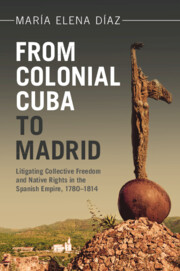
From Colonial Cuba to Madrid examines the largest and most complex freedom suit litigated in the highest court of the Spanish empire at the end of the eighteenth century. Filed by hundreds of re-enslaved Afro descendant people who had lived in quasi-freedom in eastern Cuba for more than a century, this action drew on local customary practices and broader cultural, political, and legal discourses rooted in the Spanish Atlantic world to put forward novel claims to collective freedom and native based rights at a time when questions of slavery, freedom, and citizenship were igniting in many parts of the Atlantic world. Intersecting law, society studies, and the history of slavery, María Elena Díaz offers a carefully researched study of one of the few communities of Afro descendants that managed to secure freedom and political and legal recognition from the Spanish crown during the colonial period.
Reviews
'A startlingly original study of more than a thousand freed persons, former royal slaves who were re-enslaved and then litigated for their liberty. Díaz investigates the unusual legal arguments these men and women, through their Black advisors and representatives, deployed to present themselves as a free people, native to a free Black town, within the context of the Bourbon Enlightenment. Continuing her compelling microhistory of the people of El Cobre, Díaz reminds us that there is still much to learn from enslaved and free Black litigants in the Spanish empire.'
Karen Graubart - author of Republics of Difference: Religious and Racial Self-Governance in the Spanish Atlantic World
Contents
Contents
References
Metrics
Altmetric attention score
Full text views
Full text views helpTotal number of HTML views: 0
Total number of PDF views: 0 *
 Loading metrics...
* Views captured on Cambridge Core between #date#. This data will be updated every 24 hours.
Usage data cannot currently be displayed.
Accessibility standard: Unknown
Why this information is here
This section outlines the accessibility features of this content - including support for screen readers, full keyboard navigation and high-contrast display options. This may not be relevant for you.
Accessibility Information
Accessibility compliance for the PDF of this book is currently unknown and may be updated in the future.