To save content items to your account,
please confirm that you agree to abide by our usage policies.
If this is the first time you use this feature, you will be asked to authorise Cambridge Core to connect with your account.
Find out more about saving content to .
To save content items to your Kindle, first ensure no-reply@cambridge.org
is added to your Approved Personal Document E-mail List under your Personal Document Settings
on the Manage Your Content and Devices page of your Amazon account. Then enter the ‘name’ part
of your Kindle email address below.
Find out more about saving to your Kindle.
Note you can select to save to either the @free.kindle.com or @kindle.com variations.
‘@free.kindle.com’ emails are free but can only be saved to your device when it is connected to wi-fi.
‘@kindle.com’ emails can be delivered even when you are not connected to wi-fi, but note that service fees apply.
This article offers a critical synthesis of recent archaeological research on Byzantine Thrace (seventh–fourteenth centuries), emphasizing work undertaken in Bulgaria, Greece, and Türkiye over the past decade. Drawing on systematic excavations, regional surveys, and interdisciplinary projects, we highlight how new discoveries and re-examinations of legacy data have significantly reshaped our understanding of the landscape, settlements, and modes of connectivity in this strategically vital region. Key themes include long-term human–environment interactions, settlement hierarchies, and the interplay between urban and rural landscapes.
Case studies of fortified centres such as Skopelos, Philippopolis, and Karasura reveal Thrace’s integration into imperial defence and trade networks, while investigations of port landscapes at Firuzköy, Ainos, and sites along the Black Sea coast underscore the centrality of waterways in structuring economic and social life. Research on monastic landscapes, from Mount Papikion to the Kosmosoteira monastery at Bera, demonstrates how religious communities functioned as hubs of economic production and aristocratic patronage. Parallel studies of rural and rupestrian sites highlight the dynamism of the countryside, challenging urban-centric models and foregrounding the adaptability of local populations to political and environmental change.
Beyond individual sites, these findings reframe Thrace not as a peripheral hinterland but as a mosaic of interconnected microregions, each shaped by distinct ecological, cultural, and geopolitical conditions. They reveal both resilience and innovation in the face of shifting imperial borders, foreign incursions, and long-term environmental transformation. Yet the study also underscores the need for greater cross-border collaboration, as modern political boundaries continue to fragment the region’s archaeological record. By integrating diverse datasets and advocating for a transnational approach, this review situates Byzantine Thrace within broader Mediterranean discourse and highlights its potential to illuminate processes of connectivity, resilience, and change across the Byzantine world.
The Cycladic islands have traditionally been considered as backwaters during the Roman and Late Antique periods. Through analysis of the material culture produced from the late first century BCE through to the seventh century CE, however, Rebecca Sweetman offers a fresh interpretation of Cycladic societies across this diachronic period. She demonstrates that the Cyclades remained vibrant, and that the islands embraced the potential of being part of wider political, economic and religious networks that were enabled as part of the Roman Empire. Sweetman also argues that the Cyclades were at the forefront of key social developments, notably, female social and physical mobility, as well as in the islands' early adoption of Christianity. Drawing on concepts related to Globalization, Christianization, and Resilience, Sweetman's analysis highlights the complex relationships between the islands and their Imperial contexts over time. The gazetteer of archaeological sites will be fundamental for all working on archaeology of the Roman and Late Antique periods as well as those interested in the Mediterranean.
Palmyra is one of the most famous sites of the ancient world and played a major role in the overland trade between the Mediterranean and the East. This volume explores fascinating aspects of Palmyrene archaeology and history that underline the site's dynamic relations with the Roman world, whilst simultaneously acknowledging its extremely local nature. The chapters explore Palmyra as a site, but also Palmyrene society both at home and abroad – as travellers in the then known world and contractors and businesspeople as well as innovative political and military leaders of their time. They illuminate Palmyra's and Palmyrene society's negotiations, struggles, benefits and disadvantages from being part of the Roman Empire, situated on the fringes between the East and the West, and their use of this location to recreate themselves as a central power player – at least for a time – within a rapidly changing world.
During the second and third centuries AD, recruitment in the Roman army brought many Palmyrenes from their home city to various parts of the Roman Mediterranean and its hinterland. Military recruitment brought them to Dacia and Numidia in particular, but a famously well-documented unit of Palmyrenes was stationed at Dura-Europos on the Middle Euphrates. Most Palmyrene soldiers served in units of the auxilia or numeri, and many of these then settled in the regions in which they had served. Their descendants could be found in the same regions generations later. As Palmyrene soldiers and their descendants faced varied degrees of dispersal and isolation from their compatriots, they endured diverse pressures to assimilate. They also witnessed their ancestral divinities being adopted by fellow soldiers, military collectives or networks and local populations. Did Palmyrenes maintain social or cognitive links to their ancestral homeland under such circumstances? Did they conceive of themselves as part of a broader, dispersed Palmyrene community even as they became enmeshed in local ones? This chapter address such questions.
To understand the integration of Palmyra in the wider system of the Roman Empire and Mediterranean societies, this study will follow the paths of individuals between their place of origin and different Mediterranean locations. Palmyrenes in the Mediterranean were traders, soldiers or craftsmen, and their itineraries have to be integrated in a more complex picture. The personal names and the use of Palmyrene Aramaic generally testify to individuals of Palmyrene origin. If the routes are beyond our evidence, it is often possible to understand the relationships of those individuals with the populations around them and their local integration.
The chapter is focused on the Palmyrene Tariff (CIS II.3913), a lengthy bilingual text in Aramaic and Greek promulgated in the city in AD 137 to regularize local taxation, i.e. taxes on goods entering and leaving the city which originate within its immediate vicinity, and on trades being plied within the city, not taxes on long-distance trade. Attention is given to the book on the Tariff by Ilia Sholeimovich Shifman, published in Russian in 1980 and republished in English in 2014, and to the publications of Michał Gawlikowski (2012, 2014) on the original location of the Tariff stone opposite a shrine devoted to Rab-Asīrē and close to the Agora. The respective roles of Greek and Aramaic are explored, including the question of which had priority in the drawing up of the Tariff. The sources and composition of the text are analysed with reference to the role played by earlier Roman authorities. A final section considers the position of tax collectors in Palmyrene society and the light which the Tariff can throw on life in Roman Syria.
Palmyra is usually studied for one of three reasons, either its role in the long-distance trade between Indian Ocean and Mediterranean, its distinctive cultural identity as visible in the epigraphic and material record from the city or its rise as an independent regional power in the Near East in the third quarter of the third century AD. While Palmyra was indeed a special place, with a private sorte, or destiny of its own, as Pliny famously expressed it (HN 5.88), the city’s ability to maintain its distinctiveness arguably rested on deep entanglements with her local and regional surroundings. This chapter addresses how the city engaged with its neighbours and its Roman imperial overlords. Actions, events and policies attested in the epigraphic record from the city and from the Palmyrene diaspora in the Roman Empire are discussed in light of theoretical insights from archaeology, sociology and economics. It is argued that Palmyra’s remarkable success built on the city’s ability to connect with the range of social networks that constituted the Roman Empire.
Palmyra, the famous oasis city in the Syrian Desert, has long been a subject of study. It is often brought to the forefront as a case study on trade networks, elite culture and local religious life. However, over the course of the last decades the data available from the city now allows us to investigate new facets of the city’s life, its culture, and its social and religious structure. This contribution provides a short introduction to the history and archaeology of the city as well as the history of research, before turning to the ways in which Palmyra was not only unique in the sense that through its location in an oasis and as a major trade hub it came to hold a pivotal role in the region for a while in the Roman period but can also be studied in a unique light in its relation to the Mediterranean world through the evidence from the city.
This chapter juxtaposes Palmyrene funerary portraiture with the portraiture of Egypt and Pannonia in the first three centuries AD to discern stylistic connections between the provincial centres as well as to the portraiture produced in Rome. Due to its inherently subjective (and hence, flawed) nature, the notion of style as an interpretative framework has fallen by the wayside in archaeology and art history. This chapter will return to the concept of style and evaluate its helpfulness in determining the significance of Palmyrene funerary portraiture in the context of Roman provincial portraiture. Is it appropriate to describe Palmyrene portraiture as ‘Roman’ in style, or perhaps, ‘eastern Mediterranean’, and at what point does it become ‘Palmyrene’? A better understanding of the place of this portraiture in terms of style, not only in antiquity but also in contemporary analyses of funerary portraiture in the Roman world, enhances our ability to interpret its significance at the local level.
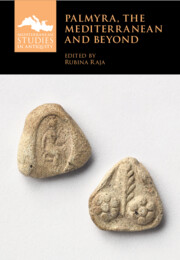
The Palmyrene banqueting tesserae, clay entrance tickets to religious banquets, have been revisited over and over again since the publication of the RTP in 1955. These small but often elaborate objects have been used as lenses into Palmyra’s religious life and the general organization of social, cultural and religious life in the city. However, only in recent years have they become the object of new detailed studies, which aim to systematically examine this unique group of objects within their local context. In this contribution, the focus is on disentangling the tesserae as physical objects to be used, touched and looked at; in particular it seeks to understand a facet of their rich iconographic repertoire, which in so many ways stands in contrast to the otherwise allegedly streamlined visual art repertoire found at Palmyra, namely that of the signet seal impressions. These signet seal impressions were impressed on many of the tesserae, most likely by the sponsor of the banquet, who left his personal mark on the tickets. The seal impressions give us insight into the images circulating in Palmyra in the Roman period in a material group, which today is almost lost to us, namely the glyptic art.
This chapter focuses on Palmyra’s choices in weaving a wider network of social ties to both the Mediterranean and eastern world in order to enjoy the recognizable success that lasted several centuries. It gleans evidence of the presence of Palmyrenes in the Mediterranean, Egypt, the Persian Gulf and Indian Ocean, before discussing the observable strategies in terms of strengthening commercial ties or choices in items of trade based on their high commercial value and lightness in terms of transport, such as silk or pearls.
Little is known about the Jewish presence Roman time Palmyra: the remains of a synagogue and other archaeological and epigraphic data indicate that Jews lived in Palmyra. Their presence is confirmed by onomastics. About twenty biblical names are preserved in inscriptions from Palmyra. Others are found in epitaphs from Beth She‘arim catacombs. However, Palmyrene Jews also bore Palmyrene names, and therefore it is not always easy to reconstruct identity and religious affiliation. Therefore the epigraphic data indicate only a small portion of what must have been the Jewish population of Palmyra. Examples of the mobility of Palmyrene Jews are illustrated by their presence in the Roman army, by first century BC–first century AD ossuaries from Palestine with Palmyrene epitaphs and by Palmyrene onomastics in Aramaic and Greek epitaphs. Westward mobility of Palmyrenes is displayed in an Aramaic Bar Kokhba letter mentioning an individual of Palmyrene origin. Finally, fourth to seventh centuries AD documents from Israel and Jordan written in Hebrew, Aramaic or Greek show the persistence and fortune, within Jewish and proto-Christian communities, of the name Zenobios and Zenobia, an onomastic choice inspired by the foremost protagonist of the last phase of Palmyrene history.
Pierre-Louis Gatier, almost twenty years ago in 1996, presented to the academic community an attempt to sketch the state of play of studies concerning the relationships between the ‘caravan city’ par excellence, Palmyra, and its closest western neighbour, the city of Emesa. That contribution constituted the first attempt at reconsidering and putting into discussion hypotheses and opinions, which, despite being formulated in the fifties, mainly by Henri Seyrig, were still prevalent in modern research. Gatier’s contribution affirmed Emesa’s right to an autonomous identity and an independent historical evolution despite the enormous disparity in the information available between the two cities. This chapter tries to show, through putting into discussion the epigraphic sources used to prove a direct link between the two cities and presenting some brand new ones, that if, on the one hand, Gatier’s Emesa could exist ‘sans Palmyre’, there is no convincing reason, on the other, to think that the Palmyrene trade network needed Emesa and that the goods from the East had to pass through Palmyra’s western neighbour to reach the Mediterranean coast.
This Element revisits the historiographical and archaeological paradigms of Roman rural economies, with a particular focus on the peasant communities of Roman Iberia. Traditionally overshadowed by the dominance of the villa schiavistica model, which centers on large-scale slave-operated agricultural estates, recent interdisciplinary research has unveiled the complexity and persistence of peasant economies. By integrating data from archaeological surveys, rescue excavations, and textual analyses, this volume highlights the significance of dispersed settlements, small-scale farms, and sustainable agrarian strategies that defined the peasant landscape. Case studies from diverse sectors of the Iberian Peninsula demonstrate diverse modes of land use, such as intensive cultivation, crop rotation, and manuring, which contrast with the economic assumptions tied to elite-dominated production models. Furthermore, the author explores Roman peasants' socio-economic structures and adaptive strategies, emphasizing their pivotal role in shaping landscapes. This Element advocates for reexamining Roman peasantries as active and complex agents in ancient history.