To save content items to your account,
please confirm that you agree to abide by our usage policies.
If this is the first time you use this feature, you will be asked to authorise Cambridge Core to connect with your account.
Find out more about saving content to .
To save content items to your Kindle, first ensure no-reply@cambridge.org
is added to your Approved Personal Document E-mail List under your Personal Document Settings
on the Manage Your Content and Devices page of your Amazon account. Then enter the ‘name’ part
of your Kindle email address below.
Find out more about saving to your Kindle.
Note you can select to save to either the @free.kindle.com or @kindle.com variations.
‘@free.kindle.com’ emails are free but can only be saved to your device when it is connected to wi-fi.
‘@kindle.com’ emails can be delivered even when you are not connected to wi-fi, but note that service fees apply.
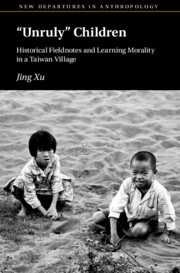
How do we become moral persons? What about children’s active learning in contrast to parenting? What can children’s learning morality teach us about ethnographic knowledge or any social knowledge? My book explores such questions via analyzing old fieldnotes collected by Arthur and Margery Wolf in a Taiwan village (1958–60) in Martial Law Era, before rapid economic growth, industrialization and urbanization. Born from the Six Cultures Study, a landmark project in cross-cultural research, the Wolfs’ fieldwork was the first ethnographic study on ethnic Han children. Bringing to light the rich texts of systematic observation, interview and projective tests, I combined ethnographic interpretation with NLP and machine learning techniques, behavioral coding and social network analysis. I explain how children defied parental commands and violated cultural precepts. I trace how they navigated cooperation, conflict and the gray areas in between, with complex moral sensibilities and gendered expressions, and highlight the role of peers and siblings. I connect the two themes, learning morality and making ethnography, in light of social cognition, and urge all of us to take children seriously.
Abstract: Chapter 5 presents an untold tale of an older brother and his younger sister. While their mother was the protagonist in Wolf’s classic ethnography, "A Thrice-told-Tale," the story of these children was obscured. Childhood sibling relation in “the Chinese family” was rarely studied by anthropologists, yet it is an important relation that shapes children’s moral development and family dynamics. I present systematic patterns of this sibling dyad’s social network positioning, uncover their distinct personalities, and trace their nuanced dynamics of care, rivalry and coalitional maneuvers. I closely examine projective tests data to reveal children's own emotional experience in and perspectives about their family life. This chapter is a unique narrative: in addition to illuminating childhood sibling relation, it simultaneously rediscovers the voices of these two children from ethnographic omissions and silences. Therefore, this case study echoes the dual themes of the entire book, children learning morality and anthropologists reconstructing an ethnography.
Abstract: Chapter 2 reflects on a key assumption about the “traditional Chinese family,” the “child-training” paradigm that emphasizes parenting and overlooks children. The chapter draws from interview and observational data with mothers and children to contrast an important local cultural model of parenting, that is, preventing children’s fights, with the reality of prevalent fighting and conflict among children. Weaving together qualitative, quantitative and machine learning analyses of texts, the chapter uncovers the experiences of “dis-obedient children” which departs from the parental ideal of training obedience. After debunking the myths of “Chinese parenting,” I explain the inefficacy of parental punishment through the lens of children’s sociomoral cognition, against the popular assumption and paradigm of reinforcement learning. These findings remind anthropologists to pay more attention to the ethical experience and reflections of young children, “the punished,” and urge adults to see the world through children's eyes.
Abstract: Chapter 3 delves into the world of peer interactions. I present general patterns of children’s social networks, highlighting the importance of child-to-child ties. I illustrate the key features of this humorous, playful world and examine how peer play facilitates children’s moral learning. In peer play children are developing what I call “the spectrum of moral sensibilities:” They are learning about and engaging in cooperation and care, conflict and dominance, and creating gray areas in between. This poses a stark contrast to the imagery of “the innocent child” permeating in historical and philosophical views of Chinese childhood that fixate on the brighter side of human nature in moral cultivation. Moreover, through deciphering children’s pretend play, I argue that these non-elite children, often relegated to history’s silent margins, have a much richer inner life than my predecessors assumed. Lastly, using a human–machine hybrid approach, I find that young learners’ sensibilities in discerning layered intentions and moral sentiments defeat AI algorithms. This sheds light on the mystery of human sensemaking and inspires reflections on ethnographic epistemology.
Chapter 1 presents my “alternative fieldwork,” how I make sense of my predecessors’ fieldwork and fieldnotes. I introduce Xia Xizhou in its historical cultural context, including its colonial history and changing kinship, economy, and schooling system. I contextualize the multiple boundaries, identities, and relationships between the researched and the researchers and highlight children's agency. I recover the experience of native research assistants, not just as mediators between anthropologists and children, but as lively characters participating in children’s moral development journey. I expose the challenges of reconstructing this ethnography and the puzzles I encountered. I reveal the inherent ethical dimension of actions and interactions that made ethnographic knowledge possible. I also draw from my own experience and expertise to discern the voices, silences and voids in this archive. Throughout this chapter, I connect my discussion of reinterpreting historical fieldnotes to children's developing social cognition and moral sensibilities, which provides the foundation for intersubjectivity and communication in the original fieldwork and in the making of fieldnotes.
Abstract: Chapter 4 tells stories of mischievous, naughty and fierce boys and girls, prompting us to rethink gendered moralities and how they are learned in childhood. Systematic behavioral analyses reveal gendered patterns in children’s moral experience, for example, boys initiate physical aggression, dominance and swearing more than girls, but girls assert themselves in more subtle ways, such as through tattling and scolding. I further explore how children’s learning of authority, aggression, boyhood, and violence is shaped by their family life as well as the larger historical trends. The chapter also examines how young girls understand their own situations and defend themselves. Despite the entrenched son-preference in this community, little girls are far from passive or submissive. To honor Arthur Wolf’s legacy on marriage and adoption and offer new insights on young girls’ emotional experience, which was not addressed in Wolf’s previous works, I present the case of an adopted daughter: an “unruly” girl who defies parental commands, asserts her own will, and negotiates love-hate relationships with different family members.
How do we become moral persons? What about children’s active learning in contrast to parenting? What can children teach us about knowledge-making more broadly? My book explores such questions via analyzing old fieldnotes collected by Arthur and Margery Wolf in a Taiwan village (1958–60) in Martial Law Era, before rapid economic growth, industrialization and urbanization. Born from the Six Cultures Study, a landmark project in cross-cultural research, the Wolfs’ fieldwork was the first ethnographic study on ethnic Han children. Bringing to light the rich texts of systematic observation, interview and projective tests, I combined ethnographic interpretation with NLP and machine learning techniques, behavioral coding and social network analysis. I explain how children defied parental commands and violated cultural precepts. I trace how they navigated cooperation, conflict and the gray areas in between, with complex moral sensibilities and gendered expressions, and highlight the role of peers and siblings. I connect the two themes, learning morality and making ethnography, in light of social cognition, and urge all of us to take children seriously.
How do we become moral persons? What about children's active learning in contrast to parenting? What can children teach us about knowledge-making more broadly? Answer these questions by delving into the groundbreaking ethnographic fieldwork conducted by anthropologists Arthur and Margery Wolf in a martial law era Taiwanese village (1958-60), marking the first-ever study of ethnic Han children. Jing Xu skillfully reinterprets the Wolfs' extensive fieldnotes, employing a unique blend of humanistic interpretation, natural language processing, and machine-learning techniques. Through a lens of social cognition, this book unravels the complexities of children's moral growth, exposing instances of disobedience, negotiation, and peer dynamics. Writing through and about fieldnotes, the author connects the two themes, learning morality and making ethnography, in light of social cognition, and invites all of us to take children seriously. This book is ideal for graduate and undergraduate students of anthropology and educational studies.