
Skip to main content Accessibility help
×
  • Cited by 5
    • Show more authors
    • You may already have access via personal or institutional login
    • Select format
    • Publisher:
      Cambridge University Press
      Publication date:
      31 October 2024
      14 November 2024
      ISBN:
      9781009416269
      9781009416276
      9781009416252
      Dimensions:
      (229 x 152 mm)
      Weight & Pages:
      0.55kg, 290 Pages
      Dimensions:
      (229 x 152 mm)
      Weight & Pages:
      0.42kg, 290 Pages
    You may already have access via personal or institutional login
  • Selected: Digital
    Add to cart View cart Buy from Cambridge.org

    Book description

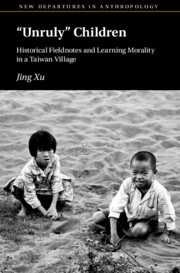
    How do we become moral persons? What about children's active learning in contrast to parenting? What can children teach us about knowledge-making more broadly? Answer these questions by delving into the groundbreaking ethnographic fieldwork conducted by anthropologists Arthur and Margery Wolf in a martial law era Taiwanese village (1958-60), marking the first-ever study of ethnic Han children. Jing Xu skillfully reinterprets the Wolfs' extensive fieldnotes, employing a unique blend of humanistic interpretation, natural language processing, and machine-learning techniques. Through a lens of social cognition, this book unravels the complexities of children's moral growth, exposing instances of disobedience, negotiation, and peer dynamics. Writing through and about fieldnotes, the author connects the two themes, learning morality and making ethnography, in light of social cognition, and invites all of us to take children seriously. This book is ideal for graduate and undergraduate students of anthropology and educational studies.

    Reviews

    ‘A unique book where Jing Xu gains access to a vast collection of observations concerning children’s behavior in Taiwan. As a renowned specialist in childhood and morality, she is uniquely qualified to explore this treasure trove of evidence and document the historical and psychological processes that inform young children’s moral behavior.’

    Pascal Boyer - Washington University in St. Louis

    ‘In Unruly Children Xu Jing masterfully takes on the formidable task of analyzing the voluminous Wolf Archive data. After digitizing the Archive and building a database, Xu used an array of techniques to analyze the textual data, including topic modeling and social network analysis. The richest data was found in the extended interaction sequences in the child observation episodes, and Xu artfully uses these peer play dramas to illustrate children's active role in constructing moral rules to guide and manipulate their play, deal with conflicts, and subvert parental control. Xu transcends older frameworks emphasizing the top-down perspectives of child-rearing and socialization to enter the sometimes rough and tumble world of children learning to cope with siblings, playmates, parents and neighbors. Unruly Children is a landmark work of anthropology, China studies, and child moral development.’

    John R. Shepherd - University of Virginia

    ‘Through a careful and methodologically innovative analysis of the Wolf archives, Xu reconstructs the lives of children growing up in a Taiwanese village in the late 1950s. Xu’s book provides rich insights into their experiences and their social and moral development. Amid intense debates on open science and AI-assisted approaches, this work presents a landmark exploration of the value and limitations of both human and machine intelligence in anthropological knowledge production.’

    Anni Kajanus - University of Helsinki

    ‘Xu points out that Western stereotypes of obedient, well-behaved Chinese children are contradicted by the "unruly" behavior they can show when the occasion suggests it. They take care of each other, obey their parents, and follow Confucian norms, but are far from limited thereby. Suitable for all readers interested in child development or in Chinese family life. … Recommended.’

    E. N. Anderson Source: Choice

    Refine List

    Actions for selected content:

    Select all | Deselect all
    • View selected items
    • Export citations
    • Download PDF (zip)
    • Save to Kindle
    • Save to Dropbox
    • Save to Google Drive

    Save Search

    You can save your searches here and later view and run them again in "My saved searches".

    Please provide a title, maximum of 40 characters.
    ×

    Contents

    Metrics

    Altmetric attention score

    Full text views

    Total number of HTML views: 0
    Total number of PDF views: 0 *
    Loading metrics...

    Book summary page views

    Total views: 0 *
    Loading metrics...

    * Views captured on Cambridge Core between #date#. This data will be updated every 24 hours.

    Usage data cannot currently be displayed.

    Accessibility standard: Unknown

    Why this information is here

    This section outlines the accessibility features of this content - including support for screen readers, full keyboard navigation and high-contrast display options. This may not be relevant for you.

    Accessibility Information

    Accessibility compliance for the PDF of this book is currently unknown and may be updated in the future.
