To save content items to your account,
please confirm that you agree to abide by our usage policies.
If this is the first time you use this feature, you will be asked to authorise Cambridge Core to connect with your account.
Find out more about saving content to .
To save content items to your Kindle, first ensure no-reply@cambridge.org
is added to your Approved Personal Document E-mail List under your Personal Document Settings
on the Manage Your Content and Devices page of your Amazon account. Then enter the ‘name’ part
of your Kindle email address below.
Find out more about saving to your Kindle.
Note you can select to save to either the @free.kindle.com or @kindle.com variations.
‘@free.kindle.com’ emails are free but can only be saved to your device when it is connected to wi-fi.
‘@kindle.com’ emails can be delivered even when you are not connected to wi-fi, but note that service fees apply.
The courts of universal emperors presided over the spread of cosmopolitan elite cultures, literary, artistic and conspicuous. The Indologist Sheldon Pollock has studied this phenomenon for classical Sanskrit, but his vision of cosmopolitan and classical language cultures can easily be extended across Afro-Eurasia to comprise Greek, Latin, Arabic, Persian and Classical Chinese, among others. Starting from the Alexander Romance and the image of Orpheus, the chapter explores how Greco-Roman literary culture created an elite language cosmopolis, much as the other examples mentioned here. Rather than studying Greek and Latin, as is often done, as the precursor of the modern Romance and national languages, it is rather in this context of imperial civilizational cosmopoleis that they should be analyzed. Themes include the formation of classical canons and elite distinction, the size of literary cultures based on manuscript rather than the printing press, and the development of transcendental and monotheist forms of religious belief such as Christianity, Buddhism and Islam.
This chapter considers literary expressions of sovereignty in the nineteenth-century United States that underscore sovereignty’s oppositional nature and its productive potential, and it demonstrates how these literary expressions were, like public argument about sovereignty, constructed through the interplay between law and religion. Religious discourse provided a set of terms, examples, and motifs that shaped the nineteenth-century debate over political autonomy as it ranged across matters of territorial possession and the individual conscience. I first briefly address ideas of sovereignty that circulated in the long nineteenth century and informed US literature and public argument. Then I turn to competing visions of sovereignty expressed by the Cherokee Nation, the state of Georgia, the US federal government, and the US Supreme Court in the early decades of the nineteenth century. In the final section, I briefly turn to the figure of John Brown who, in linking the vision of Indigenous sovereignty expressed by the Cherokee Nation to the sovereign individuality espoused by Henry David Thoreau and the Transcendentals, serves as a harbinger of the contests over political sovereignty that ultimately led to the US Civil War.
This chapter surveys the interrelated histories of literature, religion, and politics in the nineteenth-century United States. In the wake of official church disestablishment, a wave of religious fervor combined with a rising tide of immigrants to form a nation in which literature became a venue for conversion, condemnation, and cultural affirmation. From early national historical romances that sought to confirm the new nation as God’s (Protestant) chosen land to Transcendentalist writings that celebrated the sacredness of the individual American soul, nineteenth-century literature tied American identity to religious pluralism and personal devotion. Sentimental novels penned by women writers and narratives of escape written by the formerly enslaved fitted religious tropes of conversion and resurrection to visions of social reform and political regeneration, while Mormons, Millerites, Shakers, Spiritualists, and other religious innovators developed new models of spiritual identity and literary language suited to an expansive and imperial nation. Over the course of the century, literature served as a venue for theological debate, a vehicle for conversion, a passionate plea for abused humanity, and an imaginative space for envisioning social reform. In each of these modes, authors of literature intervened not only in religious discourses but in the vital political life of the nation.
The neo-Kantian transcendentalist reading of the epistemic status of logical axioms in Frege argues that he is committed to the neo-Kantian idea that we are epistemically justified in accepting logical axioms because accepting them is necessary for achieving epistemically crucial goals. However, I show that Frege hesitates to be fully committed to neo-Kantian transcendentalism because he struggles to accept the idea that such a teleological reason can constitute an epistemic warrant. This interpretation shows some crucial aspects of his philosophy of logic, such as his understanding of the relationship between the simplicity and the sufficiency of logical systems.
Chapter 9 suggests how Hinduism and Confucianism may be understood in relation to the construct of transcendentalism in order to set up a discussion of India and China in the final chapter. (Unearthly Powers had largely taken Christianity, Islam and Buddhism as the main examples of transcendentalist traditions.) This involves a consideration of distinct forms that the Axial Age took in both regions and the religious and philosophical traditions that emerged from them. The diverse traditions coming under the umbrellas of Hinduism and Confucianism represent very substantial continuity with the immanentist pre-Axial past, especially in a fundamental emphasis on the role of ritual action. However, they also incorporated Axial elements, particularly an emphasis on liberation/salvation in the case of Hinduism and ethical rectitude in the case of Confucianism. Confucianism remains the most awkward fit within the mould of transcendentalism because of the absence of a soteriological imperative.
Chapter 1 explains the theoretical framework deployed throughout the book, largely drawn from the companion volume, Unearthly Powers. Above all, this means explaining the two forms of religiosity – immanentism and transcendentalism – and how they related to each other. While immanentism is a default or universal strand of human life, transcendentalism defines what is distinctive about the religions of salvation that emerged from the Axial Age of the first millennium BCE. These world religions also contained an immanentist element, however, even as they produced reform movements that insisted on the transcendentalist dimension. These modes also gave rise to two different means by which rulers could be sacralised: divinised kingship (immanentism) and righteous kingship (transcendentalism). The chapter then fleshes out a tripartite model for ruler conversion: (1) religious diplomacy often first induced rulers to favour foreign missionaries; (2) immanent power, or supernatural assistance in this life, tended to be crucial in convincing them to make a change of allegiance, and (3) the Christianisation of their realms was linked to its capacity to enhance their authority. Lastly, the themes of cultural glamour and intellectual appeal are introduced.
The introduction outlines the arrangement of the book, explains the comparative method and the selection of the case studies, and comments on the primary sources.
This chapter provides an overview of vegetarian and vegan practice from Ancient times to the beginning of the twentieth century. The first section focuses on the representation of Pythagoras in Ovid’s Metamorphoses and on the Aristotelian and Biblical depictions of the relationship between humans and non-human animals; the second explores Early Modern attitudes, including a discussion of the vegetarianism in More’s Utopia; the third offers readings of Swift’s Gulliver’s Travels and Goldsmith’s The Citizen of the World; the fourth details the emergence of the word ’vegetarian’ in the context of Romanticism and Transcendentalism.
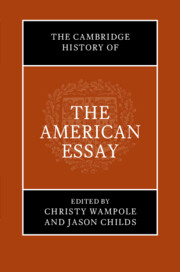
From the country's beginning, essayists in the United States have used their prose to articulate the many ways their individuality has been shaped by the politics, social life, and culture of this place. The Cambridge History of the American Essay offers the fullest account to date of this diverse and complex history. From Puritan writings to essays by Indigenous authors, from Transcendentalist and Pragmatist texts to Harlem Renaissance essays, from New Criticism to New Journalism: The story of the American essay is told here, beginning in the early eighteenth century and ending with the vibrant, heterogeneous scene of contemporary essayistic writing. The essay in the US has taken many forms: nature writing, travel writing, the genteel tradition, literary criticism, hybrid genres such as the essay film and the photo essay. Across genres and identities, this volume offers a stirring account of American essayism into the twenty-first century.
The complicated relationship between American and European cultural production, particularly in the nineteenth century, is the subject of this chapter. American essayists of this period were, on the one hand, greatly influenced by the literature and culture of Europe and sought to absorb its lessons into their own writing. On the other, these same essayists pushed back against the idea that European writing should be their primary influence. Instead, they frequently critiqued Europe from afar and sought to develop a new idiom and fresh form of expression unique to the United States. Writers like Washington Irving, Walt Whitman, Ralph Waldo Emerson, Margaret Fuller, Edgar Allan Poe, Frederick Douglass, Henry James, and Henry David Thoreau explored the many tensions between the United States and Europe in their essays and used them to debate the extent to which America should remain in Europe’s cultural shadow.
This chapter focuses on the essays of Transcendentalists such as Henry David Thoreau, Ralph Waldo Emerson, and Margaret Fuller who used writing as a spiritual and philosophical tool. This special form of prose allowed them to write themselves, and thus Transcendentalism as a movement, into being, creating a flexible, open-ended, and experimental instrument for the radical self-fashioning of an emergent sensibility: the American individual as a freestanding soul, entire in (him)self, capable of encompassing all the potential of the cosmos. The resulting works forever stamped this most antinomian of genres with the Transcendentalist’s indelible signature. The chapter traces the movement back to Harvard College in the 1820s and ’30s, where students and faculty discussed spirituality, philosophy, and the art of writing. The chapter traces the influence of this convergence and of key figures like the Unitarian preacher William Ellery Channing on the burgeoning movement. The chapter’s final pages highlight how central Transcendentalism has been to the American essay tradition, with writers today of greatly varying backgrounds absorbing its lessons and style into their own writing.
By analysing material from and slightly after Heidegger’s brief time as rector of Freiburg University, I show that he conceives of the state and the educational system as means to sustaining a communal commitment to a philosophically inflected nationalism. Although it relies on a distinctly Heideggerian conception of the state, Heidegger’s nationalism is by most measures rather trivial. He does, however, try to philosophically justify his nationalism and antisemitism by recourse to what has become known as the history of being. I show that this period of Heidegger’s thought is marred by several assumptions and inferences that contradict his earlier and much more convincing social ontology. I thus find myself in a position to criticise Heidegger’s politics from within. More specifically, I criticise Heidegger for inconsistently attributing an exceptional type of world-disclosure to the Führer; for confusing ontic and ontological senses of community and the shared world; and, finally, for giving methodological priority to a radical form historicism over and above transcendentalism.
This chapter surveys the history of nature writing and the nature essay, from American Transcendentalists such as Ralph Waldo Emerson, Henry David Thoreau, and Margaret Fuller to more recent writers such as Barry Lopez, Amitav Ghosh, and Camille T. Dungy. The author examines the political and scientific aspects of nature writing and the genre’s response to changing conceptions of “nature.”
In “Toward a Transatlantic Philosophy of Nature,” Samantha C. Harvey demonstrates how British Romantic poets like Wordsworth and Coleridge articulated a philosophy of nature in poetic form that would be reinterpreted in two central prose works of American Transcendentalism: Emerson’s Nature (1836) and Thoreau’s Walden (1854). Through detailed analysis of the works of Wordsworth and Emerson, Harvey suggests that nature’s vital role in the nineteenth century becomes particularly pronounced when Romanticism is considered as a transnational movement that flowed beyond national boundaries. Harvey shows how a transcendentalist philosophy of nature crossed, recrossed, and crisscrossed the Atlantic in various directions, undergoing continual transformations along the way.
Given that “Nature” is historically imbricated in the history of Christianity, the secularizing movement of modernity puts nature under intense pressure. The resulting conflicts are modeled by the United States, which authorized political revolution by invoking “the laws of Nature and of Nature’s God.” The American Transcendentalists extended nature as divine order and transcendent arbiter to authorize intellectual revolution, consolidating liberal Protestantism, European Romanticism, and modern science into a template for the meaning of nature in modernity; humans became not humble creatures in God’s creation but God’s avatars commanding all merely material beings. Today, as the resulting ecological collapse destabilizes inherited concepts of nature, “ecology” is offered as a replacement, even though ecology as a science cannot offer moral value or spiritual meaning. This intellectual history is traced through the founding work of Ralph Waldo Emerson, who offered idealism as the engine of modernity, and three followers, Orestes Brownson, Henry David Thoreau, and Margaret Fuller, who variously pluralized nature into the plenitude of material forms and beings seen as vulnerable incarnations of a higher or divine life force, prefiguring the science and ethics of ecology as an aspect of, rather than replacement for, nature.
This chapter continues the analysis of Dylan’s conspicuous and copious allusions to events, characters and literature from the past with reference to Fredric Jameson’s (2011) Marxist historiography. It explores the parallels between Dylan’s romantic attachment to nature and his cultural forebears in nineteenth-century New England transcendentalism, and argues that this was rooted in his Midwestern upbringing on the Minnesotan Iron Range. As with the analysis of Lennon in Chapter 4, it shows how Dylan’s historical awareness formed the basis for his acute response to cultural tensions that arose as the post-war Fordist economic boom shifted into the economic crises of the early 1970s.
This chapter shows that biblical criticism encouraged some figures, including Ralph Waldo Emerson and Theodore Parker, to abandon what they perceived as transient historical grounds for what they understood as a transcendent moral sphere. Many scholars have stressed the ahistorical aspects of Transcendental belief and emphasized the ways in which Transcendentalism outgrew its Unitarian roots. In doing so, however, they have often neglected to note how historical arguments freed heterodox thinkers such as Emerson and Parker in their attempts to build atemporal worlds. While most biblical scholars used historical readings to ground universal truths in a biblical past, these Transcendentalists employed historical explication to unmoor such truths from that historical setting. The growing perception of historical distance assisted them in that effort. As these and other thinkers drew attention to the shiftiness of historical evidence, the limitations of time, and the remoteness of the past, they exposed the transience of the historical grounds on which American Protetants based their faith.
This article argues that Henry David Thoreau believed in the essential unity of the five senses and privileged each as a source of wild and divine knowledge, which, when combined, created a full picture that might result in a true approximation of God in and beyond nature—the hallmark of Thoreau’s fundamentally incarnational theology. Thoreau treated each sense not only as a source of divine knowledge but as a site of theological discourse: for touch, the relationship between sin and grace; for smell, the conundrum of an eternal divinity acting in historical time; for taste, the efficacy of sacraments; for hearing, the possibility of continuing revelation; and for sight, the ability for human beings to actually see God. The senses were the practical entry point to Thoreau’s theological system, which was concerned with the discovery and redemption of internal “wildness” and reconnection to the mysterious, divine source of that wildness, to the unaccountable in nature.
William James was one of the most influential American psychologists and philosophers. His writings remain thought-provoking and relevant more than a century after his death. His seminal ideas range from free will, determinism, the nature of consciousness, the mechanisms responsible for our emotions, religious and spiritual experiences, psychic phenomena, and the veracity of mediumship. This chapter focuses on what is less well known, that behind the appearance of success he lived a life burdened with recurrent depression, hypochondria, and myriad physical afflictions, most of them psychosomatic in nature. His search for a career path was long and torturous. At different stages in his life, he was a frustrated artist, a reluctant physician, and a drifter. He found his calling in teaching. His lifelong search for the nature of the mind and the soul was deeply entangled with his father’s, whose tragic and accidental loss of a leg in childhood led to a relentless lifelong quest for “real” answers. The chapter also touches on Ralph Waldo Emerson, his godfather, and includes brief descriptions of William James’ famed novelist brother, Henry James, Jr., as well as his sister, Alice James, the brilliant reclusive diarist.
This chapter shows that in the German intellectual tradition, Kant, followed by Fichte and Hegel, saw the reliance upon the opinion of others (“recognition”) in a completely different way than the French and British traditions. Specifically, in Germany recognition was seen as a condition not only for self-control, but also for individual self-determination. The chapter provides a detailed explanation of how this shift in orientation became possible, its connection with the “idealistic” presuppositions of German philosophy at the end of the eighteenth century, and the broader political claims of this new interpretation of “recognition”.