
Skip to main content Accessibility help
×
  • Cited by 4
    • Show more authors
    • You may already have access via personal or institutional login
    • Select format
    • Publisher:
      Cambridge University Press
      Publication date:
      June 2021
      July 2021
      ISBN:
      9781108784344
      9781108478144
      9781108746892
      Dimensions:
      (229 x 152 mm)
      Weight & Pages:
      0.75kg, 400 Pages
      Dimensions:
      (229 x 152 mm)
      Weight & Pages:
      0.636kg, 400 Pages
    You may already have access via personal or institutional login
  • Selected: Digital
    Add to cart View cart Buy from Cambridge.org

    Book description

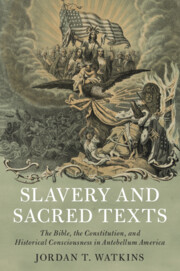
    In the decades before the Civil War, Americans appealed to the nation's sacred religious and legal texts - the Bible and the Constitution - to address the slavery crisis. The ensuing political debates over slavery deepened interpreters' emphasis on historical readings of the sacred texts, and in turn, these readings began to highlight the unbridgeable historical distances that separated nineteenth-century Americans from biblical and founding pasts. While many Americans continued to adhere to a belief in the Bible's timeless teachings and the Constitution's enduring principles, some antislavery readers, including Theodore Parker, Frederick Douglass, and Abraham Lincoln, used historical distance to reinterpret and use the sacred texts as antislavery documents. By using the debate over American slavery as a case study, Jordan T. Watkins traces the development of American historical consciousness in antebellum America, showing how a growing emphasis on historical readings of the Bible and the Constitution gave rise to a sense of historical distance.

    Awards

    Winner, 2022 S-USIH Annual Book Prize, Society for U.S. Intellectual History

    Reviews

    ‘Watkins examines an impressively wide range of thinkers, white and Black, famous and forgotten, as they argued over whether Scripture and the Constitution (itself a kind of secular ‘scripture’) supported slavery - and if so, how opponents of slavery should respond. This important book not only illuminates the striking parallels between biblical criticism and constitutional interpretation, it will help Americans think through the racism at the root of so many of our institutions.’

    Dean Grodzins - author of American Heretic: Theodore Parker and Transcendentalism

    ‘Watkins tells a fascinating story of conceptual change, an account as ironic as it is important. He vividly shows how a reverence for the past tangled with the moral crisis of human slavery to generate a new kind of historical consciousness. Some of modernity’s most characteristic patterns of thought result from the history he has recovered.’

    David Frank Holland - Harvard Divinity School

    ‘Watkins’ comparison of debates over constitutional interpretation and biblical hermeneutics is revelatory at every turn. This book is an essential read for scholars of law, religion, and slavery - and for anyone seeking to understand how the past haunts the present in American life.’

    Margot Minardi - author of Making Slavery History: Abolitionism and the Politics of Memory in Massachusetts

    ‘Watkins persuasively demonstrates how in shoring up the Bible and the Constitution for the debates over slavery, nineteenth-century Americans evoked an awareness of temporal distance, a new historical consciousness. Antebellum-era struggles with time and history come to life in this insightful and compelling study, which substantially propels our understanding of historicism.’

    Eran Shalev - University of Haifa

    ‘The book makes clear contributions to the study of religion in America and US constitutional history, and is readable for a wider public.’

    John Fadden Source: Reading Religion

    '… the book … makes a real contribution to our understanding of the antebellum slavery debates and their legacy in American public life since. Scholars who work on religion, law, and/or slavery will benefit from reading this book.'

    Paul J. Gutacker Source: Journal of Church and State

    Refine List

    Actions for selected content:

    Select all | Deselect all
    • View selected items
    • Export citations
    • Download PDF (zip)
    • Save to Kindle
    • Save to Dropbox
    • Save to Google Drive

    Save Search

    You can save your searches here and later view and run them again in "My saved searches".

    Please provide a title, maximum of 40 characters.
    ×

    Contents

    Metrics

    Altmetric attention score

    Full text views

    Total number of HTML views: 0
    Total number of PDF views: 0 *
    Loading metrics...

    Book summary page views

    Total views: 0 *
    Loading metrics...

    * Views captured on Cambridge Core between #date#. This data will be updated every 24 hours.

    Usage data cannot currently be displayed.

    Accessibility standard: Unknown

    Why this information is here

    This section outlines the accessibility features of this content - including support for screen readers, full keyboard navigation and high-contrast display options. This may not be relevant for you.

    Accessibility Information

    Accessibility compliance for the PDF of this book is currently unknown and may be updated in the future.
