Refine search
Actions for selected content:
40 results
Hyperbolic geometry and real moduli of five points on the line
- Part of
-
- Article
-
- You have access
- Open access
- HTML
- Export citation
11 - Recent Developments on Compactifications of Stacks of Shtukas
-
-
- Book:
- Moduli, Motives and Bundles
- Published online:
- 31 October 2025
- Print publication:
- 20 November 2025, pp 423-446
-
- Chapter
- Export citation
A flag version of Beilinson–Drinfeld Grassmannian for surfaces
- Part of
-
- Article
-
- You have access
- Open access
- HTML
- Export citation
-
We define and study a generalization of the Beilinson–Drinfeld Grassmannian to the case where the curve is replaced by a smooth projective surface $X$, and the trivialization data are given on loci associated with a nonlinear flag of closed subschemes. We first establish some general formal gluing results for moduli of (almost) perfect complexes and torsors. We construct a simplicial object $\operatorname {\underline {\mathsf{Fl}}}_X$ of flags of closed subschemes of a smooth projective surface $X$, associated with the operation of taking union of flags. We prove that this simplicial object has the $2$-Segal property. For an affine complex algebraic group $G$, we define a derived, flag analogue $\mathcal{G}r_X$ of the Beilinson–Drinfeld Grassmannian of $G$-bundles on the surface $X$, and show that most of the properties of the Beilinson–Drinfeld Grassmannian for curves can be extended to our flag generalization: we prove a factorization formula, the existence of a canonical flat connection and define a chiral product on suitable sheaves on $\operatorname {\underline {\mathsf{Fl}}}_X$ and on $\mathcal{G}r_X$. We sketch the construction of actions of flags analogues of the loop group and of the positive loop group on $\mathcal{G}r_X$. To fixed ‘large’ flags on $X$, we associate ‘exotic’ derived structures on the stack of $G$-bundles on $X$.
$X$.


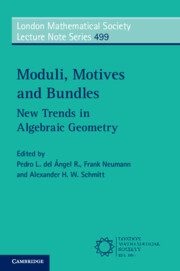
Moduli, Motives and Bundles
- New Trends in Algebraic Geometry
-
- Published online:
- 31 October 2025
- Print publication:
- 20 November 2025
Moduli space theory for complete, constant Q-curvature metrics on finitely punctured spheres
- Part of
-
- Journal:
- Proceedings of the Royal Society of Edinburgh. Section A: Mathematics , First View
- Published online by Cambridge University Press:
- 15 October 2025, pp. 1-23
-
- Article
-
- You have access
- Open access
- HTML
- Export citation
MODULI SPACES OF SLOPE-SEMISTABLE SHEAVES WITH REFLEXIVE SESHADRI GRADUATIONS
- Part of
-
- Journal:
- Nagoya Mathematical Journal / Volume 260 / December 2025
- Published online by Cambridge University Press:
- 22 August 2025, pp. 728-746
- Print publication:
- December 2025
-
- Article
- Export citation
Maximal real varieties from moduli constructions
- Part of
-
- Article
-
- You have access
- Open access
- HTML
- Export citation
-
A real variety whose real locus achieves the Smith–Thom equality is called maximal. This paper introduces new constructions of maximal real varieties, by using moduli spaces of geometric objects. We establish the maximality of the following real varieties:
– moduli spaces of stable vector bundles of coprime rank and degree over a maximal real curve (recovering Brugallé–Schaffhauser’s theorem with a short new proof), which extends to moduli spaces of parabolic vector bundles;
– moduli spaces of stable Higgs bundles of coprime rank and degree over a maximal real curve, providing maximal hyper-Kähler manifolds in every even dimension;
– if a real variety has maximal Hilbert square, then the variety and its Hilbert cube are maximal, which happens for all maximal real cubic 3-folds, but never for maximal real cubic 4-folds;
– punctual Hilbert schemes on a maximal real surface with vanishing first $\mathbb {F}_2$-Betti number and connected real locus, such as $\mathbb {R}$-rational maximal real surfaces and some generalized Dolgachev surfaces;
– moduli spaces of stable sheaves on an $\mathbb {R}$-rational maximal Poisson surface (e.g. the real projective plane).


The coarse geometry of hexagon decomposition graphs
- Part of
-
- Journal:
- Canadian Journal of Mathematics , First View
- Published online by Cambridge University Press:
- 16 January 2025, pp. 1-19
-
- Article
-
- You have access
- Open access
- HTML
- Export citation
Towards a modular construction of OG10
- Part of
-
- Journal:
- Compositio Mathematica / Volume 160 / Issue 10 / October 2024
- Published online by Cambridge University Press:
- 08 November 2024, pp. 2496-2529
- Print publication:
- October 2024
-
- Article
- Export citation
-
We construct the first example of a stable hyperholomorphic vector bundle of rank five on every hyper-Kähler manifold of $\mathrm {K3}^{[2]}$-type whose deformation space is smooth of dimension 10. Its moduli space is birational to a hyper-Kähler manifold of type OG10. This provides evidence for the expectation that moduli spaces of sheaves on a hyper-Kähler could lead to new examples of hyper-Kähler manifolds.

Geometric aspects on Humbert-Edge curves of type 5, Kummer surfaces and hyperelliptic curves of genus 2
- Part of
-
- Journal:
- Glasgow Mathematical Journal / Volume 65 / Issue 3 / September 2023
- Published online by Cambridge University Press:
- 25 July 2023, pp. 612-624
- Print publication:
- September 2023
-
- Article
-
- You have access
- Open access
- HTML
- Export citation
-
In this work, we study the Humbert-Edge curves of type 5, defined as a complete intersection of four diagonal quadrics in ${\mathbb{P}}^5$. We characterize them using Kummer surfaces, and using the geometry of these surfaces, we construct some vanishing thetanulls on such curves. In addition, we describe an argument to give an isomorphism between the moduli space of Humbert-Edge curves of type 5 and the moduli space of hyperelliptic curves of genus 2, and we show how this argument can be generalized to state an isomorphism between the moduli space of hyperelliptic curves of genus $g=\frac{n-1}{2}$ and the moduli space of Humbert-Edge curves of type $n\geq 5$ where $n$ is an odd number.


Derived categories of hyper-Kähler manifolds: extended Mukai vector and integral structure
- Part of
-
- Journal:
- Compositio Mathematica / Volume 159 / Issue 1 / January 2023
- Published online by Cambridge University Press:
- 31 January 2023, pp. 109-152
- Print publication:
- January 2023
-
- Article
-
- You have access
- Open access
- HTML
- Export citation
13 - Dimensional Reduction and T-Duality
- from Part IV - Outlook
-
- Book:
- A Short Introduction to String Theory
- Published online:
- 31 March 2022
- Print publication:
- 07 April 2022, pp 155-214
-
- Chapter
- Export citation
REPRESENTATION VARIETIES OF ALGEBRAS WITH NODES
- Part of
-
- Journal:
- Journal of the Institute of Mathematics of Jussieu / Volume 21 / Issue 6 / November 2022
- Published online by Cambridge University Press:
- 15 June 2021, pp. 2215-2245
- Print publication:
- November 2022
-
- Article
- Export citation
LOCALIZATION BY $2$-PERIODIC COMPLEXES AND VIRTUAL STRUCTURE SHEAVES
- Part of
-
- Journal:
- Journal of the Institute of Mathematics of Jussieu / Volume 21 / Issue 5 / September 2022
- Published online by Cambridge University Press:
- 22 December 2020, pp. 1477-1506
- Print publication:
- September 2022
-
- Article
- Export citation
-
In [12], Kim and the first author proved a result comparing the virtual fundamental classes of the moduli spaces of $\varepsilon $-stable quasimaps and $\varepsilon $-stable $LG$-quasimaps by studying localized Chern characters for $2$-periodic complexes.
In this paper, we study a K-theoretic analogue of the localized Chern character map and show that for a Koszul $2$-periodic complex it coincides with the cosection-localized Gysin map of Kiem and Li [11]. As an application, we compare the virtual structure sheaves of the moduli space of $\varepsilon $-stable quasimaps and $\varepsilon $-stable $LG$-quasimaps.


Instanton sheaves and representations of quivers
- Part of
-
- Journal:
- Proceedings of the Edinburgh Mathematical Society / Volume 63 / Issue 4 / November 2020
- Published online by Cambridge University Press:
- 04 September 2020, pp. 984-1004
-
- Article
- Export citation
Lecture 1 - Closed Holomorphic Curves in Symplectic 4-Manifolds
-
- Book:
- Lectures on Contact 3-Manifolds, Holomorphic Curves and Intersection Theory
- Published online:
- 06 March 2020
- Print publication:
- 26 March 2020, pp 11-25
-
- Chapter
- Export citation
Introduction: Motivation
-
- Book:
- Lectures on Contact 3-Manifolds, Holomorphic Curves and Intersection Theory
- Published online:
- 06 March 2020
- Print publication:
- 26 March 2020, pp 1-10
-
- Chapter
- Export citation
Appendix A - Properties of Pseudoholomorphic Curves
-
- Book:
- Lectures on Contact 3-Manifolds, Holomorphic Curves and Intersection Theory
- Published online:
- 06 March 2020
- Print publication:
- 26 March 2020, pp 94-107
-
- Chapter
- Export citation
7 - Bergman Tau-Function: From Einstein Equations and Dubrovin-Frobenius Manifolds to Geometry of Moduli Spaces
-
-
- Book:
- Integrable Systems and Algebraic Geometry
- Published online:
- 19 March 2020
- Print publication:
- 02 March 2020, pp 215-287
-
- Chapter
- Export citation
Dynamical degrees of Hurwitz correspondences
- Part of
-
- Journal:
- Ergodic Theory and Dynamical Systems / Volume 40 / Issue 7 / July 2020
- Published online by Cambridge University Press:
- 04 December 2018, pp. 1968-1990
- Print publication:
- July 2020
-
- Article
- Export citation
-
Let $\unicode[STIX]{x1D719}$ be a post-critically finite branched covering of a two-sphere. By work of Koch, the Thurston pullback map induced by $\unicode[STIX]{x1D719}$ on Teichmüller space descends to a multivalued self-map—a Hurwitz correspondence ${\mathcal{H}}_{\unicode[STIX]{x1D719}}$—of the moduli space ${\mathcal{M}}_{0,\mathbf{P}}$. We study the dynamics of Hurwitz correspondences via numerical invariants called dynamical degrees. We show that the sequence of dynamical degrees of ${\mathcal{H}}_{\unicode[STIX]{x1D719}}$ is always non-increasing and that the behavior of this sequence is constrained by the behavior of $\unicode[STIX]{x1D719}$ at and near points of its post-critical set.


