To save content items to your account,
please confirm that you agree to abide by our usage policies.
If this is the first time you use this feature, you will be asked to authorise Cambridge Core to connect with your account.
Find out more about saving content to .
To save content items to your Kindle, first ensure no-reply@cambridge.org
is added to your Approved Personal Document E-mail List under your Personal Document Settings
on the Manage Your Content and Devices page of your Amazon account. Then enter the ‘name’ part
of your Kindle email address below.
Find out more about saving to your Kindle.
Note you can select to save to either the @free.kindle.com or @kindle.com variations.
‘@free.kindle.com’ emails are free but can only be saved to your device when it is connected to wi-fi.
‘@kindle.com’ emails can be delivered even when you are not connected to wi-fi, but note that service fees apply.
This chapter examines the introduction of new lay participation systems in Asian countries. Focusing on Russia, South Korea, Japan, and Taiwan, I explore the social and political contexts and goals of the policymakers that motivated the incorporation of citizen decision-making into the legal systems of these countries. In each of the four countries, the adoption of new systems of lay participation occurred during periods of political democratization. Those who argued in favor of citizen involvement hoped that it would promote democratic self-governance, create more robust connections between the citizenry and the government, and improve public confidence in the courts. Policymakers drew on the experiences of other countries, including other Asian nations, to develop a distinctive model that incorporated some features of lay participation systems elsewhere, and modified them to suit the specific circumstances of their own countries.
The final chapter looks at how Sino-North Korean relations changed after the Cold War. Both sides continued to find the idea of Sino-North Korean friendship useful even as they went in very different political and cultural directions during the 1970s and 1980s.
The paper presents the main characteristics and the distinctive nature of the South Korean third sector compared to most Western countries. Differences are explained in terms of cultural embededdness and political embededdness—in particular with respect to the import of Confucianism (or neo-Confucianism) and of human rights abuse in articulation with a strong ideology of anticommunism that has been developed by a succession of dictatorial regimes since the end of the Japanese colonization of Korea. The paper concludes by highlighting positive factors for the future development of the third sector in Korea.
Welfare politics can be largely assessed by the following three kinds of political prisms: bureaucratic politics, partisan politics, and social politics. Bureaucratic and partisan politics which accounted for the evolution of welfare states in East Asia are not adequate to illuminate the difference in recent welfare reforms between Korea and Japan after a significant political transition. Social politics is construed as a triangular relationship between civic advocacy groups, trade unions, and political leaders. The relative strength and weakness of civic advocacy groups in Korea and Japan, respectively, provide an analytical niche capable of explaining cross-national variations in welfare politics. The original version of the power resources model thus needs to be complemented by incorporating the role of civil society mobilisation in welfare politics. The core of new power resources in our comparative analysis is alliance-building led by non-parliamentary social forces, which cannot be easily measured by quantifiable strength of labour movements and affiliated political parties.
In this paper, we analyse the emergence and development of social enterprise in South Korea. Our purpose is to show how different broad, consensual and successive conceptions of social enterprise—the so-called meta-models—have generated a dynamic and complex environment which includes a variety of models of social enterprise. Based on multiple data sources, including interviews, documents, statistics and field research, we illustrate the diversity of Korean social enterprise models by using the EMES ideal-type as a conceptual framework that leads us to analyse the social, economic and governance dimensions of each type of social enterprise. This research suggests that the social enterprise phenomenon should not be limited to its expressed contents or to an excessively strict legal or economic definition. It eventually contributes to advancing our understanding on social enterprise by showing that the definitions and concepts of social enterprise can be diverse across different social, economic and political contexts. For this reason, building a universal typology that can embrace social enterprises in different national contexts is by far a challenging task.
The U.S. and the U.K. are considered as successful models of social enterprise. The Korean government benchmarked these two models in the hope of achieving similar success, without much avail. The growth of social enterprises in South Korea is attributed to the country’s characteristically strong central government and its creation of relevant institutions and provision of support services. However, this paper provides an alternate explanation by highlighting role of the third sector as the ‘policy entrepreneur’ in agenda-setting and policy implementation with regards to social enterprises in South Korea. Additionally, the decentralized local governments as well as the market structure dominated by big businesses are also examined as the main contributors to ‘policy windows’ for the third sector’s policy entrepreneurship. The paper showcases successful development of social enterprise despite the absence of a welfare state or a well-developed third sector, and argues that the phenomenon should hold numerous policy implications for other Asian countries.
Previous studies have shown that social enterprises can improve the health conditions of socially disadvantaged people through qualitative approaches. As income-related health inequality has grown, the role of social enterprises in addressing this issue has become more significant. This study examined whether social enterprises could positively affect the self-rated health of South Korean low-income residents using multilevel models. The results showed that government-certified social enterprises were associated with positive self-rated health among low-income residents. On the other hand, preliminary social enterprises with insufficient profitability and weak corporate governance showed mixed results. Based on the empirical results, this study suggests relevant policy implications.
This study examines the long-held argument that civic participation transfers to political participation, as expressed by South Korean citizens. Compared to the majority of existing research that has focused primarily on Western developed countries, the present study examines South Korea, to which little scholarly attention has been devoted. Relying on the World Values Survey (2005–2006 wave), the present study finds that in South Korea, civic participation outside of the political sphere does push individuals to be more politically active. However, the results also demonstrate that there are more questions that need to be resolved. First, when the analysis unpacked the dependent variable—political participation—the relationship between civic engagement and attending demonstrations or signing petitions is robust. However, this is not the case for joining boycotts or taking part in voting. Moreover, when unpacking the independent variable—civic participation—this study finds that not every type of civic organization spawns political participation. There is a positive impact of non-political organizations, such as art, music, or charitable organizations, on political participation, while a negative impact exists for interest-based and political organizations, such as professional associations or environmental organizations.
This paper examines whether three sets of factors—humanitarianism, the South Korean government’s official aid, and concerns regarding performance—affect South Korean CSOs’ decisions regarding aid recipients and the amount of aid to them. The statistical results of these two-stage analyses show that South Korean CSOs take into consideration different sets of factors at each stage of their aid allocation decisions. While humanitarianism and ODA allocation are consistently important at both stages of South Korean CSOs’ aid allocation decisions, performance concerns for aid effectiveness and efficiency (language and religion) matter especially at the second stage. Governance level of a developing country has a positive relationship with aid allocation decisions, while the direction of influence changes when only recipient countries are included in the regression analysis. These findings suggest that concerns regarding accountability and autonomy of CSOs in the context of their growing engagement in development cooperation may be unwarranted.
The knowledge produced about the third sector in one country can provide useful insights to understand the nonprofit sector in other countries. It goes without saying “Knowledge not shared is knowledge wasted.” While the volume of research on the South Korean third sector has been growing in recent decades, its readership has been mostly limited to Korean language users, missing the opportunity to globalize knowledge. Recognizing an opportunity to spark conversations about how to share the third sector research done in one country with global readers, we conducted semantic network analysis to identify long-term patterns of research in South Korean third sector knowledge production, reviewing about 6500 nonprofit studies published between 1987 and 2019. With a bigram and trend analysis of key themes, we find key characteristics and discuss them in detail. This study contributes to the literature by highlighting the benefits of sharing knowledge produced in one country with scholars and practitioners in other countries.
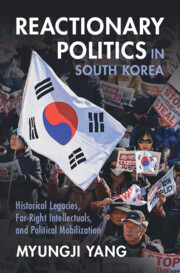
In December 2024, South Korean president Yoon Seok-yeol stunned the world by declaring martial law. More puzzling was that Yoon's insurrection unexpectedly gained substantial support from the ruling right-wing party and many citizens. Why do ordinary citizens support authoritarian leaders and martial law in a democratic country? What draws them to extreme actions and ideas? With the rise of illiberal, far-right politics across the globe, Reactionary Politics in South Korea provides an in-depth account of the ideas and practices of far-right groups and organizations threatening democratic systems. Drawing on eighteen months of field research and rich qualitative data, Myungji Yang helps explain the roots of current democratic regression. Yang provides vivid details of on-the-ground internal dynamics of far-right actors and their communities and worldviews, uncovering the organizational and popular foundations of far-right politics and movements.
While it is widely accepted that watching televised presidential debates helps voters stay informed about candidates and campaign issues, voters are increasingly turning to the media to learn about televised debates rather than watching them directly. Coupled with this trend is growing criticisms over presidential debates’ focus on negative attacks on opponents at the expense of policy discussions. We examine whether media outlets systematically bias the content of presidential debates, potentially amplifying their perceived negativity in presidential debates. Specifically, we theorize that the media outlets overemphasize non-policy aspects of presidential debates, because such coverage can help them draw viewer attention and is perceived to have greater news value. We further expect the continued exposure to media coverage of debates to weaken policy-related considerations in voters’ decision-making. We test these theoretical expectations using the case of the 2022 presidential election in South Korea. Using keyword-assisted topic model (keyATM), we first compare candidates’ speeches during the presidential debates with newspaper coverage of the debates. We find that non-policy topics, including personal attacks on the opponent and scandals, appeared more frequently in the newspaper coverage than in the actual debates. Next, we show that the continued exposure to media’s election coverage can reinforce voters’ tendency to base their voting decisions on non-policy issues through post-election survey data. Our findings offer significant insights into understanding media campaign coverage and its electoral significance in today’s media environment.
This study investigates the transnational mobility of Iranian women pursuing higher education in South Korea, focusing on their motivations, adaptation, and postgraduation trajectories. Drawing on the influence of the Korean Wave since the 2000s, it examines how popular culture, gender constraints in Iran, and migration aspirations intersect. Despite their initial attraction to Korea’s global image, many face cultural barriers, discrimination, and restrictive visa systems that limit settlement opportunities. Consequently, some seek “onward migration” to third countries such as Canada or Germany. By situating these experiences within broader Iranian migration dynamics, the study highlights gendered dimensions of educational migration and the policy limitations shaping Iranian students’ transnational mobility.
The paper examines job quality in South Korea by applying a novel wellbeing-based approach to defining ‘bad jobs’, extending methodology previously validated in European labour markets. The study analyses Korean Working Conditions Survey (2014–2023) data to investigate the relationship between job quality and worker wellbeing. The analysis reveals a significant discontinuity in the marginal effects of job quality on wellbeing at the bottom decile, where improvements yield distinctly larger wellbeing gains for workers moving above this threshold, providing empirical support for this approach to defining ‘bad jobs’. The prevalence of bad jobs shows a declining trend between 2014 and 2023, reflecting both economic growth and policy interventions. While the sectoral distribution of bad jobs shows similarities with European patterns, distinctive features emerge in South Korea’s labour market structure, characterised by the unique role of large business conglomerates (chaebols) and institutional arrangements. This study represents the first application of a wellbeing-based approach to defining bad jobs in an Asian context, demonstrating both its international applicability and the importance of national context in understanding the patterns of bad jobs. The findings carry significant implications for labour market policy in South Korea’s rapidly evolving economy, particularly for addressing persistent disparities in job quality across different segments of the labour market.
The Korean term insamansa – “human resources are everything” –‘captures the deep value the nation places on personnel. Despite long-standing recognition of their importance, formal selection systems have emerged only recently. This chapter examines bias and fairness in Korean personnel selection through historical, legal, and societal lenses. Korea’s transformation from the labor-intensive industries of the 1960s–1980s to a technology-driven economy in the 2000s has reshaped perceptions of employment fairness. Current workplace protections primarily address sex and disability discrimination through laws such as the Equal Employment Opportunity and Work-Family Balance Assistance Act. Although the Fair Hiring Procedure Act aims to reduce biased practices, challenges persist in ensuring the validity and fairness of selection methods. Moreover, the increasing use of artificial intelligence in hiring raises concerns over algorithmic bias. The chapter calls for evidence-based policies and robust statistical methods to improve validity and fairness in Korea’s evolving labor market.
States were again unable to reach consensus on the text of a plastics treaty during negotiations in Geneva in 2025. The majority of states stood firm against petrochemical interests and demanded a “high-ambition” treaty with binding global obligations across the full life cycle of plastics. What these states specifically support, however, varies considerably, as does the strength of their commitment. The case of South Korea offers insights into how changes in political leadership, industry lobbying, shifting narratives and competing foreign policy goals can shape the nature of ambition. Early in the negotiations, South Korea called for ambitious measures and was chosen to host the final round of talks set for late 2024. Yet, this did not translate into meaningful action or strong advocacy in later stages. Some South Korean policymakers may have been sincerely committed to global controls. South Korea’s early signaling of high ambition, however, was primarily motivated by strategic calculations to influence the treaty and become a “global pivotal state.” Its support for ambition, moreover, grew increasingly ambiguous as leadership changed and as states describing themselves as “ambitious” pushed for binding controls on plastics production and supply. South Korea’s foreign policy strategy, we further argue, failed to enhance the country’s diplomatic standing, as its ambiguous ambition came to light, and as industry recalcitrance, bureaucratic infighting and political turmoil undermined its capacity for effective leadership.
The dominant view in proliferation research holds that security guarantees from nuclear patrons reduce client states’ incentives to pursue nuclear armament. Yet in South Korea, public support for indigenous nuclear capabilities remains high despite strong trust in US extended deterrence. Drawing on the “better-now-than-later” logic from preventive war theory, we argue that this support reflects public forward-looking pessimism about the security environment, shaped by perceptions of the relative decline of the US and North Korea’s advancing nuclear capabilities. Analysis of the 2023 EAI Public Opinion Poll shows that concerns about systemic power shifts and pessimism about future inter-Korean relations are significantly associated with support for nuclear armament. South Korean public assessments of US extended deterrence and North Korea’s military threat do not align with conventional alliance theory expectations that high trust in extended deterrence should reduce support for nuclear armament. These findings underscore the need for reassurance strategies that address enduring alliance credibility.
Sexual slavery has been an ongoing human rights issue within South Korea since World War II, yet discourse has almost exclusively centred on World War II sex slaves. Redress efforts typically focus on these survivors, their bodies symbolising the Korean nation, with post-World War II Korean sex slaves generally seen as ‘willing’ prostitutes. Nevertheless, the bodies, experiences and victimhood of all survivors remain contested. This paper discusses the connection between the ‘ideal’ victims, the World War II Korean sex slaves, and an example of ‘non-ideal’ victims, the gijichon women of the 1970s. Drawing upon recent judgments, Korean law and society, it analyses the impact of an ‘ideal’ victim construct upon survivors’ pursuit of redress in the Korean courts. In this paper I argue that, despite some success within domestic courts, the ‘ideal’ victim construct can explain why all survivors remain marginalised and have yet to receive full truth and justice.
South Korea’s enduring obsession with English education has recently taken a new form in chil-se-ko-si, a Korean term referring to competitive English entrance exams for six- and seven-year-olds. This phenomenon reflects a broader shift toward performance-driven, high-stakes instruction in early childhood, shaped by policy gaps, market expansion, and parental anxiety. This article examines how chil-se-ko-si has become a mechanism of social sorting. It further explores whether such trends remain justifiable in an era increasingly mediated by generative AI. Drawing on a critical policy review that integrates media discourse, government data, and a national survey (Shin et al. 2023), the analysis is grounded in critical discourse analysis and Bourdieu’s theory of symbolic capital. Findings show that early English education is less about language acquisition and more about signaling class status, imposing emotional and financial burdens on families while reinforcing social hierarchies. Medical and educational experts express concern about the developmental and psychological costs of such early academic pressure. As AI tools begin to reshape how English is accessed and used, the persistence of chil-se-ko-si raises urgent questions about what it means to prepare children for the future. The article calls for early English education to be reoriented toward developmental appropriateness, equity, and contextual relevance in a rapidly evolving, technology-mediated world.
This article examines the lived experiences of multiculturalism among the Indonesian migrant women living in South Korea through the lens of ‘everyday otherness’. The process experienced in this context is seen as part of a broader development of Korean multiculturalism. The article investigates how cultural encounters are perceived, interpreted, and negotiated by Indonesian migrant women. Drawing from qualitative research that dealt with migration narratives, the study aims to contribute to the ongoing discussion on Korean multiculturalism and identify areas for improvement. It argues that everyday otherness practices in Korea have become subtler, more nuanced, and multi-layered. It reveals that while everyday multicultural practices in Korea have become more welcoming the presence of foreigners, the daily experience of racism and otherness continues, and is even more confounding.