To save content items to your account,
please confirm that you agree to abide by our usage policies.
If this is the first time you use this feature, you will be asked to authorise Cambridge Core to connect with your account.
Find out more about saving content to .
To save content items to your Kindle, first ensure no-reply@cambridge.org
is added to your Approved Personal Document E-mail List under your Personal Document Settings
on the Manage Your Content and Devices page of your Amazon account. Then enter the ‘name’ part
of your Kindle email address below.
Find out more about saving to your Kindle.
Note you can select to save to either the @free.kindle.com or @kindle.com variations.
‘@free.kindle.com’ emails are free but can only be saved to your device when it is connected to wi-fi.
‘@kindle.com’ emails can be delivered even when you are not connected to wi-fi, but note that service fees apply.
Analytical Mechanics, first published in 1999, provides a detailed introduction to the key analytical techniques of classical mechanics, one of the cornerstones of physics. It deals with all the important subjects encountered in an undergraduate course and prepares the reader thoroughly for further study at graduate level. The authors set out the fundamentals of Lagrangian and Hamiltonian mechanics early on in the book and go on to cover such topics as linear oscillators, planetary orbits, rigid-body motion, small vibrations, nonlinear dynamics, chaos, and special relativity. A special feature is the inclusion of many 'e-mail questions', which are intended to facilitate dialogue between the student and instructor. Many worked examples are given, and there are 250 homework exercises to help students gain confidence and proficiency in problem-solving. It is an ideal textbook for undergraduate courses in classical mechanics, and provides a sound foundation for graduate study.
This textbook provides engineers with the capability, tools and confidence to solve real-world heat transfer problems. It includes many advanced topics, such as Bessel functions, Laplace transforms, separation of variables, Duhamel's theorem and complex combination, as well as high order explicit and implicit numerical integration algorithms. These analytical and numerical solution methods are applied to topics not considered in most textbooks. Examples include heat exchangers involving fluids with varying specific heats or phase changes; heat exchangers in which axial conduction is a concern; and regenerators. Derivations of important results are presented completely, without skipping steps, which reduces student frustration and improves readability and retention. The examples are not trivial 'textbook' exercises; they are rather complex and timely real-world problems that are inherently interesting. This book integrates the computational software packages Maple, MATLAB®, FEHT and Engineering Equation Solver (EES) directly with the heat transfer material.
For thirty years, Peter Singer's Practical Ethics has been the classic introduction to applied ethics. For this third edition, the author has revised and updated all the chapters and added a new chapter addressing climate change, one of the most important ethical challenges of our generation. Some of the questions discussed in this book concern our daily lives. Is it ethical to buy luxuries when others do not have enough to eat? Should we buy meat from intensively reared animals? Am I doing something wrong if my carbon footprint is above the global average? Other questions confront us as concerned citizens: equality and discrimination on the grounds of race or sex; abortion, the use of embryos for research and euthanasia; political violence and terrorism; and the preservation of our planet's environment. This book's lucid style and provocative arguments make it an ideal text for university courses and for anyone willing to think about how she or he ought to live.
Providing readers with the confidence needed to debate key issues in bioethics, this introductory text clearly explains bioethical theories and their philosophical foundations. Over 250 activities introduce topics for personal reflection, and discussion points encourage students to think for themselves and build their own arguments. Highlighting the potential pitfalls for those new to bioethics, each chapter features boxes providing factual information and outlining the philosophical background, along with detailed case studies that offer an insight into real-life examples of bioethical problems. Within-chapter essay questions and quizzes, along with end-of-chapter review questions, allow students to check their understanding and to broaden their thinking about the topics discussed. The accompanying podcasts by the author (two of whose podcasts on iTunesU™ have attracted over 3 million downloads) explain points that might be difficult for beginners. These, along with a range of extra resources for students and instructors, are available at www.cambridge.org/bioethics.
Cross-Cultural Psychology is a leading textbook offering senior undergraduate and graduate students a thorough and balanced overview of the whole field of cross-cultural psychology. The team of internationally acclaimed authors present the latest empirical research, theory, methodology and applications from around the world. They discuss all domains of behavior (including development, social behavior, personality, cognition, psycholinguistics, emotion and perception), and present the three main approaches in cross-cultural psychology (cultural, culture-comparative, and indigenous traditions) as well as applications to a number of domains (including acculturation, intercultural relations and communication, work and health). With new additions to the writing team, the third edition benefits from an even broader range of cross-cultural perspectives. Now in 2-colour, the format is even more reader-friendly and the features include chapter outlines, chapter summaries, further reading and an updated glossary of key terms. This edition also offers an accompanying website containing additional material and weblinks.
In this important theoretical treatist, Jean Lave, anthropologist, and Etienne Wenger, computer scientist, push forward the notion of situated learning - that learning is fundamentally a social process. The authors maintain that learning viewed as situated activity has as its central defining characteristic a process they call legitimate peripheral participation (LPP). Learners participate in communities of practitioners, moving toward full participation in the sociocultural practices of a community. LPP provides a way to speak about crucial relations between newcomers and old-timers and about their activities, identities, artefacts, knowledge and practice. The communities discussed in the book are midwives, tailors, quartermasters, butchers, and recovering alcoholics, however, the process by which participants in those communities learn can be generalised to other social groups.
Resource Economics is a text for students with a background in calculus and intermediate microeconomics and a familiarity with the spreadsheet software Excel. The book covers basic concepts (Chapter 1), shows how to set up spreadsheets to solve simple dynamic allocation problems (Chapter 2), and presents economic models for fisheries, forestry, nonrenewable resources, and stock pollutants (Chapters 3–6). Chapter 7 examines the maximin utility criterion when the utility of a generation depends on consumption of a manufactured good, harvest from a renewable resource, and extraction from a nonrenewable resource. Within the text, numerical examples are posed and solved using Excel's Solver. Exercises are included at the end of each chapter. These problems help make concepts operational, develop economic intuition, and serve as a bridge to the study of real-world problems in resource management.
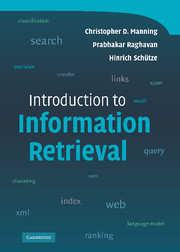
Class-tested and coherent, this textbook teaches classical and web information retrieval, including web search and the related areas of text classification and text clustering from basic concepts. It gives an up-to-date treatment of all aspects of the design and implementation of systems for gathering, indexing, and searching documents; methods for evaluating systems; and an introduction to the use of machine learning methods on text collections. All the important ideas are explained using examples and figures, making it perfect for introductory courses in information retrieval for advanced undergraduates and graduate students in computer science. Based on feedback from extensive classroom experience, the book has been carefully structured in order to make teaching more natural and effective. Slides and additional exercises (with solutions for lecturers) are also available through the book's supporting website to help course instructors prepare their lectures.
These two volumes provide a translation of the philosophical works of Descartes, based on the best available Latin and French texts. They are intended to replace the only reasonably comprehensive selection of his works in English, by Haldane and Ross, first published in 1911. All the works included in that edition are translated here, together with a number of additional texts crucial for an understanding of Cartesian philosophy, including important material from Descartes' scientific writings. The result should meet the widespread demand for an accurate and authoritative edition of Descartes' philosophical writings in clear and readable modern English.
This is the revised version of Peter Laslett's acclaimed edition of Two Treatises of Government, which is widely recognised as one of the classic pieces of recent scholarship in the history of ideas, read and used by students of political theory throughout the world. This 1988 edition revises Dr Laslett's second edition (1970) and includes an updated bibliography, a guide to further reading and a fully reset and revised introduction which surveys advances in Locke scholarship since publication of the second edition. In the introduction, Dr Laslett shows that the Two Treatises were not a rationalisation of the events of 1688 but rather a call for a revolution yet to come.
Nietzsche regarded 'Thus Spoke Zarathustra' as his most important work, and his story of the wandering Zarathustra has had enormous influence on subsequent culture. Nietzsche uses a mixture of homilies, parables, epigrams and dreams to introduce some of his most striking doctrines, including the Overman, nihilism, and the eternal return of the same. This edition offers a new translation by Adrian Del Caro which restores the original versification of Nietzsche's text and captures its poetic brilliance. Robert Pippin's introduction discusses many of the most important interpretative issues raised by the work, including who is Zarathustra and what kind of 'hero' is he and what is the philosophical significance of the work's literary form? The volume will appeal to all readers interested in one of the most original and inventive works of modern philosophy.
This book introduces the reader to all the basic physical building blocks of climate needed to understand the present and past climate of Earth, the climates of Solar System planets, and the climates of extrasolar planets. These building blocks include thermodynamics, infrared radiative transfer, scattering, surface heat transfer and various processes governing the evolution of atmospheric composition. Nearly four hundred problems are supplied to help consolidate the reader's understanding, and to lead the reader towards original research on planetary climate. This textbook is invaluable for advanced undergraduate or beginning graduate students in atmospheric science, Earth and planetary science, astrobiology, and physics. It also provides a superb reference text for researchers in these subjects, and is very suitable for academic researchers trained in physics or chemistry who wish to rapidly gain enough background to participate in the excitement of the new research opportunities opening in planetary climate.
This 2006 book is intended for undergraduate courses in dynamics. The work is a unique blend of conceptual, theoretical, and practical aspects of dynamics generally not found in dynamics books at the undergraduate level. In particular, in this book the concepts are developed in a highly rigorous manner and are applied to examples using a step-by-step approach that is completely consistent with the theory. In addition, for clarity, the notation used to develop the theory is identical to that used to solve example problems. The result of this approach is that a student is able to see clearly the connection between the theory and the application of theory to example problems. While the material is not new, instructors and their students will appreciate the highly pedagogical approach that aids in the mastery and retention of concepts. The approach used in this book teaches a student to develop a systematic approach to problem-solving.
ANOVA (Analysis Of Variance) is one of the most fundamental and ubiquitous univariate methodologies employed by psychologists and other behavioural scientists. Analysis of Variance Designs presents the foundations of this experimental design, including assumptions, statistical significance, strength of effect, and the partitioning of the variance. Exploring the effects of one or more independent variables on a single dependent variable as well as two-way and three-way mixed designs, this textbook offers an overview of traditionally advanced topics for advanced undergraduates and graduate students in the behavioural and social sciences. Separate chapters are devoted to multiple comparisons (post hoc and planned/weighted), ANCOVA, and advanced topics. Each of the design chapters contains conceptual discussions, hand calculations, and procedures for the omnibus and simple effects analyses in both SPSS and the new 'click and shoot' SAS Enterprise Guide interface.
This overview of diffusion and separation processes brings unsurpassed, engaging clarity to this complex topic. Diffusion is a key part of the undergraduate chemical engineering curriculum and at the core of understanding chemical purification and reaction engineering. This spontaneous mixing process is also central to our daily lives, with importance in phenomena as diverse as the dispersal of pollutants to digestion in the small intestine. For students, Diffusion goes from the basics of mass transfer and diffusion itself, with strong support through worked examples and a range of student questions. It also takes the reader right through to the cutting edge of our understanding, and the new examples in this third edition will appeal to professional scientists and engineers. Retaining the trademark enthusiastic style, the broad coverage now extends to biology and medicine.
The aim of this book is to collect in one comprehensive volume a representative selection of ancient sources in translation, with commentary, on the history, institutions, society and economy of the Greek world from c. 750 to 338 BC - that is, the period best known and most important for the evolution of the polis, a form of political community which combined the aspects of city and state in a physical and psychological unity unparalleled either before or since. For us, the inheritors of much that the Greeks created, there is an inherent interest in the way in which they organised their society during these centuries. Although this book assumes no knowledge of Greek, the reader is introduced to a range of key Greek words and concepts which offer a direct insight into the mentality, both collective and individual, of the times. The sources themselves (all of which have been translated by the authors) are supported by introductory commentary, notes, bibliographies, chronological tables and maps. All students and teachers of the history of ancient Greece or of classical civilisation generally will find this book an invaluable tool.
The pebbles used in ancient abacuses gave their name to the calculus, which today is a fundamental tool in business, economics, engineering and the sciences. This introductory book takes readers gently from single to multivariate calculus and simple differential and difference equations. Unusually the book offers a wide range of applications in business and economics, as well as more conventional scientific examples. Ideas from univariate calculus and linear algebra are covered as needed, often from a new perspective. They are reinforced in the two-dimensional case, which is studied in detail before generalisation to higher dimensions. Although there are no theorems or formal proofs, this is a serious book in which conceptual issues are explained carefully using numerous geometric devices and a wealth of worked examples, diagrams and exercises. Mathematica has been used to generate many beautiful and accurate, full-colour illustrations to help students visualise complex mathematical objects. This adds to the accessibility of the text, which will appeal to a wide audience among students of mathematics, economics and science.
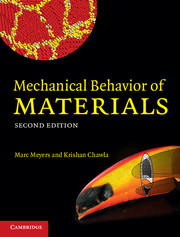
A balanced mechanics-materials approach and coverage of the latest developments in biomaterials and electronic materials, the new edition of this popular text is the most thorough and modern book available for upper-level undergraduate courses on the mechanical behavior of materials. To ensure that the student gains a thorough understanding the authors present the fundamental mechanisms that operate at micro- and nano-meter level across a wide-range of materials, in a way that is mathematically simple and requires no extensive knowledge of materials. This integrated approach provides a conceptual presentation that shows how the microstructure of a material controls its mechanical behavior, and this is reinforced through extensive use of micrographs and illustrations. New worked examples and exercises help the student test their understanding. Further resources for this title, including lecture slides of select illustrations and solutions for exercises, are available online at www.cambridge.org/97800521866758.
This book differs from other thermodynamics texts in its objective, which is to provide engineers with the concepts, tools, and experience needed to solve practical real-world energy problems. The presentation integrates computer tools (such as EES) with thermodynamic concepts to allow engineering students and practising engineers to solve problems they would otherwise not be able to solve. The use of examples, solved and explained in detail, and supported with property diagrams that are drawn to scale, is ubiquitous in this textbook. The examples are not trivial, drill problems, but rather complex and timely real-world problems that are of interest by themselves. As with the presentation, the solutions to these examples are complete and do not skip steps. Similarly the book includes numerous end-of-chapter problems, both typeset and online. Most of these problems are more detailed than those found in other thermodynamics textbooks. The supplements include complete solutions to all exercises, software downloads, and additional content on selected topics. These are available on the book's website www.cambridge.org/KleinandNellis.
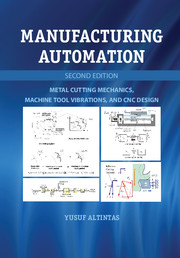
Metal cutting is widely used in producing manufactured products. The technology has advanced considerably along with new materials, computers and sensors. This new edition considers the scientific principles of metal cutting and their practical application to manufacturing problems. It begins with metal cutting mechanics, principles of vibration and experimental modal analysis applied to solving shop floor problems. There is in-depth coverage of chatter vibrations, a problem experienced daily by manufacturing engineers. Programming, design and automation of CNC (computer numerical control) machine tools, NC (numerical control) programming and CAD/CAM technology are discussed. The text also covers the selection of drive actuators, feedback sensors, modelling and control of feed drives, the design of real time trajectory generation and interpolation algorithms and CNC-oriented error analysis in detail. Each chapter includes examples drawn from industry, design projects and homework problems. This is ideal for advanced undergraduate and graduate students and also practising engineers.