To save content items to your account,
please confirm that you agree to abide by our usage policies.
If this is the first time you use this feature, you will be asked to authorise Cambridge Core to connect with your account.
Find out more about saving content to .
To save content items to your Kindle, first ensure no-reply@cambridge.org
is added to your Approved Personal Document E-mail List under your Personal Document Settings
on the Manage Your Content and Devices page of your Amazon account. Then enter the ‘name’ part
of your Kindle email address below.
Find out more about saving to your Kindle.
Note you can select to save to either the @free.kindle.com or @kindle.com variations.
‘@free.kindle.com’ emails are free but can only be saved to your device when it is connected to wi-fi.
‘@kindle.com’ emails can be delivered even when you are not connected to wi-fi, but note that service fees apply.
According to the value-free ideal of science, scientists should draw their conclusions in a manner free of influence from value judgments. This ideal lends itself to a variety of interpretations and specifications. The ideal also faces numerous challenges that call into question not only whether it can be achieved but whether it really constitutes an ideal scientists ought to use to guide their actions. The chapter considers whether and in what conditions the value judgments of scientists might prevent or facilitate the achievement of scientific objectivity. From the role of value judgments in science the chapter turns to the closely related question of the appropriate role of scientists in the formulation of public policies. In many situations, the consideration of scientific evidence and scientific research bears importantly on questions of policy. The chapter then considers the complicated relationship between the reliance of policymakers on scientific expertise and the goals of democratic accountability and the public good.
Science is part of society, and scientific culture is part of a broader culture from which it gets much of its character. Sexism and patriarchy have been pervasive influences throughout the historical process that leads to our present scientific culture, with significant effects on science and scientists. Feminist thinkers have grappled with the problem of sexism in science and have developed a variety of philosophical responses to it. This chapter surveys some of those responses, with a focus on the ideas of feminist empiricism and feminist standpoint theory. Both approaches argue that incorporating feminist ideas will enable scientific communities to better achieve scientific aims of knowledge and objectivity, although they disagree on which feminist ideas are best suited to achieve this. The chapter also considers ways in which the two approaches have become more alike as they developed over the past several decades, hinting at a possible synthesis of the two approaches.
Since the publication of the first edition of this highly regarded textbook, the value of data assimilation has become widely recognized across the Earth sciences and beyond. Data assimilation methods are now being applied to many areas of prediction and forecasting, including extreme weather events, wildfires, infectious disease epidemics, and economic modeling. This second edition provides a broad introduction to applications across the Earth systems and coupled Earth–human systems, with an expanded range of topics covering the latest developments of variational, ensemble, and hybrid data assimilation methods. New toy models and intermediate-complexity atmospheric general circulation models provide hands-on engagement with key concepts in numerical weather prediction, data assimilation, and predictability. The inclusion of computational projects, exercises, lecture notes, teaching slides, and sample exams makes this textbook an indispensable and practical resource for advanced undergraduate and graduate students, researchers, and practitioners who work in weather forecasting and climate prediction.
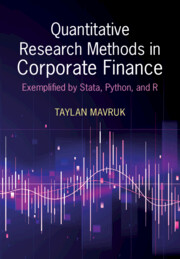
Focused on empirical methods and their applications to corporate finance, this innovative text equips students with the knowledge to analyse and critically evaluate quantitative research methods in corporate finance, and conduct computer-aided statistical analyses on various types of datasets. Chapters demonstrate the application of basic econometric models in corporate finance (as opposed to derivations or theorems), backed up by relevant research. Alongside practical examples and mini case studies, computer lab exercises enable students to apply the theories of corporate finance and make stronger connections between theory and practice, while developing their programming skills. All of the Stata code is provided (with corresponding Python and R code available online), so students of all programming abilities can focus on understanding and interpreting the analyses.
This chapter aims to prepare the reader for the models, applications, lab work, and mini case studies in the coming chapters. The focus is on sample selection, identification strategy, and hypothesis development. The chapter first covers some terminology and then discusses data types, units of analysis, data management, and different sampling methods. The sample-selection part explores the steps in a well-structured sample design. The identification strategy part covers the causal relationship of interest, ideal experiments, and statistical inference. This part is of particular significance because, in corporate finance research, it is important that the hypothesis is closely tied to economic theory and the previous literature. It is only then that we can draw meaningful conclusions from the studied relationships and deductions follow from hypotheses. The chapter ends with a hypothesis development section that details some decision/rejection rules. Stata codes are provided for the examples.
The health and well-being of families is an important consideration for federal, state, and/or local levels of government. Family health policies based on recent knowledge of early childhood development have evolved to emphasise the importance of providing every child with the best possible start to life. Childhood sets the foundation for future health and well-being and is recognised by the 1979 United Nations Convention on the Rights of the Child. To impact health inequalities, government policies and services must address the social determinants of early child health, development and well-being.
A masters-level overview of the mathematical concepts needed to master the art of derivatives pricing, this textbook is a must-have for anyone considering a career in quantitative finance in industry or academia. Starting from the foundations of probability, the book allows students with limited technical background to build a solid knowledge base of the most important notions. It offers a unique compromise between intuition and mathematics, even when discussing abstract notions such as change of measure. Mathematical concepts are initially introduced using “toy” examples, before moving on to examples of finance cases, in both discrete and continuous time. Throughout, numerical applications and simulations illuminate the analytical results. The end-of-chapter exercises test students’ understanding, with solved exercises at the end of each part to aid self-study. Additional resources are available online, including slides, code, and an interactive app.
This chapter explores the relationship between primary health care (PHC), health literacy and health education with empowering individuals, groups and communities to improve and maintain optimum health. PHC philosophy encompasses principles of accessibility, affordability, sustainability, social justice and equity, self-determination, community participation and intersectoral collaboration, which drive health care service delivery and health care reform. Empowerment is a fundamental component of social justice, which seeks to redistribute power so those who are disadvantaged can have more control of the factors that influence their lives. Lack of empowerment is linked to poorer health outcomes due to limited control or agency, associated with poorer social determinants of health. This influences personal resources, agency and participation, as well as limited capacity to access services and opportunities. Health care professionals and systems need to work in ways to promote the empowerment of individuals, groups and communities to achieve better health outcomes.
A masters-level overview of the mathematical concepts needed to master the art of derivatives pricing, this textbook is a must-have for anyone considering a career in quantitative finance in industry or academia. Starting from the foundations of probability, the book allows students with limited technical background to build a solid knowledge base of the most important notions. It offers a unique compromise between intuition and mathematics, even when discussing abstract notions such as change of measure. Mathematical concepts are initially introduced using “toy” examples, before moving on to examples of finance cases, in both discrete and continuous time. Throughout, numerical applications and simulations illuminate the analytical results. The end-of-chapter exercises test students’ understanding, with solved exercises at the end of each part to aid self-study. Additional resources are available online, including slides, code, and an interactive app.
A time series contains the values of a dataset sampled at different points in time. Some examples in financial research include asset prices, volatility indices, inflation rates, revenues, and so on. This chapter briefly covers the basic methods used in time-series analysis. Issues include whether the time-series data have equally spaced intervals, whether there is noise or error, how quickly the series grows, and whether the series has missing values. The chapter begins by testing for autocorrelation and remedies for autocorrelation. It then presents some standard tests for stationarity and cointegration, briefly covering random walks and the unit-root test. The models covered, among others, include autoregressive distributed lag (ARDL), autoregressive moving average (ARMA), autoregressive integrated moving average (ARIMA), generalized autoregressive conditional heteroskedasticity (GARCH), and vector autoregressive (VAR) models. The chapter provides an application to mortgage rates and ends with lab work and a mini case study.
Nurses and other health care professionals play a vital role in providing equitable, collaborative health care in the community. A primary health care approach is underpinned by the social model of health care and examines how social, environmental, economic and political factors affect the health of individuals, families and communities. An Introduction to Community and Primary Health Care provides a comprehensive and practical explanation of the fundamentals of this approach, preparing learners for professional practice in Australia and Aotearoa New Zealand.
The fourth edition has been restructured into four parts covering theory, working with diverse communities, key skills for practice, and the professional roles that nurses and other health care practitioners can play in primary care and community health practice. Each chapter has been thoroughly revised to reflect the latest research and includes up-to-date case studies, reflection questions and critical thinking activities to strengthen students’ knowledge and analytical skills. A new postface reflects on the future directions of primary health care.
Written by an expert team of nurse authors with experience across a broad spectrum of professional roles, An Introduction to Community and Primary Health Care remains an indispensable resource for students of nursing and other health care professions.
A masters-level overview of the mathematical concepts needed to master the art of derivatives pricing, this textbook is a must-have for anyone considering a career in quantitative finance in industry or academia. Starting from the foundations of probability, the book allows students with limited technical background to build a solid knowledge base of the most important notions. It offers a unique compromise between intuition and mathematics, even when discussing abstract notions such as change of measure. Mathematical concepts are initially introduced using “toy” examples, before moving on to examples of finance cases, in both discrete and continuous time. Throughout, numerical applications and simulations illuminate the analytical results. The end-of-chapter exercises test students’ understanding, with solved exercises at the end of each part to aid self-study. Additional resources are available online, including slides, code, and an interactive app.
In regressions where the dependent variable takes limited values such as 0 and 1, or takes some category values, using the OLS estimation method will likely provide biased and inconsistent results. Because the dependent variable is either discontinuous or its range is bounded, one of the assumptions of the CLRM is violated (that the standard error is normally distributed conditional on the independent variables). This chapter focuses on limited dependent-variable models, for example, covering firm decision-making, capital structure decisions, investor decision-making, and so on. The chapter presents and discusses the linear probability model, maximum-likelihood estimator, probit model, logit model, ordered probit and logit models, multinomial logit model, conditional logit model, tobit model, Heckman selection model, and count data models. It covers the assumptions behind and applications of these models. As usual, the chapter provides an application of selected limited dependent-variable models, lab work, and a mini case study.
A masters-level overview of the mathematical concepts needed to master the art of derivatives pricing, this textbook is a must-have for anyone considering a career in quantitative finance in industry or academia. Starting from the foundations of probability, the book allows students with limited technical background to build a solid knowledge base of the most important notions. It offers a unique compromise between intuition and mathematics, even when discussing abstract notions such as change of measure. Mathematical concepts are initially introduced using “toy” examples, before moving on to examples of finance cases, in both discrete and continuous time. Throughout, numerical applications and simulations illuminate the analytical results. The end-of-chapter exercises test students’ understanding, with solved exercises at the end of each part to aid self-study. Additional resources are available online, including slides, code, and an interactive app.