To save content items to your account,
please confirm that you agree to abide by our usage policies.
If this is the first time you use this feature, you will be asked to authorise Cambridge Core to connect with your account.
Find out more about saving content to .
To save content items to your Kindle, first ensure no-reply@cambridge.org
is added to your Approved Personal Document E-mail List under your Personal Document Settings
on the Manage Your Content and Devices page of your Amazon account. Then enter the ‘name’ part
of your Kindle email address below.
Find out more about saving to your Kindle.
Note you can select to save to either the @free.kindle.com or @kindle.com variations.
‘@free.kindle.com’ emails are free but can only be saved to your device when it is connected to wi-fi.
‘@kindle.com’ emails can be delivered even when you are not connected to wi-fi, but note that service fees apply.
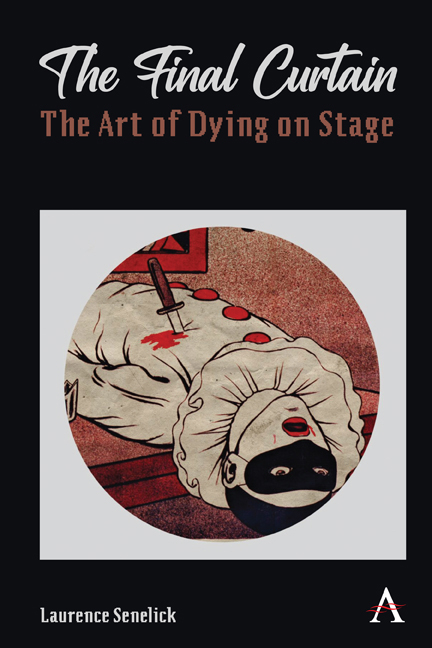
This is a book about dying, or, more accurately, about the representation of dying in the theatre. Its chief concern is how actors undertook to translate words and concepts into forms legible and significant to an audience. It deals with the ways in which playwrights wrote about death and attitudes towards death in their cultures. Nevertheless, the emphasis is on the practice of acting.
Before the nineteenth century, when death began to be confined behind closed doors, it was widely available as a spectacle. Death and the suffering that preceded it were in plain sight; no effort was made to hide the diseased and moribund. The absence of medical means of alleviating pain or of hygienic measures meant that the most distressing and abhorrent aspects of dying were out in the open. The contempt for human life shown by the law-courts and the death penalty for the slightest offence occasioned frequent and enthusiastically attended public executions. In addition, the Church and religion generally hoped, through elaborate rites and ceremonies, both before and after death, to invest it with an edifying value that could be extended for the greater good. The sacred and social ceremony makes a transition into an aesthetic and political performance, marking a more modern frame of mind.
Neoclassic decorum eschewed such displays; and, after a heyday of spectacular dying on the nineteenth-century stage, critics again began to insist on more moderate displays. This conformed to the growing emphasis on mental processes and psychological complexity. However, it runs counter to the theatre’s need for high color, extreme situations and fanciful invention. Denied house-room in literary drama, these desiderata found a welcome haven in the various manifestations of performance art.
Philosophical liberalism is the dominant view in the world today. Even those who reject liberalism philosophically, subscribe to its view of freedom, which is a negative view, common to liberalism, libertarianism, and anarchism. The alternative is recognition of nature, thoroughly, applied fully to human beings. The Buddha set it out as a philosophy, and he lived it. It was a practice.
It brings death back into life. The common view is that death is the opposite of life. Yet death is part of life, from the beginning. We see this in many great writers, Dostoevsky, for example. His characters find human communion in suffering, despite their differences. Contradictions are inherent in life, but we find our way, not a single way. It brings realism back, which is truth.
It has been present in human societies throughout history. It has been banished because of a false view of truth, connected to a false view of freedom. It could be recognized as philosophy. The Buddha taught people simply. There was no dogma. He did not teach them to follow him but to be masters of their own salvation. Unless this view is recognized as Philosophy, as it should be, including truth, it will again become religion, rather than a way of life, an art of living.
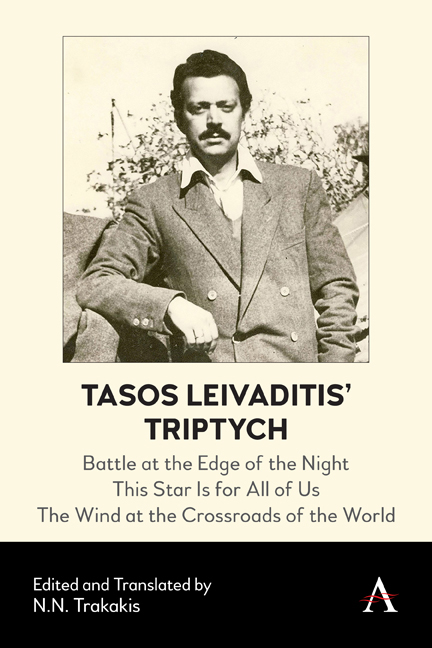
Tasos Leivaditis (1922-88), one of the undiscovered greats of Modern Greek literature, entered the poetic scene in the middle of the last century with three short poetry books, presented here in English translation for the first time. These works, received with both popular and critical acclaim upon publication in 1952-53, give compelling testimony to the violence of the twentieth century, witnessed by Leivaditis and his generation in the Nazi occupation of Greece in World War II and the subsequent civil war (1946-49) between the left and right-wing factions. The latter found Leivaditis, a committed communist, on the defeated side, and he was exiled to concentration camps on various islands for more than three years. Soon after his release, he published a remarkable triptych of poetic works that evoke the horrors of war and, in the midst of this, the yearning for justice and peace.
In 1887, following several years' imprisonment for his role in the People's Will terrorist group, Ivan P. Iuvachëv was exiled with other political prisoners to the notorious Sakhalin penal colony. The penal colony emerged during the late 1860s and 1870s, and collapsed in 1905, under the weight of Japan’s invasion of Sakhalin. The eight years between 1887 and 1895 that Iuvachëv spent on the island were some of the most tumultuous in the penal colony's existence. Originally published in 1901, his memoir offers a first-hand account of this netherworld that embodied the extremities of tsarist Russian penality. A valuable historical document as well as a work of literature testifying to one man's ability to retain his humanity amid a sea of human degradation, this annotated translation marks the first time Iuvachëv's memoir has appeared in any language besides Russian.
International student migration makes a significant contribution to higher education in the United Kingdom, with Southern Africa, and Nigeria in particular, positioned joint sixth in the top ten of sending countries. Many of these student-migrants, in supplementing their finances to fund their studies in the United Kingdom, undertake employment. Temporary and/or part-time employment is integral to the student-migrant experience, despite the express purpose of their admission into the United Kingdom designated for study purposes and not work. This explicit object is reflected in restrictions affixed to international students' employment rights whilst studying; they are generally restricted to a maximum of twenty hours of work per week during term time and proscribed from working full time or as independent contractors. Given the scant regard this topic has received in the existing literature, this study offers an examination of students' lived employment experiences under these rules. The study aims to offer a contribution, first in respect of the employment experiences of student-migrants through the analytical framework of 'precarity' by examining the various manifestations of insecurity in the students' lived realities, nuanced by structures of migration control and labour market temporalities. Secondly, by adopting the socio-legal schema of legal consciousness, the study considers the student-migrants' relationship with the law by way of the legal restrictions on their employment and examines their agency as evidenced through efforts to derogate from these rules.
The mandate system is sometimes described as a waystation between colonialism and independence. The population of Palestine had lived under foreign overlords, but not in classic colonialism. Under Turkey, the Palestine Arabs enjoyed considerable autonomy in local governance. They even held seats in Turkey's parliament. Britain not only assumed full control but, in collaboration with the Zionist Organization, inserted an outside population bent on taking over the country. The League of Nations, more through its weakness than as a matter of its policy, provided cover for Britain, lending an aura of pseudo-legality to its project. When the Arabs staged an armed revolt, as they did in 1936, Britain put it down so harshly that their capacity to protect themselves was severely reduced. As a result, the European settlers who came under Zionist auspices were able, a decade later, to force most of the Arabs out of the country.
The star of self-determination shone briefly at the Paris Peace Conference as Britain felt itself compelled to subject its conquest of Arab territory to a procedure that gave the appearance of limiting Britain's power. That appearance was largely illusory. Britain could decide on its own to remain in Palestine and to govern it. Britain could define the territory of Palestine. The mandate system required Britain to consult the population on the choice of a mandatory, and to allow for an indigenous government. Britain ignored these stipulations, and the League Council did nothing to enforce them. The Covenant, to be sure, gave the Council no enforcement authority, leaving Britain a free hand. The mandate system presupposed that a mandatory would hold legal title to the territory. Britain never gained that title, so even by the Council's standards, Britain had no legal authority over Palestine.
The peace treaty by which Turkey renounced sovereignty, the Treaty of Lausanne, gave no sovereignty to Britain or its Allies. Britain conceded that fact, as we saw, in the Permanent Court of Justice. It acknowledged to the Court that Britain had taken Palestine militarily during World War I and was holding it on that basis and on that basis alone.
chuanju 川劇 is a Sichuan xiqu genre of considerable antiquity, sharing some repertoire with kunqu through borrowing in both directions. It incorporates five different musical systems, one of which is kunqu.
errenzhuan 二人轉 is a genre from northeastern China, literally meaning two people (erren 二人) telling stories by performing different roles (zhuan 轉). First recorded in the mid-twentieth century, it has historically been a relatively informal performance genre (Haili Ma 2019b). However, troupes have also developed larger and more formal productions, such as the Zhu Maichen play discussed by Zhang Jiqing in Lecture 3.
Frontline Song and Dance Troupe (Qianxian gewutuan 前綫歌舞團) was a Nanjing-based troupe belonging to the People's Liberation Army, founded in 1955 and disbanded as part of the restructuring of military performance troupes in 2016.
huaiju 淮劇 is a genre that developed in the mid-nineteenth century, popular in northern Jiangsu and among migrants from that region to Shanghai. Perhaps due to its relatively recent origin, it has proven receptive to influences from other genres and open to modernization (Wenwei Du 2012).
huaju 話劇 is a modern spoken drama in China, derived from Western and Japanese models in the early twentieth century. It has a complex, sometimes antagonistic, but often productive relationship with xiqu.
jingju 京劇, formerly also known as jingxi 京戲 and “national opera” (guoju 國劇), is frequently referred to as “Peking opera” or “Beijing opera” in English. It is the best-known and most-studied genre of xiqu, and also the genre with the closest relationship to kunqu. When it overtook kunqu as a court genre in the nineteenth century, it adopted many of its elements and some of its music (Marjory Liu 1974, 64). In the early twentieth century, kunqu repertoire was kept alive to a substantial degree because certain scenes were kept in repertoire by jingju actors, notably Mei Lanfang. Even after 1949, the institutional separation was incomplete, with both Jiangsu and Shanghai troupes being historically connected to jingju companies. Kunqu actors training in martial scenes were and are also often trained by jingju performers, and major figures such as Yu Zhenfei and Yan Huizhu were equally if not more famous for their jingju work.
What are the lessons of America's experience with mandatory military service as we approach the second quarter of the twenty-first century? Almost a half century has passed since the end of the draft and the beginning of reliance on an All-Volunteer Force in 1973. That period can be contrasted with the 35 years (1917–18 and 1940–73) in which America mandated at least the possibility of military service for young men. All of the authors of this book served in the military in the final decade of mandatory military service. Let us compare the two eras.
The Draft Eras
America relied on mandatory military service to fight WW I, WW II, most of the long Cold War with the Soviet Union, the Korean War and the Vietnam War. The first four conflicts involved combat or potential combat against powerful enemies with military capabilities similar to that of the United States. WW I and WW II ended in victory for America and her Allies. The Cold War helped to avoid a shooting war between the world's two major nuclear powers and helped set the stage for the collapse of the Soviet Union in 1989. The Korean War, which began with an invasion of South Korea by Communist North Korea, had limited objectives of preserving the status quo between the two Koreas. It achieved that goal, albeit at considerable cost.
Only the Vietnam War ended in a failure of American objectives as Communist North Vietnam gained control of all of Vietnam two years after the United States withdrew its military support of the South Vietnamese government. The war's unpopularity in its later stages prompted candidate and President Richard Nixon to favor ending the draft and replacing it with the All-Volunteer Force. Flawed as he was, Nixon properly sensed that popular sentiment about the war was driven in considerable measure by objection to the draft. As the risk of being drafted abated participation in antiwar protests waned.
The All-Volunteer Force Era
The 50 years of the All-Volunteer Force has seen fewer serious military challenges to the United States than during the draft eras. The collapse of the Soviet Union in 1989 through 1991 can be attributed in part to America's willingness to continue its leadership of NATO and other multinational efforts to limit possible Soviet expansion. The major armed conflicts of this era centered in the Middle East and Afghanistan.
Robert King Merton has played an important role in shaping the field of sociology of science and technology. He defined the main orientations of a collective research program with his 1935 dissertation on Science, Technology and Society in 17th Century England, but even more so through his long-lasting interest in the sociological study of the practices, norms, and values of the scientific community. He succeeded where most of his mentors (Pitirim Sorokin, George Sarton) had previously failed by developing a “disciplinary program” and gathering promising students who tested and pursued some of his intuitions in multiple directions (Dubois 2014). His Columbia University seminar with Harriet Zuckerman on the sociology of science, from 1965 to 1985, played a critical role in this matter. Key contributors to the field of science study have been initially trained in this seminar. And still today the volume edited by Norman Storer for Chicago University Press in 1973—Sociolog y of Science. Theoretical and Empirical Investigations (Merton 1973)—remains an important intellectual landmark.
As we have now reached the fourth (or even the fifth) generation of professional sociologists of science, how should we consider Merton's scientific contribution? Should it be seen as a “patrimonial” component of the field? Merton would have said “Obliteration by incorporation.” I argue here that some of his insights and findings not only still benefit from unexpected visibility but also deserve a more systematic form of critical reappropriation. As one of his former research assistants, Stephen Cole (2004, 843), put it in a quasi-autobiographical essay, “with all its faults, [Merton] had the ability to arouse interest in others—interest that frequently led others to do empirical research. This is, after all, one of the major functions of theoretical work—providing puzzles.”
In this chapter, I examine some of these “Mertonian puzzles” for the study of contemporary science and technology. In the first section, I return briefly to Merton's writings to characterize the main features of his normative approach of science. In the second section, I underline some aspects of the contemporary diffusion of Merton's ideas. Finally, in the third section, I discuss how this program provides some tools to investigate empirically some of the most recent and intriguing forms of evolution in the scientific community.
EGEON, a merchant of Syracuse, father of the Antipholus twins
ANTIPHOLUS OF EPHESUS
ANTIPHOLUS OF SYRACUSE
DROMIO OF EPHESUS
DROMIO OF SYRACUSE
ADRIANA, wife of Antipholus of Syracuse
LUCIANA, her sister
LUCE, Adriana's kitchen maid, also known as NELL
BALTHAZAR, a merchant
ANGELO, a goldsmith
DOCTOR PINCH, a schoolmaster
FIRST MERCHANT, friend to Antipholus of Ephesus
SECOND MERCHANT, to whom Angelo owes a debt
EMILIA, an Abbess at Ephesus
COURTESAN
JAILER
OFFICERS
Headmen, Attendants
Synopsis of The Comedy of Errors
Act I
Because a law forbids merchants from Syracuse to enter Ephesus, elderly Syracusian trader Egeon faces execution when he is discovered in the city. He can only escape by paying a fine of a thousand marks. He tells his sad story to Solinus, Duke of Ephesus. In his youth, Egeon married and had twin sons. On the same day, a poor woman without a job also gave birth to twin boys, and he purchased these as slaves to his sons. Soon afterward, the family made a sea voyage and was hit by a tempest. Egeon lashed himself to the main-mast with one son and one slave, and his wife took the other two infants. His wife was rescued by one boat, Egeon by another. Egeon never again saw his wife or the children with her. Recently his son Antipholus, now grown, and his son's slave Dromio left Syracuse to find their brothers. When Antipholus did not return, Egeon set out in search of him. The Duke is moved by this story and grants Egeon one day to pay his fine. That same day, Antipholus arrives in Ephesus, searching for his brother. He sends Dromio to deposit some money at The Centaur, an inn. He is confounded when the identical Dromio of Ephesus appears almost immediately, denying any knowledge of the money and asking him home to dinner, where his wife is waiting. Antipholus, thinking his servant is making insubordinate jokes, beats Dromio of Ephesus.
Act II
Dromio of Ephesus returns to his mistress, Adriana, saying that her “husband” refused to come back to his house, and even pretended not to know her. Adriana, concerned that her husband's eye is straying, takes this news as confirmation of her suspicions.
It may seem odd to point out that the primary focus of the Jewish Studies literature is Judaism. After all, what else would it be? But this mono focus on Judaism omits the work of secular Jews who have been among the most important and influential contributors to every field in the arts and letters. Like a teenager after a breakup, the attitude is largely, “if you don't care about me, then I don't care about you.” If these thinkers reject their Jewishness, at least in their intellectual endeavors, why should those who study Jewishness devote time to them? As a result, Secular Jewish Studies is pursued with less vigor.
But doing so unnecessarily impoverishes the field. Jewishness is bigger than Judaism. It may be purely an accident of history that the great revolutionaries who launched modernity in their fields—Albert Einstein in physics, Emile Durkheim in sociology, Arnold Schoenberg in music, etc. just to name a few—were Jewish. But surely it is more than a mere accident. These were outsiders who emerged from a lived context to change the context in which we live. Art historians and historians of science will study their work relative to their peers, relative to their professional situation, but it ought to be the job of those in the Jewish Studies community to provide an even larger contextu alization. Secular Jews are Jews and their Jewishness needs to be understood in their lives and works.
One way to do that is to engage in the sort of bridge building that comprises this volume. By connecting secular Jewish thinkers and artists to Judaism, allows them to re-enter the tribe. Jews are proud of the famous Jews we know of or learn about. This sort of game provides a handle with which to ground that pride. This is not to say that we should deprive secular Jews of their secularity. That surely needs to be respected, but the associativity of this sort of project (without causal claims) allows secular Jews to be both secular and Jews.
This is a project we have been engaged in for a decade. Our initial work re-Judaizing a secular Jewish figure was our article, “Einstein's Jewish Science” and we followed that with treatments of Jerry Seinfeld and Rube Goldberg (this last piece required our co-author Olivia Handelman). This volume pre sents six more.
The American military of the 2020s is drawn from a variety of sources authorized by federal and state law. As Section II indicates, throughout American history different laws and policies have governed different parts of the military. The members of the today's American armed forces are drawn from the following sources.
Officers are the product of the service academies—West Point for the Army, Annapolis for the Navy and Marines, the Air Force Academy in Colorado Springs, and the Coast Guard Academy in New London. A substantial portion of the Academy graduates are expected to serve a career in the service of twenty years or more. The best of the graduates will serve as generals and admirals 30 years or more after their academy days.
A second primary source of new officers are the ROTC. These programs are hosted at universities around the country. They appeal to students wishing to attend a civilian university with its wide variety of degrees and, at the same time, to have military training that qualifies them for an officer's commission following graduation. Government support of ROTC programs and students can substantially reduce the cost of a college education.
Other programs allow talented enlisted personnel to advance to an officer's commission. A final path to an officer's commission allows a direct commission from a professional position in civilian life to perform similar military duties. Doctors, lawyers and chaplains are examples.
Enlisted personnel today enter military service through voluntary enlistment. The terms of enlistment typically commit the enlistee to a fixed term of full-time military training and service (usually two to four years) followed by a further period of obligated reserve service. The reserve duty typically requires weekly duty in a reserve unit and several weeks of annual summer service. The reservist is also subject to recall to full-time active duty. After the reservist has completed the obligated term of service, he or she can continue as a reservist for many years, qualifying for retirement benefits at age 60.
A further essential piece of the modern federal military establishment is the National Guard. The Guard combines state government control and national government control of the service member. The states’ National Guards perform a wide variety of missions under the direction of the state governor and legislature. Some duties, such as riot control, mirror national military duties.
It seems my ties with kunqu 崑曲, a preeminent Chinese theatrical form, were fated. I was born in Taipei into a family of intense jing ju 京劇 (Peking or Beijing opera) fans [Appendix J]. My father even hired jing ju professionals to help him practice singing, and to assist my older sisters improve their singing and stage performance skills. From early childhood I saw numerous jing ju performances by both professionals and amateurs, including many famous performers from Taiwan and beyond. As long ago as I can remember, I shuttled back and forth during jing ju performances between the seats of the audience and backstage. After the show was over I would often be carried home, asleep, by my family.
My first exposure to kunqu came as a young child when I would hear the mellifluous sound of a bamboo flute as I passed by a Japanese-style house on my way to school. It made such an impression that, in high school years later, I joined the school's Chinese orchestra and bought my own flute. When my father recognized my passion for the instrument, he took me to a friend who regularly gathered kunqu afficionados at his home to practice kunqu singing, which is accompanied by the bamboo flute. These gatherings were the forerunners of Taipei's Pengying singing meetings (Pengying quji 蓬瀛曲集 [Appendix I]), which still convene to this day on a biweekly basis. At these events I also had the opportunity to study the flute with Hsia Huan-hsin 夏煥新 [Appendix H]. Eventually, Jiao Chengyun 焦承允 (another frequent member [Appendix H]) formed a little musical ensemble—one sheng, one dan [Appendix I], and a flute—made up of two other students and me. We would meet two or three times a week in Jiao Chengyun's home to practice kunqu singing with my flute accompaniment. Our small group became very close and I soon discovered that Hsia Huan-hsin was the owner of that Japanese-style house I remembered so well. I continued to participate in these gatherings during my high school and college years and played the flute for some stage performances.
On paper, this book is a long time coming. It began in 2005 when I was at the University of Hawai’i at Mānoa (UHM) working on a small grant from the US Department of State to examine an issue related to clean water supplies in Southeast Asia. Of all the infrastructures that make dense urban living possible, a clean, reliable and healthy water supply is the most important because so many other aspects of a livable community depend on it. Of course, I was drawn to research this topic in Cần Thơ, Việt Nam, where I had done work before; my initial foray led me to expand the project—with support from the Ford Foundation and the US Department of Education—to conduct similar interviews and implement surveys related to local water supplies in other areas of Việt Nam, as well as in Cambodia and Indonesia. The papers resulting from that empirical work have been through many iterations before coming to you in the form of this book. My thanks go out to the Anthem Press editorial staff, as well as two blind reviewers who helped me consolidate these case studies into a larger argument. While their input has been invaluable to me in shaping this broader case, any shortcomings are mine alone.
In my heart, this book has been much longer in its genesis. My interest in Việt Nam and other areas of Southeast Asia are part of my DNA, given that my mother, Nguyễn Xuân Đào Spencer, hails from Sa Đéc, a town in Việt Nam's Mekong Delta about 50 km north of Cần Thơ. It was during the early 1990s that I began to shape the overall perspective that I articulate in this book: that to understand and navigate the world, we need to look beyond formal declarations and systems to focus on how people behave. There are many ways in which the description of informal groups getting the important work of governance done can be traced back to the experience of being my mother's son. Having been denied in graduate education and in diplomacy, she forged her own independent and less formal professional pathway. This pathway must have been in her mind when she warned me off from law school as being too detail-oriented.
Many eons ago, long before the consolidation of the modern nation-state we call China, the southeastern quadrant of the Eurasian landmass that is China today was a complex world composed of myriad cultures of diverse origins. In the northern reaches of this region, across the vast alluvial plain formed by the eons of flooding by the Yellow River, known in Chinese texts as the Central Plain and to geographers as the North China Plain, a cluster of localized cultures had formed by the fourth to third millennia BCE. These cultures were complex and technologically sophisticated. By the early to middle second millennium a written language had evolved that enabled a narrow stratum of literate elites to share ideas and to nurture the development of a classical culture that is identified with figures such as Confucius. This culture was widely shared across the divergent cultures of the Plain, providing thereby a common bond. This is the nascent civilization that in this book we shall call Sinitic, so as not to confuse it with Chinese, which, as we shall argue, only emerged many centuries later. Concurrently, in the vast regions that lay south of the Plain and the Yellow River basin, an array of importantly and pronouncedly distinct but equally complex cultures had formed in the basin of the Yangtze River and its tributaries and along the coast south of the river's mouth. Traditionally, History has not recognized the contributions of these cultures to Chinese civilization. That is in part what this book intends to address.
Through the second millennium BCE the cultures of the Central Plain, one of the largest alluvial plains in the world, began to consolidate into a loosely homogenized whole in an era that historians know as the Shang, or Yin, dynasty. Regional differences across the Plain remained, but enough was shared that historians can realistically refer to this as the root from which Sinitic and then mature Chinese culture emerged. This consolidation, however, was limited to the Plain and the Yellow River drainage basin, including some tributary basins to the west. Even as patterns of interaction developed, especially along the lines of encounter, the cultures of the Yangtze basin and the adjacent coast largely remained both diverse and distinct.
Cai Zhengren 蔡正仁 (b. 1941) of the Shanghai Troupe [Appendix I] is arguably the best-known active sheng 生, famed especially for his portrayal of daguansheng 大官 生 roles, such as the emperor in The Palace of Lasting Life (Changsheng dian 長生殿) as well as for qiongsheng 窮生 parts. A student of Yu Zhenfei 俞振飛 [Appendix H], and former leader of the Shanghai Troupe, he was awarded the Plum Blossom Prize (Meihua jiang 梅花獎) in 1986.
Synopsis
For the general background to The Palace of Lasting Life see Lecture 5. In this scene, the emperor, still in exile in Sichuan, continues to be tortured by grief and regret following the death of Precious Consort Yang Guifei 楊貴妃. He has commissioned a sculpture of her likeness which is now ready to be instated.
Role Types
The role of the emperor, Tang Minghuang 唐明皇, belongs to the broad category of sheng 生 or xiaosheng 小生, the narrower category of guansheng 官生 and, most narrowly, daguansheng 大官生, which is reserved for high officials as well as the emperor. Although bearded and in this case elderly, the singing register remains partially falsetto like that of most sheng rather than the purely modal voice used by other bearded roles. In the lecture, Cai Zhengren specifically warns against the risk of giving the appearance of low status when adopting a more elderly gait, since the gravitas of the role means that movements must have a certain amplitude, which he also contrasts with the smaller movements of the comic xiaohualian 小花臉 or chou 丑, who features in this scene in the person of the palace eunuch Gao Lishi 高力士. Given the emperor's miserable frame of mind, however, he does borrow some movements from the qiongsheng 窮生 role type, which is used to depict sheng fallen on hard times.
Performance
Cai Zhengren's performance is available in a 1992 recording, collected in the first volume of Kunju Collection (Kunju xuanji 崑劇選輯), published in Taiwan.