Flip it Open aims to fund the open access publication of 128 titles through typical purchasing habits. Once titles meet a set amount of revenue, we have committed to make them freely available as open access books here on Cambridge Core and also as an affordable paperback. Just another way we're building an open future.
To save content items to your account,
please confirm that you agree to abide by our usage policies.
If this is the first time you use this feature, you will be asked to authorise Cambridge Core to connect with your account.
Find out more about saving content to .
To save content items to your Kindle, first ensure no-reply@cambridge.org
is added to your Approved Personal Document E-mail List under your Personal Document Settings
on the Manage Your Content and Devices page of your Amazon account. Then enter the ‘name’ part
of your Kindle email address below.
Find out more about saving to your Kindle.
Note you can select to save to either the @free.kindle.com or @kindle.com variations.
‘@free.kindle.com’ emails are free but can only be saved to your device when it is connected to wi-fi.
‘@kindle.com’ emails can be delivered even when you are not connected to wi-fi, but note that service fees apply.
Dark patterns are the subject of a surge of regulatory interest in the EU. Much new legislation in the areas of consumer law, data protection and competition law include provisions on dark patterns. Businesses use dark patterns to increase their revenue at the expense of consumers who purchase products they may not need, spend more time or give up more personal data than they would otherwise. Instead of focusing on the more normative issue of when dark patterns should be considered harmful, the chapter compares the different legal frameworks applicable to these practices and asks to what extent the increasingly fragmented EU regulatory landscape can offer effective overall protection against dark patterns. While useful complementarities may arise when parallel sets of rules target different concerns or protect different values, there are also risks of inconsistencies that may lead to either under- or overenforcement due to the fragmentation of the overall regulatory framework. The chapter submits that three needs result from the state of play and offers suggestions to improve the enforcement against dark patterns based on the current EU regulatory framework.
Provisions in consumer contracts that deprive consumers of recourse in the event of a product failure effectively cancel the insurance that the law would otherwise provide to consumers who are injured by sellers of consumer products. This redistributes wealth from the poorest consumers to richer consumers because richer consumers can afford to self-insure against the risk of product failure whereas poorer consumers cannot. It follows that consumer sovereigntist arguments that consumer indifference to consumer-unfriendly contract terms suggests that consumers prefer the lower prices that come with such terms are misleading here. The interests of rich and poor consumers diverge with respect to these contract terms and the fact that rich consumers may carry the day in the market does not imply the consumers as a group prefer these terms. Accordingly, the European approach to consumer law, which treats democratically elected governments regulating consumer contract terms as a more authentic reflection of popular will than the purchase decisions of consumers in markets, may be more appropriate when it comes to the regulation of consumer contracts.
The double-distortion argument holds that income taxation is more efficient than redistribution through changes in legal rules because a change in a legal rule distorts both the market to which the rule applies and, by altering incomes of market participants, the labor market as well. The argument succeeds only if it is possible to achieve the same distributive outcomes with the income tax as with changes to legal rules. This is not the case, however, because tax authorities cannot obtain information regarding the extent of the surplus available for redistribution without altering legal rules in individual markets and observing whether the effect is inframarginal (in which case there is surplus available for redistribution) or marginal (in which case there is not). This point is illustrated using the Ayres and Talley model of Coasean bargaining with divided entitlements.
Neoclassical economics is inherently biased against progressive policies and therefore should be avoided by progressives seeking to make the case for them. This is reflected in the history of regulation of payday loans and other fringe financial products. Conservatives used economic arguments to roll back regulation of these products in the second half of the twentieth century. Attempts to reregulate them have since been stymied despite progressives’ use of behavioral economic arguments to justify greater regulation. Progressives who eschew economic argument have had more success pursuing reform in other areas in the Biden Administration. The failure of behavioral economics to advance a progressive agenda in fringe finance suggests that inframarginalism, which also embraces the neoclassical analytic, will not help progressives. Another problem is that any neoclassical approach privileges elite expertise.
This chapter explains why inframarginal analysis should be used to evaluate whether to enforce consumer boilerplate provisions, and then applies this approach to show that the use of pro-consumer boilerplate terms should be mandatory. Inframarginal analysis looks at how the law can allocate inframarginal resources in ways that are fairer and more efficient than unregulated outcomes. Two policy considerations are paramount when carrying out this analysis: 1) devising ways to distribute resources equitably, and 2) minimizing wasteful competition. The impact of consumer boilerplate is largely inframarginal, so inframarginal analysis is the correct way to evaluate whether to enforce these provisions. In carrying out this analysis, a graph-based approach is helpful in showing why equitable considerations point toward preferring pro-consumer terms over pro-seller terms and why wasteful competition considerations point toward making the use of these pro-consumer terms mandatory. The usefulness of this analysis is further demonstrated by applying the findings here to the more specific question of whether to enforce choice-of-forum provisions in consumer contracts.
Since the Reagan era, American economic policy has amounted to self-colonization. Democratic majorities have consistently supported legal regimes that have enabled corporations to extract the lion’s share of the gains from trade from the public. For example, they have supported a corporate law regime that denies the public democratic control over the behavior of corporations and instead gives dictatorial powers to shareholders and managers. The Internet has made it even easier for firms to extract surpluses from consumers through surveillance and algorithmic pricing. One small contribution toward a project of decolonizing the public would be for consumers to obtain a property right in their personal information. This would allow them to claw back some of the surpluses that technology has taken from them.
Land is a major generator of gains from trade because it is fixed in quantity and arises naturally, resulting in low costs for sellers and high demand from buyers. The fixed quantity also allows policymakers to tailor prices or taxes to inframarginal units. But the current mode of redistributing the surpluses generated by land sales in America – the local property tax – has important drawbacks. These include the need for property value assessments, the fact that some homeowners lack the cash income required to pay the tax even when the assessment is accurate, and the fact that local administration means there is little redistribution from rich communities to poor ones. Taxing imputed rents as income at the federal level would address these problems. Imputed rent is the rent that a homeowner pays to himself for the right to live in the house. It is economically equivalent to a home’s value because home values are determined by the rents they command. Taxing them as federal income does not require home value assessments (local rental data suffice), ensures that tax rates vary with income, and leverages the mildly progressive federal income tax rate structure to redistribute wealth.
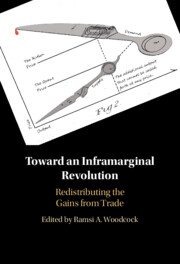
Over the past fifteen years, there has been a growing interest in altering legal rules to redistribute wealth, with many scholars believing that neoclassical economic theory is biased against redistribution. Yet a growing number of progressive scholars are pushing back against this view. Toward an Inframarginal Revolution offers a fresh perspective on the redistribution of wealth by legal scholars who argue that the neoclassical concept of the gains from trade provides broad latitude for redistribution that will not harm efficiency. They show how policymakers can redistribute wealth via taxation, price regulation, antitrust, consumer law, and contract law by focusing on the prices at which inframarginal units of production change hands. Progressive and eye-opening, this volume uses conservative economic concepts to make a compelling case for radically redistributing wealth. This title is part of the Flip it Open Programme and may also be available open access. Check our website Cambridge Core for details.
This chapter shows that the faculty of the will was presented as a ubiquitously dangerous facet of selfhood in Elizabethan and Jacobean plays, when used to gratify selfish or sinful desires. ‘Punishing the Transgressive Will’ explains how this convention helped define how the limitations of human ambition and the boundaries of moral transgression were depicted. I do so primarily through a comparative analysis of the notorious acts of wilfulness performed in Christopher Marlowe’s Tamburlaine the Great, Dr Faustus, and Elizabeth Cary’s The Tragedy of Mariam. Enticing as it was dangerous, the capacity for the will to incite violence or disorder was commonly shown to be the primary cause of its own ruin. This literary topos is, however, importantly refuted in Cary’s play through the character of Salome. Among all of the excessively wilful characters who feature in Renaissance drama, Salome proves to be an exceptional type of Neo-Senecan villain whose will functions without limit: her will is not self-defeating, nor is she punished for exercising it. I propose that Salome’s fate can help to redefine our understanding of transgressive acts in Renaissance tragedies.
‘Testamentary Drama’ continues to assess the pitfalls associated with the expression of the will by charting the presence that last wills took both as material and virtual stage props. What I term as the testamentary tradition in English Renaissance drama – plays that address both the restorative and destructive outcomes of testamentary execution – begins with Ulpian Fulwell’s interlude Like Will to Like (first printed 1568). This play focuses on the ruinous effect that Lucifer’s fake will and testament has on the destitute and prodigal beneficiaries who are enticed (and ultimately damned) by the property offered within it. The last will, thus, functions to punish wickedness and reveal the futility of willing itself. Like Will to Like sets a precedent for the popular dramatic function of these documents: last wills typically function as vehicles for testators to impose their personal will over networks of beneficiaries; last wills were commonly used as tools of moral instruction and social control to draw attention to the fraught politics of testamentary inheritance; playwrights consistently portrayed acts of will-making to be disastrously prone to being counterfeited.
This introduction establishes the overarching claim of this book: that Elizabethan and Jacobean dramatists consistently focus on the disastrous consequences of willing and will-making, while simultaneously emphasizing the vital role that wills played in defining one’s sense of identity and self-worth. English Renaissance drama can be understood, in one way, to be preoccupied with considering the influence that wills exert over human life.
Here, I provide an overview of how both the faculty of the will and the last will and testament were conceived of in the period. The will was primarily thought to be an unruly part of the soul that hinders our ability to achieve what we desire, though the performance of the will was not merely localized to the body or psyche. One way of enacting one’s will upon the world was achieved for some through the production of a last will and testament. Last wills acted as tools for testators to impose their will upon the living, dictating who will, and who will not, benefit from their death. In their immaterial and material forms, wills shaped the quality and conditions of one’s life and afterlife.