Genuinely broad in scope, each handbook in this series provides a complete state-of-the-field overview of a major sub-discipline within language study, law, education and psychological science research.
To save content items to your account,
please confirm that you agree to abide by our usage policies.
If this is the first time you use this feature, you will be asked to authorise Cambridge Core to connect with your account.
Find out more about saving content to .
To save content items to your Kindle, first ensure no-reply@cambridge.org
is added to your Approved Personal Document E-mail List under your Personal Document Settings
on the Manage Your Content and Devices page of your Amazon account. Then enter the ‘name’ part
of your Kindle email address below.
Find out more about saving to your Kindle.
Note you can select to save to either the @free.kindle.com or @kindle.com variations.
‘@free.kindle.com’ emails are free but can only be saved to your device when it is connected to wi-fi.
‘@kindle.com’ emails can be delivered even when you are not connected to wi-fi, but note that service fees apply.
For lesbian, bisexual, gay, and queer (LGBQ+) youth, disclosure of a nonheterosexual identity to parents (“coming out”) is part of identity development processes during adolescence. LGBQ+ youth in the United States who disclose at the present time do so in the context of heightened visibility and rights for LGBQ+ people, yet disclosure to parents remains complicated for many. In this chapter, we discuss contemporary research on LGBQ+ youth disclosing to parents. Focal topics include (a) disclosure as part of forming an LGBQ+ identity, (b) navigating identity disclosure and concealment decisions, (c) implications of disclosure on youth well-being and parent-adolescent relationships, and (d) methodological and ethical concerns, such as protecting the rights of LGBQ+ adolescents to participate in research and safeguarding participants’ privacy. Although most research involves LGBQ+ youth disclosing to cisgender, heterosexual parents, we discuss emerging research on “second-generation” LGBQ+ youth who disclose to sexual minority parents. We conclude with future directions for research to progress the work on information management and parental monitoring in the lives of LGBQ+ youth.
Observational data are valuable for many research studies across different fields and can be appropriate for various studies, including qualitative, quantitative, and mixed methods research. Observations can be structured, semi-structured, or unstructured and are often combined with other methods such as interviews and documentary analysis. In this chapter, we focus on the practical aspects of observational data, including identifying appropriate settings and gaining access, determining the role of the observer and the level of participation during observation, and planning how the data will be collected, recorded, and analyzed. We also emphasize the role of reflexivity – an important tool for the observer to ensure they are aware of how they are influencing the data observed. Although there are many benefits to observation as a data collection method, there are also challenges, limitations, and ethical issues to address; all these areas will be considered in this chapter.
Surface electromyography (EMG) measurements provide a non-invasive way to measure physical behavior in a way that is more sensitive and less prone to bias compared to observational methods. This chapter covers the use of EMG in social and behavioral research. First, the biological underpinnings of muscle activity are briefly reviewed to give the reader a basic understanding of the signal being measured. Next, the steps for obtaining the EMG signal are covered, including equipment and signal processing. Finally, some common use cases of EMG measures in social and behavioral research are reviewed. With modern-day equipment, EMG measures can be collected both in the traditional laboratory setting and, when signal noise concerns are acknowledged, in the “real world.”
Open-ended survey questions (OESQs) are a flexible and efficient method of collecting qualitative data but have received little attention in qualitative methods research and teaching. Here, I discuss OESQs as a stand-alone data collection method, a demographic data collection method, and an adjunct to researcher-derived survey responses. I explore the advantages and disadvantages of OESQs, review previous research using them, and provide practical guidance for survey design, data collection, and data analysis. When used thoughtfully, OESQs have potential to collect rich data from large samples and allow for exciting new directions in qualitative and survey research.
Adolescent disclosure and information management with parents have been significantly examined within the last two decades for good reason, as it allows researchers to understand how adolescents are balancing both autonomy and relatedness within this important relationship and developmental period. However, parents are not the only close relationship partners that adolescents must learn to navigate this balance with; siblings and friends are also important confidants throughout adolescence and disclosure to these more egalitarian relationships is both similar to and different from disclosure to parents. In this chapter, we compare and contrast the frequency and content of adolescent disclosure to parents, siblings, and friends, as well as the ways in which disclosure affects each of these relationships and adolescent well-being. Finally, we examine the limitations of the current information management literature across these relationships and offer future directions toward integrating these literatures.
The scientific community fundamentally requires the conduct of research to meet ethical standards. Bureaucracy and regulation may enforce these requirements, but they ultimately reflect the underlying values of science and the social norms that translate these values into practice. In creating knowledge, scientists must protect research participants, and they are also obliged to treat their data and communications in accordance with honesty, transparency, and a commitment to the benefit of society. We review the history and current state of human participant protection; make a case that many of the changes in standards of data handling and publication reporting over the past ten years themselves have ethical dimensions; and briefly list a number of pending ethics issues in research and publishing that do not as yet have a clear, consensual resolution in the field of psychology.
This chapter highlights the utility of cultural imagination, the ability to see human behaviors not just as the result of their dispositions or immediate situations but also as the result of larger cultural contexts. Our cultural imagination, as researchers, evolves as we are increasingly exposed to ideas from different parts of the world, either through collaboration with other researchers or interacting with individuals outside our immediate cultural context. While cross-cultural research has become simpler with the rise of the Internet, there still remain many challenges. This current chapter delineates concrete steps one can take to conduct an informative cross-cultural study, increasing the diversity of databases for generalizable theories of personality and social behaviors.
This chapter profiles a description of the paths that shaped research on parental monitoring and adolescents’ information management. As these areas developed, accounts of the interplay between parents’ attempts to regulate their adolescents’ behavior and adolescents’ responses grew in breadth and in detail. In this chapter, we introduce readers to the constructs and frameworks that have come to represent monitoring and information management research, including related topics that have been probed in diverse attempts to better understand parenting and adolescents’ behaviors. We track developments in the field from the initial challenges to research on parental monitoring, to the rapid shift emphasizing adolescents’ information management and challenging assumptions about monitoring specifically and parental control more generally. Finally, we not how these broad examinations of monitoring and parental control have led to theory development and offer suggestions for continuing these efforts.
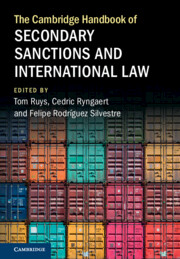
We live in an age of sanctions. For geopolitical reasons, powerful states and economic blocks increasingly impose unilateral measures restricting economic transactions with certain target states. These sanctions may apply to transactions between the sanctioning state and a target country but may at times also extend to transactions between third states and the target state. By imposing such 'secondary' sanctions, states aim to further isolate the target state. The extraterritorial character of secondary sanctions makes them controversial, as they impinge on third states' economic sovereignty and the latter's operators' freedom to conduct international business. This book addresses the legality of secondary sanctions from multiple legal perspectives, such as general international law, international economic law, and private law. It examines how third states and operators can legally react against secondary sanctions, e.g. via blocking legislation or litigation. It also provides economic and political perspectives on secondary sanctions.
Delve into the ideal resource for theory and research on parental monitoring and adolescents' disclosure to and concealment from parents. This handbook presents ground-breaking research exploring how adolescents respond to parents' attempts to control and manage their activities and feelings. The chapters highlight how adolescents' responses are as important for their mental health and behavior as parents' attempts to regulate them. Examining responsive, intrusive, and invasive parenting behaviors, the volume addresses modern challenges like monitoring in the digital age and medical decision-making. It covers cutting-edge research on diverse cultures and groups including Latinx, Turkish, Chinese, LGBTQ+, and chronically ill youth. The internationally recognized contributors offer insights from different theoretical perspectives and describe novel methodological approaches, focusing on variations across different developmental stages, contexts, and cultures.
In a time where new research methods are constantly being developed and science is evolving, researchers must continually educate themselves on cutting-edge methods and best practices related to their field. The second of three volumes, this Handbook provides comprehensive and up-to-date coverage of a variety of issues important in developing, designing, and collecting data to produce high-quality research efforts. First, leading scholars from around the world provide an in depth explanation of various advanced methodological techniques. In section two, chapters cover general important methodological considerations across all types of data collection. In the third section, the chapters cover self-report and behavioral measures and their considerations for use. In the fourth section, various psychological measures are covered. The final section of the handbook covers issues that directly concern qualitative data collection approaches. Throughout the book, examples and real-world research efforts from dozens of different disciplines are discussed.
This indispensable collection provides extensive, yet accessible, coverage of conceptual and practical issues in research design in personality and social psychology. Using numerous examples and clear guidelines, especially for conducting complex statistical analysis, leading experts address specific methods and areas of research to capture a definitive overview of contemporary practice. Updated and expanded, this third edition engages with the most important methodological innovations over the past decade, offering a timely perspective on research practice in the field. To reflect such rapid advances, this volume includes commentary on particularly timely areas of development such as social neuroscience, mobile sensing methods, and innovative statistical applications. Seasoned and early-career researchers alike will find a range of tools, methods, and practices that will help improve their research and develop new conceptual and methodological possibilities. Supplementary online materials are available on Cambridge Core.
Secondary sanctions are unique in their audacity. Their application in an interdependent global context raises the specter of an uncontrolled burn, with consequences stretching beyond even their broadest scope. Such consequences reshape markets and, at times, create new ones. This chapter uses Iran as a lens through which to examine the relationship between the informal economy and US secondary sanctions and the potential disruption provided by the proliferation of cryptocurrencies. The chapter ultimately concludes that despite much-heralded potential, cryptocurrency’s disruption to the US financial system’s supremacy, as well as the sanctions regimes reliant on such supremacy, remains, for now, limited. This incomplete disruption means that any blunting effect provided by cryptocurrency on secondary sanctions cannot fully protect the informal economies and the participants therein from the effects of such sanctions, particularly in more protracted sanctions regimes. Indeed, cryptocurrency’s likeliest role in US sanctions is not to upend the secondary sanctions regime but rather to complicate the enforcement process. Given its rapid proliferation and built-in cryptography, cryptocurrency is likely to continue to make enforcement of sanctions more difficult, more expensive, and, perhaps, less appealing to pursue all potential evaders.
The chapter assesses whether the enforcement of extraterritorial sanctions through asset freezes is consistent with customary and treaty rules of international monetary law. After defining key concepts and describing the main characteristics of asset freezes, a definition of such measures through the lenses of international monetary law is provided. The research then moves, first, to discuss whether the imposition of asset freezes to enforce extraterritorial sanctions regimes can be deemed an exercise of internal or external monetary sovereignty and, second, whether unilateral (extraterritorial) sanctions can be considered to amount to exchange restrictions legitimately introduced for security reasons for the purposes of the Articles of Agreement of the International Monetary Fund (IMF). The chapter concludes with a critical assessment of the IMF legal regime on unilateral (extraterritorial) sanctions.
The World Trade Organization (WTO) regime has a significant role to play in disciplining secondary sanctions. It provides substantial standards and procedures that differ from and supplement applicable standards and potential remedies under general public international law. The WTO system may address the specifics of secondary sanctions in different ways. In this chapter three perspectives are discussed in this regard. First, it is observed that non-discrimination standards in trade law may capture what appears to be unfair about secondary sanctions, as such standards would fail to detect discrimination, where all WTO Members – target Members and third Members – would be sanctioned alike. Second, however, WTO exception clauses can take into consideration that secondary sanctions are significantly more distant in terms of a connection between the measure and a legitimate policy objective as required under standards of good faith. Third and relating to fairness, WTO dispute settlement would open an opportunity for affected Members to seek a rebalancing of rights and obligations even in cases where a measure would be considered to conform to WTO rules.
In the last ten years, secondary sanctions have played an important role for European regulators as well as for compliance officers working for economic operators. Even though such European practitioners are looking for guidance and experience from their interlocutors from the other side of the Atlantic, including from the US Office of Foreign Assets Control, secondary sanctions do not act in the leading role but are one of many risk factors to be considered by economic operators. Instead, prohibitive policies of European economic operators, including financial institutions, against certain governments, such as Iran and to a lesser degree Russia, are mostly based on risks unrelated to secondary sanctions. On this premise, the chapter will briefly describe the relevant regulatory framework and will then explain how the regulations are operationally implemented in international financial institutions. In doing this, the chapter will also touch on practical challenges for sanctions compliance officers, such as extraterritoriality and the EU Blocking Regulation.
This chapter starts from the premise that secondary sanctions are invariably adopted to exert pressure upon foreign economic or financial actors operating in third states, with the intention to modify their conduct in alignment with the primary sanctions already imposed by the sanctioning state against the target state. As follows, due to their extraterritorial scope and their exceptional capacity to encroach upon the sovereignty of other countries, the legal status of secondary sanctions under international law is controversial. This contribution seeks to elucidate if secondary sanctions may amount to economic coercion and whether as a result these measures could constitute a breach to the principle of non-intervention. The chapter closes by exploring the potential avenues for regime interaction between the rules governing the exercise of jurisdiction by states and the principle of non-intervention in the context of secondary sanctions.