Genuinely broad in scope, each handbook in this series provides a complete state-of-the-field overview of a major sub-discipline within language study, law, education and psychological science research.
To save content items to your account,
please confirm that you agree to abide by our usage policies.
If this is the first time you use this feature, you will be asked to authorise Cambridge Core to connect with your account.
Find out more about saving content to .
To save content items to your Kindle, first ensure no-reply@cambridge.org
is added to your Approved Personal Document E-mail List under your Personal Document Settings
on the Manage Your Content and Devices page of your Amazon account. Then enter the ‘name’ part
of your Kindle email address below.
Find out more about saving to your Kindle.
Note you can select to save to either the @free.kindle.com or @kindle.com variations.
‘@free.kindle.com’ emails are free but can only be saved to your device when it is connected to wi-fi.
‘@kindle.com’ emails can be delivered even when you are not connected to wi-fi, but note that service fees apply.
The main goal of this chapter is to introduce one type of AI used for law enforcement, namely predictive policing, and to discuss the main legal, ethical, and social concerns this raises. In the last two decades, police forces in Europe and in North America have increasingly invested in predictive policing applications. Two types of predictive policing will be discussed: predictive mapping and predictive identification. After discussing these two practices and what is known about their effectiveness, I discuss the legal, ethical, and social issues they raise, covering aspects relating to their efficacy, governance, and organizational use, as well as the impact they have on citizens and society.
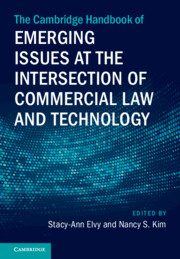
The Cambridge Handbook of Emerging Issues at the Intersection of Commercial Law and Technology is a timely and interdisciplinary examination of the legal and societal implications of nascent technologies in the global commercial marketplace. Featuring contributions from leading international experts in the field, this volume offers fresh and diverse perspectives on a range of topics, including non-fungible tokens, blockchain technology, the Internet of Things, product liability for defective goods, smart readers, liability for artificial intelligence products and services, and privacy in the era of quantum computing. This work is an invaluable resource for academics, policymakers, and anyone seeking a deeper understanding of the social and legal challenges posed by technological innovation, as well as the role of commercial law in facilitating and regulating emerging technologies.
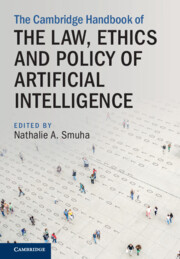
This informative Handbook provides a comprehensive overview of the legal, ethical, and policy implications of AI and algorithmic systems. As these technologies continue to impact various aspects of our lives, it is crucial to understand and assess the challenges and opportunities they present. Drawing on contributions from experts in various disciplines, the book covers theoretical insights and practical examples of how AI systems are used in society today. It also explores the legal and policy instruments governing AI, with a focus on Europe. The interdisciplinary approach of this book makes it an invaluable resource for anyone seeking to gain a deeper understanding of AI's impact on society and how it should be regulated. This title is also available as Open Access on Cambridge Core.
This chapter presents the current state of research in multimodal Construction Grammar with a focus on co-speech gestures. We trace the origins of the idea that constructions may have to be (re-)conceptualized as multimodal form–meaning pairs, deriving from the inherently multimodal nature of language use and the usage-based model, which attributes to language use a primordial role in language acquisition. The issue of whether constructions are actually multimodal is contested. We present two current positions in the field. The first one argues that a construction should only count as multimodal if gestures are mandatory parts of that construction. Other, more meaning-centered, approaches rely less on obligatoriness and frequency of gestural (co-)occurrences and either depart from a recurrent gesture to explore the verbal constructions it combines with or focus on a given meaning, for example, negation, and explore its multimodal conceptualization in discourse. The chapter concludes with a plea for more case studies and for the need to develop large-scale annotated corpora and apply statistical methods beyond measuring mere frequency of co-occurrence.
This chapter discusses the implications of the inclusion of emission allowances within the scope of EU capital markets legislation, and its interrelations with other relevant sources of EU law, namely the Emissions Trading Schemes and REMIT. The process leading to the comprehensive treatment of emission allowances by EU capital markets legislation began with MiFID I and reached its peak with MiFID II, that includes EUAs within the definition of financial instruments. This inclusion also implies that EUAs are subject to the provisions of the Market Abuse Regulation. This phenomenon raises several issues, first and foremost those that concern coordination between different legal texts. It also raises the question as to whether capital markets legislation is indeed capable of supporting the ultimate goal that the entire regulation of EUAs pursues, that is, the reduction of emissions. Whereby there is still insufficient empirical evidence as to whether this is effectively the case, EU legislation seems to believe in an assumption that would need to be better verified overtime.
This chapter discusses the integration of sustainability risks and factors into insurance regulation. According to the European Commission, sustainability considerations should be placed at the heart of the financial system. In its Action Plan, the European Commission announced its intention to clarify the integration of sustainability in so-called fiduciary duties in sectoral legislation. The objective of the European Commission is to direct financial and capital flows to green investment and to avoid stranded assets, which could be facilitated if sustainability is more clearly integrated in such duties of financial undertakings. This chapter describes the wide range and variety of developments in this area, which reflects some of the unique characteristics of the insurance sector, and which provides opportunities to contribute to the EC’s sustainability agenda. This contribution is not limited to the provision of considerable financial contributions to the sustainable investment agenda, which is closely related to the fiduciary duties of insurers and the application of the prudent person principle, but relate as well as to other elements of the sustainability agenda and resilience of the European economy, for which the insurance and reinsurance sector is well positioned to provide a meaningful support, for instance by addressing the protection gap.
The European financial markets have been placed on the path to a sustainable and green transition. The European Commission embraced with the EU Green Deal a new growth strategy built on a sustainable economic model that aims at making the EU the first carbon neutral continent by 2050. This generational economic and industrial transition set by the EU Green Deal will require at least 1 trillion euro in public and private sustainable investments. This chapter analyzes how derivatives markets can contribute to support the green transition, enable private markets to raise capital towards sustainable goals, and help market participants to manage the market and transition risk to a sustainable economy. “Green derivatives” like ESG- linked swaps, emission allowance futures, extreme weather events derivatives, are examples of financial innovation is dealing with climate-related risk. This chapter focuses on the EU Strategy for Financing the Transition to a Sustainable Economy in the EU and offers a looks at what the Commodities Futures Trading Commission is doing in the US on climate-related risk and derivatives markets. The chapter offers some early critical considerations on the private-public synergies and opportunities that might result from the growth and expansion of sustainable derivatives markets and the possible risks that policymakers should consider in the evolution process of such markets.
Technology (especially the high energy-consuming blockchain) is not often associated with environmental goals but the elements of peer-to-peer networks, sharing economy and ‘direct’ finance in the Fintech world present coherence and continuity with the ESG world. Furthermore, the potential of Fintech in reducing costs, connecting people on a global scale, improving financial inclusion, diversification and resilience offer great opportunities also in the area of sustainable finance, advancing societal factors. Nonetheless, relevant risks and limitations must be considered, too. This chapter will first introduce the emerging area of sustainable digital finance, with particular regard to environmental objectives. Second, it will focus on ‘green Fintech’ facilitating capital raising. In particular, the chapter will analyse the main legal and technical challenges related to green financing, with special regard to green crowdfunding, green tokens offerings and other Distributed Ledger Technology (DLT)-based opportunities, also considering recent EU regulatory initiatives, also advancing some policy proposals.
Over the last few decades, executive pay has undergone several major reinterpretations, which have affected both its design and regulation.Our chapter provides an overview of the trajectory of executive pay,including the recent trend toward integration of sustainability and ESG targets in compensation packages.Our chapter also provides empirical evidence as to the prevalence of ESG-linked executive pay in public listed companies. Analysing a sample of 8,649 publicly traded firms covering 58 countries in the period 2002–2021, we show that a growing number of listed firms include drivers involving sustainable performance in their executive remuneration packages. However, we identify notable differences associated with sector and country characteristics in this regard. For example, we find that, in countries with better government features, firms are more likely to adopt ESG-linked compensation.Overall, our empirical analysis presents a mixed picture. Some of our findings could be consistent with the idea that ESG-linked compensation exacerbates the agency problem of executive pay. We cannot, however, rule out the possibility that such compensation provides a powerful incentive towards more sustainable corporate practices in the future.
It follows from the usage-based view of language adopted in most strands of Construction Grammar that the constructicons of speakers of what is considered to be one and the same language will differ along social, or ‘lectal’, lines. This chapter explains the inherent theoretical importance of lectal variation for Construction Grammar and surveys existing construction-based work on synchronic language variation. Four major research strands are discussed: (i) studies aimed at the analysis of the form and/or meaning poles of constructions from specific lects; (ii) comparisons of the properties of a given construction or a set of related constructions across different lects; (iii) quantitative studies of grammatical alternations which include lectal variables in their research design; and (iv) studies of social variables involved in the propagation of constructional changes through communities of speakers. The chapter also identifies a number of challenges and open questions.
The care for sustainability is one of the most urgent problems addressed by policy makers. It requires combined effort by multiple players for its efficiency. There are various levels at which different tools of multiple character are being introduced. Eventually, they turn into policies and actions by private businesses and public agencies. These different instruments can be of legislative and regulatory nature introduced on various levels: the UN conventions, communications, policies and protocols, the EU legislation, the Member States, regional and local authorities. As a result, they take a shape of instruments of various types. The range of non-regulatory tools that supplement the regulatory instruments is wide and often takes the form of financial measures. They can be divided into four groups – incentives, tradable instruments, fines and contractual compensations. All these instruments differ in terms of their character, reach and efficiency. Not necessarily being perfect, still, they contribute to the overall re-shift of approach and help transforming the current anxiety for the nature to tangible actions that protect it. The text addresses questions that are not limited to analyses of the efficiency of existing financial tools but also refer to what else could be done to enhance them and make them even more efficient.
This chapter, structured in three sections, discusses an aspect of significant importance in relation to sustainable finance under EU secondary law: the gradual shift from capital markets to banking regulation. Section 21.1 sets the scene, by briefly overviewing the initiatives of (mainly) the (European) Commission in relation to sustainable finance – which are mainly related to EU capital markets regulation, albeit with an impact on credit institutions as well – and the rules adopted by the European Parliament and Council during the period 2019–2021. The focus of the following section 21.2 is on the legislative proposals submitted by the Commission in 2021 to amend the CRD IV and the CRR in relation to sustainability and contribution to the green transition. After a general overview of this legislative ‘banking package’ and some introductory remarks on the proposed amendments (including the harmonised definitions of the ESG-related risks by amendment of the CRR), this section presents the key proposed new rules (by amendment of the CRD IV) which relate to governance issues, ESG risks, the supervisory review and evaluation process (SREP) and the enhanced competent authorities’ powers, as well as the (further) amendments proposed to the CRR. Section 21.3 contains the concluding remarks.
In this chapter, a central tenet of Construction Grammar is explored: the idea that linguistic knowledge on all levels (e.g., lexicon, morphosyntax, pragmatics) is related in a network fashion, with the building blocks of language (i.e., constructions) forming different types of connections (i.e., links). In general, we discuss the ingredients of constructional networks with our main focus on construction-external links (vertical and horizontal). Another aim of the chapter is to embed constructional networks into a larger domain-general theory of networks but also to demarcate constructional modeling from other network models in linguistics, like Connectionism or models of sociolinguistic propagation. We also glance at how diachronic network change is currently being conceptualized and end by a discussion of open issues.